

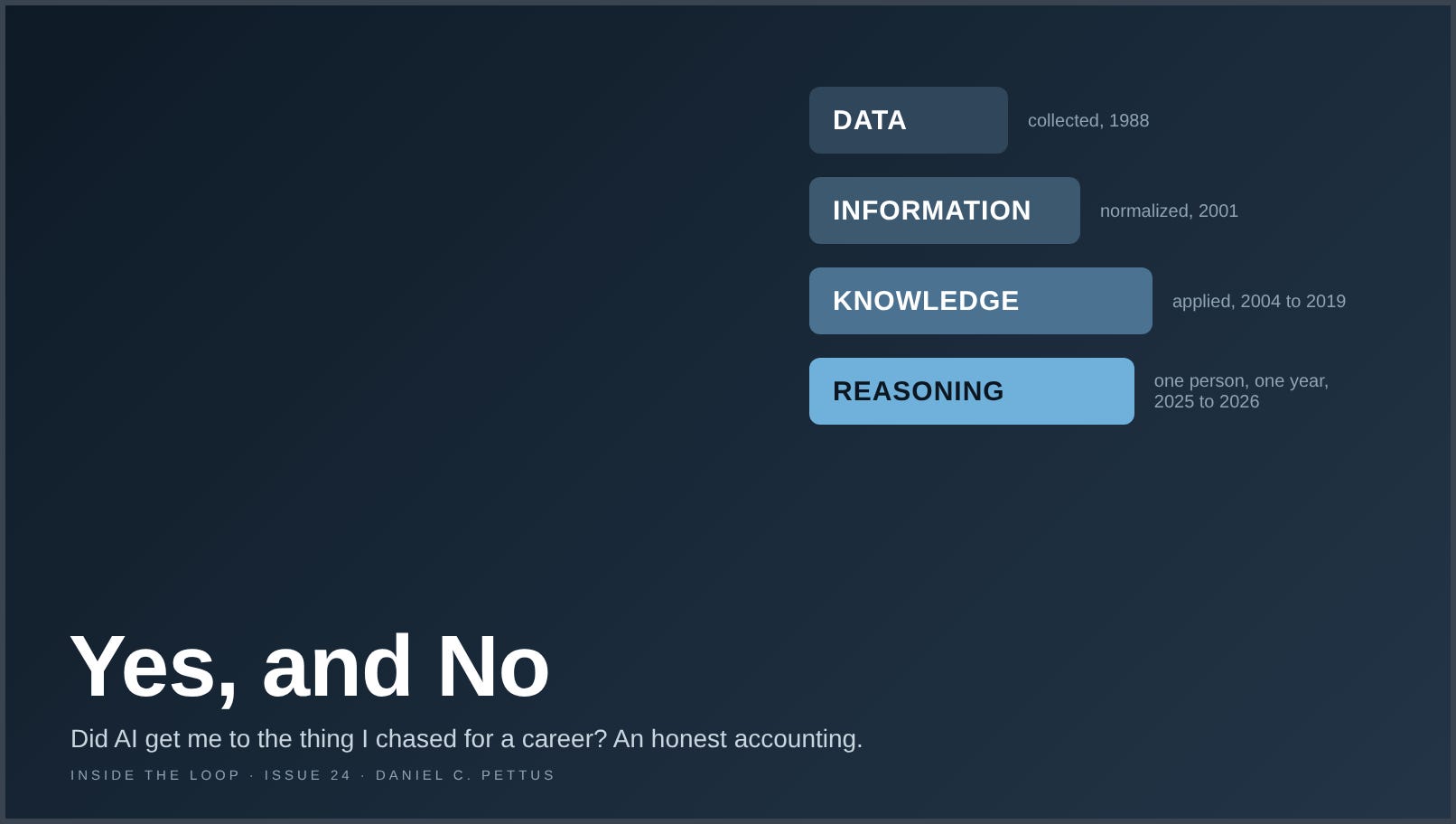
Inside the Loop, Issue 24 | Daniel C. Pettus | October 2026
Last week a few friends asked what I was doing with AI, and whether it had anything to do with the book. The second question is easy. It is the whole reason for the book. The first one deserves a straight answer, because there is a lot of noise about what AI does and does not do, and I have now spent about a year finding out for myself.
So here is the accounting. Not dramatic. The case does not need it.
The same story, told four times
My book lays out a career spent chasing one idea: that data becomes information, information becomes knowledge, and knowledge, if you are lucky and patient, becomes wisdom at the bedside. Every job I had moved that idea one notch. None of them finished it.
It started in anesthesia. In 1988 we introduced ARKIVE, an anesthesia record keeper that listened to the gas machine, the monitors, the ventilator and the IV pumps and wrote the record while the clinician worked [1]. We collected every number in the room. We did not yet know what to do with most of them. That was the data step, and I thought it was the hard one.
Around 2001, at iMetrikus, I used the Unified Medical Language System for the first time. The UMLS is the National Library of Medicine’s metathesaurus, begun in 1986, a single key that ties together more than a hundred vocabularies so that a drug, a lab or a diagnosis means the same thing no matter which system wrote it down [2]. We loaded it off CDs. It was free then and it is free now. That was the first time I understood that the normalization problem was bigger than the collection problem, and that the government had already paid for most of the answer. Information, not just data.
Then came the fifteen years at Alaris, which became Cardinal Health, then CareFusion, then BD [3]. That stretch is where the value of data stopped being a theory. The Medley pump shipped in 2001, and for a while our older one- and two-channel pumps outsold it; nurses were right to be skeptical of a new box. What changed the market was not the box. It was Guardrails, which put the hospital’s own dose limits inside the pump; CQI reporting, which turned every override into a number a pharmacy committee could act on; wireless and a server to carry data sets down and events up; and finally auto-programming, where the pump took its settings from the verified order in the EHR [4][5][6]. Alaris went from about 32 percent of installed US channels in 2002 to more than half the market by 2019 [4][7]. Knowledge, applied.
By the time I retired in May 2019, BD held several of the assets that touch a dose on its way to a patient: pharmacy systems, IV compounding, automated dispensing, and the infusion pumps. Every one of them generated data. We did real work to connect them, and patients were safer for it. I am proud of that work.
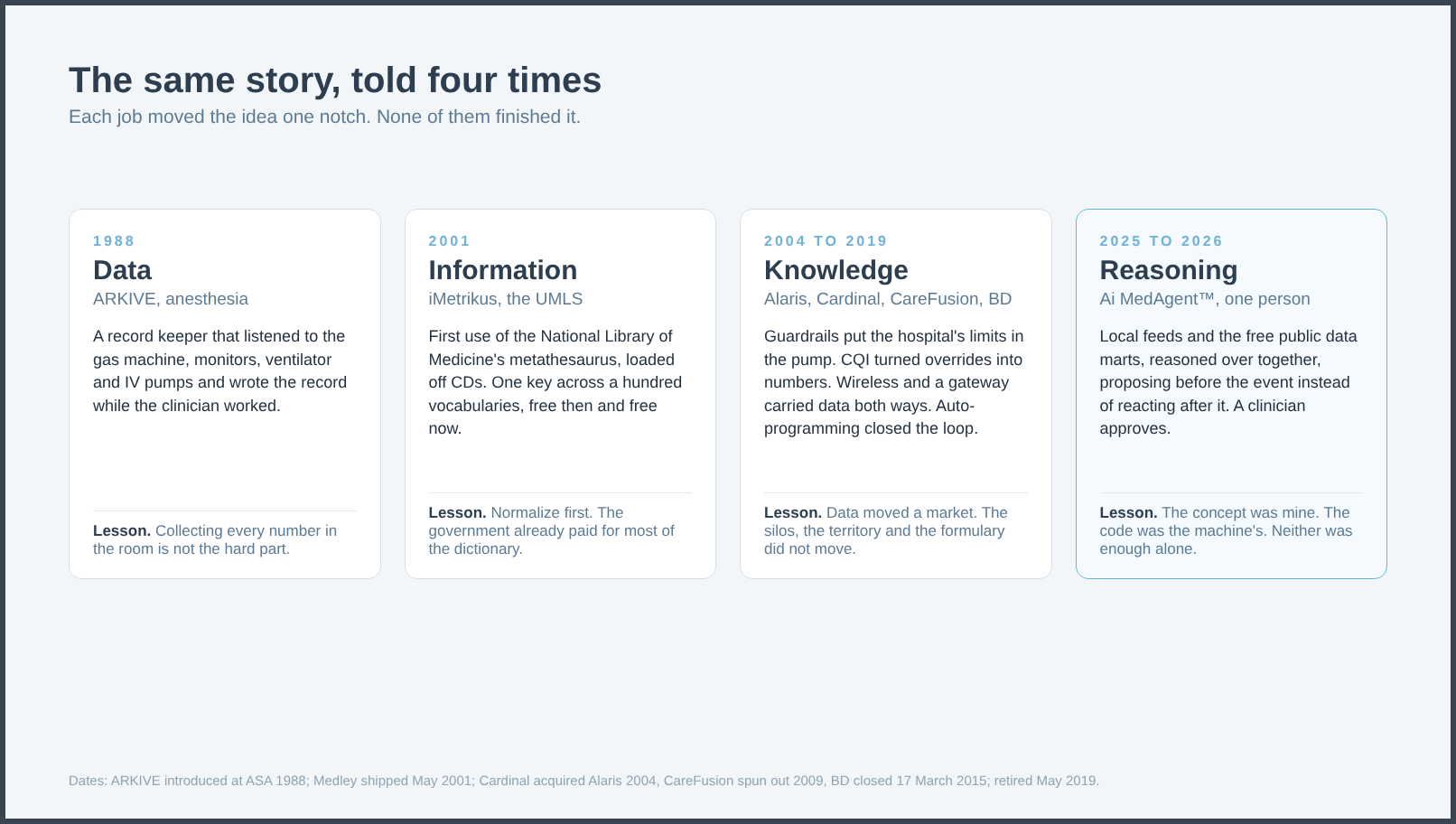
What I came to realize
I also came to realize, somewhere in those last years, that we were pushing the status quo as far as it would go and no further. The fundamental problems were the same ones I had met with the UMLS in 2001.
Data by itself is noise. It has to be normalized and codified before it means anything, and in a hospital that starts with the formulary. Four systems describe the same drug four ways, and nobody owns the dictionary.
Territory. Who owns the patient’s medication record: the device company, the hospital, or the EHR vendor? Everyone had an answer and the answers did not agree.
Workflow and the single source of truth. A pump knows what it is doing. The pharmacy knows what it dispensed. The EHR knows what was ordered. Each is correct about its own piece, and the patient is the only place the pieces meet.
Do not get the wrong idea. We improved a lot of patient encounters. But the barriers were still standing when I left, and for BD things got harder afterward. The Alaris system went on a distribution hold in 2020 and did not get its new clearance until July 2023 [8]. Credibility is slow to earn and quick to lose. I do not keep in close touch with former colleagues, and they have their own work to do. That is another story and not this one.
What retiring does not do is erase what you learned. The accumulation stays. It just stops having anywhere to go.
Then I started experimenting
About a year ago I began working with AI. Not as a chat tool, although I use that too. I started to see that the years of learning could be pointed at something I had wanted to do for decades: change the way we manage therapy for critical care patients. The premise is basic. Move from an event-driven reaction to proactive therapy. Try to see a little way into the future using the data already flowing through local connectivity, joined to the lesson of 2001, the free medical data available to anyone, and then put reasoning over the top of all of it.
What AI let me do was turn methods and concepts into a working series of applications. That sentence hides the important part, so let me say it plainly.
AI does not invent. That is still a human job, at least for now. The concept came from me, the knowledge of the space came from me, and the judgment about what was worth building came from me. What I did not have was the ability to write the software. This was going to be a series of connected applications running on a server and in the cloud, which means code, and a lot of it. The last time I wrote commercial code was the late 1980s, in PL/M, a language anyone under fifty has never heard of [9]. There was a reason for that language, and it is not important here.
So I learned to be precise about what I asked. I used Claude on the desktop, Opus for some tasks and Fable for others. I wrote a standing set of instructions that governs every session: be honest first; validate every reference the way a journalist would; tell me when I am wrong; no flattery; and, because I can spot it a mile away, no em dashes. I learned that the machine will cheerfully build the wrong thing if you describe it loosely, and that most of my job was describing the right thing.
It took cloud functions to reach the public data marts and feed the reasoning engine. It took patience. It took iterations, a great many of them, and more than one evening where the honest instruction came back to bite me: the machine told me a number in my own film was wrong, and it was.
What came about
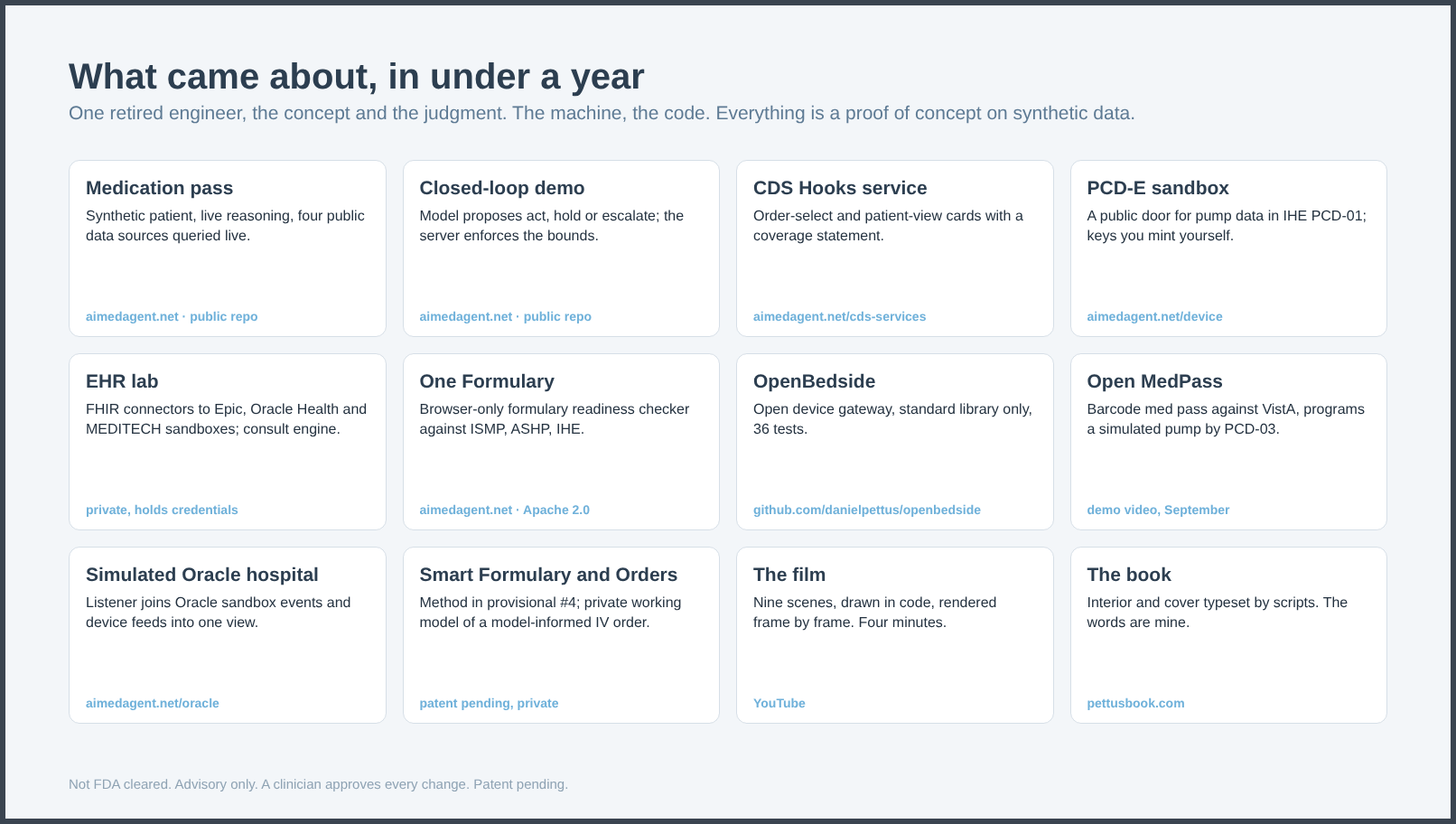
Here is what exists today, one line each, and where the code lives. Everything on aimedagent.net runs on simulated patients and is a proof of concept, not a product.
AI MedAgent medication pass. A synthetic patient moves through an encounter while a reasoning model reads the chart and four public data sources live and writes advisories a clinician approves. aimedagent.net; public repository on GitHub.
The closed-loop demonstration. The model proposes act, hold or escalate within clinician-set bounds, and the server enforces the bounds afterward. Same site, same repository.
A CDS Hooks service. Order-select and patient-view hooks that return cards with a coverage statement saying exactly which checks ran and which did not. aimedagent.net/cds-services.
The PCD-E sandbox. A public door for infusion pump data in IHE PCD-01, with a reference client and keys you mint yourself. It refuses anything that looks like a real patient before it reads a byte. aimedagent.net/device.
The EHR lab. FHIR connectors to the Epic, Oracle Health and MEDITECH sandboxes, and a consult engine that ran over their records and over Synthea patients. Private, not published, because it holds the credentials.
One Formulary. A browser-only checker that reads a hospital’s infusion formulary and reports what stands between it and pump auto-programming, against ISMP, ASHP and IHE. Open source, Apache 2.0, on the site.
OpenBedside. An open-source gateway between bedside devices and the EHR, standard library only, 36 tests, Apache 2.0. Written up in Issue 23. github.com/danielpettus/openbedside [10].
Open MedPass. A barcode medication pass against the VA’s open-source VistA that programs a simulated pump by PCD-03. Demonstrated on video in September.
A simulated Oracle Health hospital. A listener that joins Oracle sandbox events and OpenBedside device feeds into one hospital view. aimedagent.net/oracle; the listener is private.
Smart Formulary and Orders. The method in my fourth provisional application and a private working model of a model-informed IV order. Patent pending; not public.
The film. Nine scenes of a patient’s medications, drawn in code and rendered frame by frame, four minutes, no narration. It is below.
The book. The interior and the cover were typeset by scripts the machine and I wrote together. The words are mine.
Could I have done any of this without AI? No. I want to be careful here because it is easy to overstate. I could have written the concept. I have been writing it for years. I could not have built it, and a concept that cannot be clicked is a slide.
I am proud of what one person was able to put together in under a year.

So, yes and no
Did AI help me realize a vision of proactive care using local and public data, reasoned over in real time? Yes. The demonstration is real, it is live, and anyone can go and press the buttons. And no. I know this business. It is full of invented-here silos, and the regulatory requirements are real and they are not optional. It was never my intent to build a product for commercial sale. My intent was to prove that we can change for the better, and that AI can dramatically accelerate the raw development work that used to stand between an idea and a demonstration.
AI still needs the human to have the concept, the knowledge of the field, and the judgment about what to build and how. That part has not changed and I do not expect it to soon. What has changed is everything after that.
For me, AI worked. And it worked brilliantly.
If your organization is heading in this direction and wants an advisor who has already made the mistakes, or would rather license the method and build it properly, reply below. It reaches me.
Daniel Pettus spent forty years in medical device and health IT leadership at Alaris, CareFusion and BD, was a founding member of the iMetrikus team, and contributed to IHE Patient Care Device interoperability standards. He is co-inventor on US patent 7,375,647 and has filed four provisional applications on the reasoning method behind Ai MedAgent™. He writes Inside the Loop from Murrieta, California.
The serious version of the day job is a book. The Technology Was Never the Problem: forty years of trying to connect medical devices to the record, and what finally changed. pettusbook.com.
Ai MedAgent™ is a research demonstration of a patent-pending method. Advisory only. Not a medical device. Not FDA cleared. Synthetic patients and simulated feeds. See it at aimedagent.net.
Notes
[1] Pettus, D. The Technology Was Never the Problem. 2026. The ARKIVE anesthesia record keeper was introduced at the American Society of Anesthesiologists meeting, 1988; see the chapters on ARKIVE. pettusbook.com.
[2] National Library of Medicine. Unified Medical Language System (UMLS), nlm.nih.gov/research/umls. Begun 1986 under Donald A. B. Lindberg; integrates more than 100 vocabularies, including RxNorm, SNOMED CT and LOINC; license free of charge. Accessed 6 October 2026.
[3] Cardinal Health acquired ALARIS Medical Systems in 2004; CareFusion was spun out of Cardinal Health in 2009; BD completed its acquisition of CareFusion on 17 March 2015. CareFusion, Wikipedia, accessed 6 October 2026, and the companies’ own releases.
[4] ALARIS Medical Systems, Inc. Annual Report on Form 10-K for the year ended 31 December 2002. “We shipped the first Medley System in May 2001 and we implemented full market release in January 2002.” Installed base: approximately 32% of US large volume infusion channels, with Baxter 33%, Abbott 26% and B. Braun 6%. sec.gov.
[5] ALARIS Medical Systems, Inc. First quarter 2004 results. Enterprise-wide networked Medley demonstrated at HIMSS, 23 February 2004, “currently on patients at several institutions across the United States.” sec.gov.
[6] CareFusion and Cerner implement integrated solution at Children’s Hospitals and Clinics of Minnesota, 30 November 2012: the pump programmed from the verified order by scanning a barcode. See also Pettus, D. Worth the Effort? Closed-Loop Infusion Pump Integration with the EMR. AAMI BI&T 2013;47(6):467, doi.org/10.2345/0899-8205-47.6.467.
[7] iData Research. Best-Selling Large Volume Infusion Pumps in the United States: BD held over 50% of the large volume pump market in 2019. idataresearch.com. Accessed 6 October 2026.
[8] MedTech Dive. BD gains FDA clearance to relaunch Alaris infusion pump after recalls. 510(k) clearance 21 July 2023; distribution hold since 2020. Accessed 6 October 2026.
[9] PL/M, Programming Language for Microcomputers, developed by Gary Kildall at Intel in 1973 for the Intel 8008. Wikipedia, accessed 6 October 2026.
[10] Pettus, D. OpenBedside, release 0.2.0, 26 September 2026, Apache License 2.0. github.com/danielpettus/openbedside. And Inside the Loop, Issue 23, Why I Gave Away the Plumbing.
[11] The film: A Day in the Life of a Patient’s Medications. Ai MedAgent™, October 2026. YouTube link to be inserted. Not FDA cleared. Synthetic patient. Proof of concept live at aimedagent.net.