

Substack added a button this summer. Any reader can press it and get a number: how much of what you just read was written by a machine. Press it on this newsletter and you get 100 percent. Fully AI. I am not going to argue with it. The number is correct.
I write about medical device data and hospital IT. I spent forty years in it. I am also, by my own honest measure, a poor writer. The ideas arrive fine. Getting them onto a page that someone wants to finish is a different skill, and it is not mine. So I use AI to do the writing, the way I would hand a draft to an editor who never sleeps and never tires of my sentences. Every fact in here I checked myself. Every claim is mine. I read it, corrected it, and signed it. The machine did the typing. It did not do the thinking.
That distinction is the whole point, and I can prove it with the thing I built.
The idea came first
A while back I sat down and drew a straw man. Not on a computer. On paper. The question I was chasing was easy to say and hard to do: why does critical care wait for a patient to crash before it reacts? A rising potassium, a falling kidney function, a new drug stacked on two others that push the same direction. The signals are already there, in systems that already exist, hours before anyone gets paged. Nothing reads them together. Nothing looks ahead.
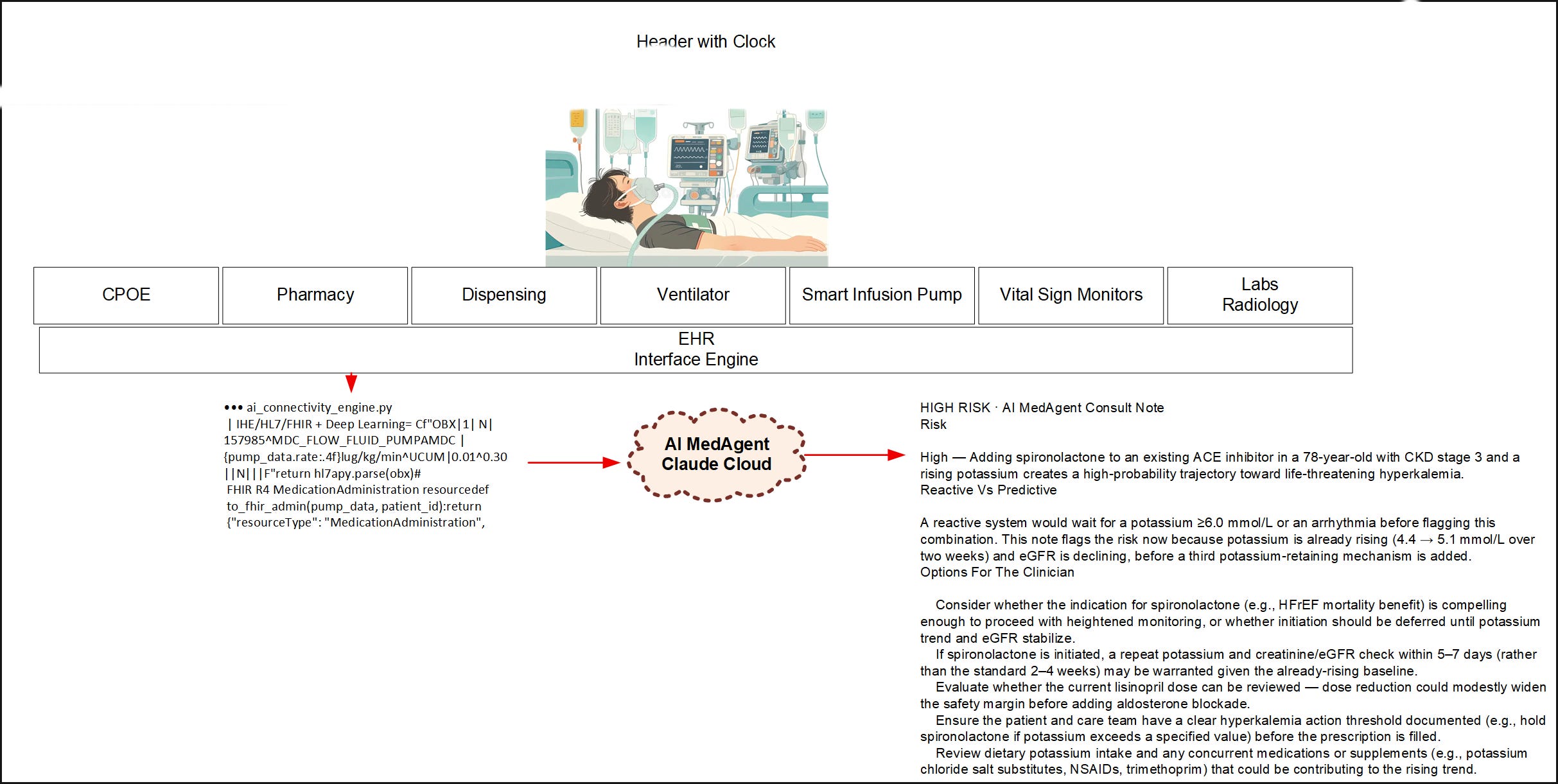
So I sketched something that would. Pull a patient’s data from the places it already lives. Put it into one clean stream. Reason over it looking forward instead of back. Then hand a plain warning to the person who can act. Four steps. I have argued for years that healthcare is not a technology problem, it is a data problem, and this was the shape of an answer.
Every part of that, the concept, the method, the goal, the first ugly drawing, was mine. A machine does not wake up wanting to catch a dangerous potassium before it happens. A person who has spent a career watching the misses does.
What the machine did
This is where AI earned its place. I gave it my specifications, and it built to them. It wrote an interactive website. It wrote the reasoning code that reads a patient forward instead of back. It wrote the cloud code that reaches out to public health data, which sits at the base of my invention and the patents I filed. It wrote the documentation, including the datasheets that are open and downloadable at aimedagent.net, so anyone can read the concept and judge it for themselves. Every piece was built to my specs, checked at every step, and corrected when it was wrong, and it was wrong plenty.
What that bought me was time. Building this the old way, alone, would have taken a year or more of coding and testing before I had anything to show. It was live in weeks. I did not save a little time. I skipped past the part that used to stop retired people like me from ever testing an idea, and landed at the part that matters: does the thing actually work.
Watch it work
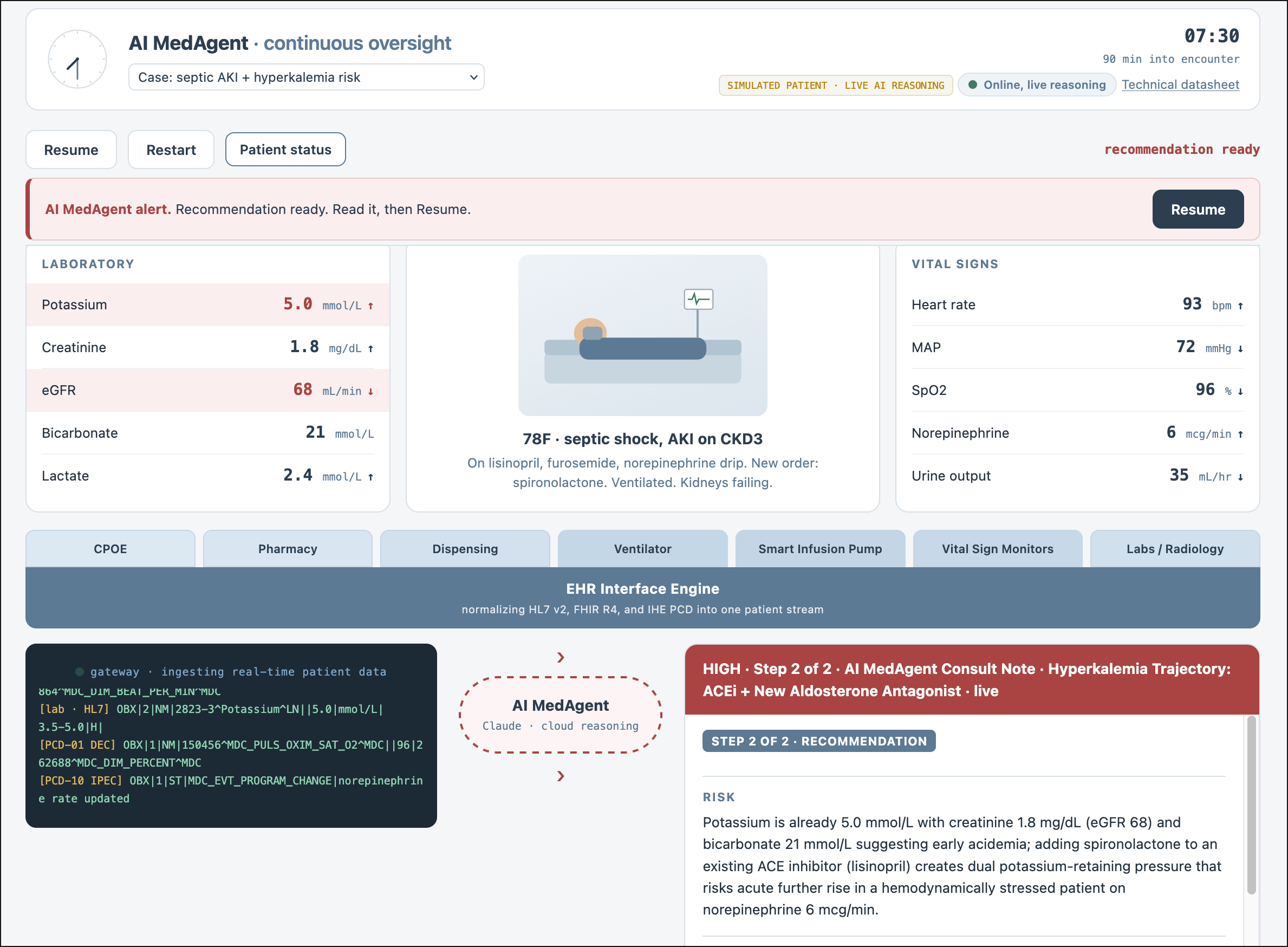
Look at the screen at the top of this post. One case is running on the site right now.
A simulated 78-year-old woman. Septic shock, kidneys failing, on a ventilator and three drugs. Her potassium is 5.0 and creeping up. A new order arrives for spironolactone, which happens to raise potassium, on top of an ACE inhibitor she is already taking that does the same. Three forces, one direction, in a patient who cannot afford it.
An ordinary monitor waits. It alarms when the potassium crosses a red line, which is to say after the problem has already arrived. My system flags it while the number is still climbing and writes the clinician a short note in plain English: the trajectory, the reason, the options. Reactive medicine waits for the crash. This looks down the road and taps you on the shoulder before you get there.
What it is, and what it is not
I want to be careful about what I am claiming. That patient is simulated, and the screen says so in plain sight. The system connects to test copies of hospital software, not to a real medical record, and it is not cleared to treat anyone. It is a proof of concept, running live, that a person can open and try. It is not running on a single real patient, and I built that honesty into the product on purpose. The idea is strong enough that it does not need to be oversold.
The person has to drive
None of this is hands-off. AI will hand you a wrong answer with complete confidence and a straight face. It does not know when it is out of its depth. The person in the chair has to know enough to catch the bad answer and throw it out. Point it carelessly and you get carelessly wrong results, delivered beautifully. The tool is only as good as the judgment steering it, and mine came from forty years of being in the room.
Why I am telling you
I believe in this enough that I filed three provisional patents this summer, in my own name, without a lawyer. Not because a machine had a good idea, but because I did, and the machine let me build it fast enough to find out I was right.
People are worried about where AI is taking us. They should be. It is still worth seeing clearly what the tool actually is when someone who knows their field drives it. It is not the author. It is the fastest, most tireless assistant ever made, and it will do great good or real harm depending entirely on who is holding it. The rules for all of this are not written yet. I found a way to use it that let a retired engineer turn a paper sketch into a working system in weeks, and it has changed everything I do.
So yes, a machine wrote this. I built the thing it is about. Read it anyway.
I will keep posting, with AI as my editor. Every idea, every concept, every claim is mine, and I check every fact before it goes out. I just cannot say it as clearly as my editor can. If you scan this and it says AI, that is the typing, not the thinking. More on the way.
Daniel Pettus spent forty years in medical device and health IT leadership at Alaris, CareFusion and BD, contributed to IHE Patient Care Device interoperability standards, and is named on two US patents. He is the author of The Technology Was Never the Problem, available in paperback and Kindle, and the builder of the AI MedAgent research demonstration at aimedagent.net. Advisory only. Not a medical device. Patient shown is synthetic