

Inside the Loop, Issue 23 | Daniel C. Pettus | 28 September 2026
For about a year I have been saying the same thing to anyone who would listen, and to a few who would rather not. AI in healthcare is stuck at the keyboard. It writes the note, summarizes the chart and answers the question. That is chat. It is useful, and it is not the prize.
The prize is reasoning. A model in the cloud that reads the public knowledge of medicine and the live state of one patient at the same time, and keeps asking one question: is what is happening to this person still consistent with what we believe is happening to her, and is what we are doing about it still the right thing to be doing? Not waiting for an alarm. Not waiting for a tired nurse to spot the trend at three in the morning, with two sicker patients down the hall. Predicting the better therapy before the event, instead of documenting the event after it.
That is the whole idea. Move from chat to reasoning, and from reacting to predicting.
From an idea to something you can click
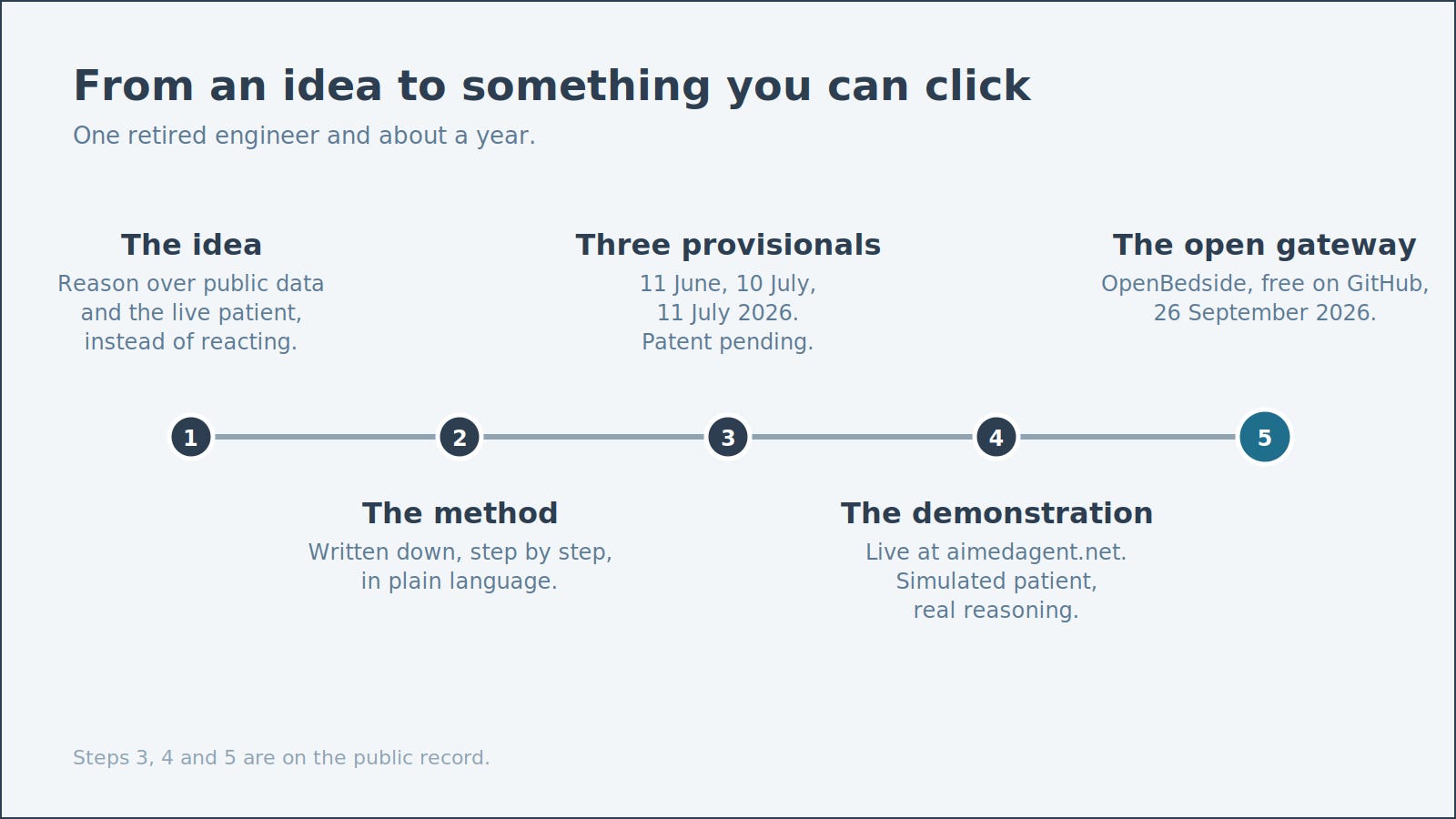
It went from an idea to a method written out in plain language, to three provisional patent applications filed on 11 June, 10 July and 11 July 2026, to a full demonstration running online at aimedagent.net. The patient in that demonstration is simulated. The reasoning is real, and it runs every time someone presses the button.
I have spent forty years watching good ideas die in the gap between a slide and a hospital. I did not want this one to die there, so I built it. Retirement is excellent for that. Nobody schedules a meeting to discuss whether you should.
It has not been a straight line. The first version of the demonstration told me it was running live when it was not. A system that will tell you it is live when it is not is worse than no system at all, so I took it down and rebuilt it. Today every alert says whether it was generated live or written in advance, and every response says how many of the eight standard medication safety checks it was able to perform. On one vendor’s certified test record, the honest answer was two of eight. That half is the point.
The data was already there, and we already paid for it
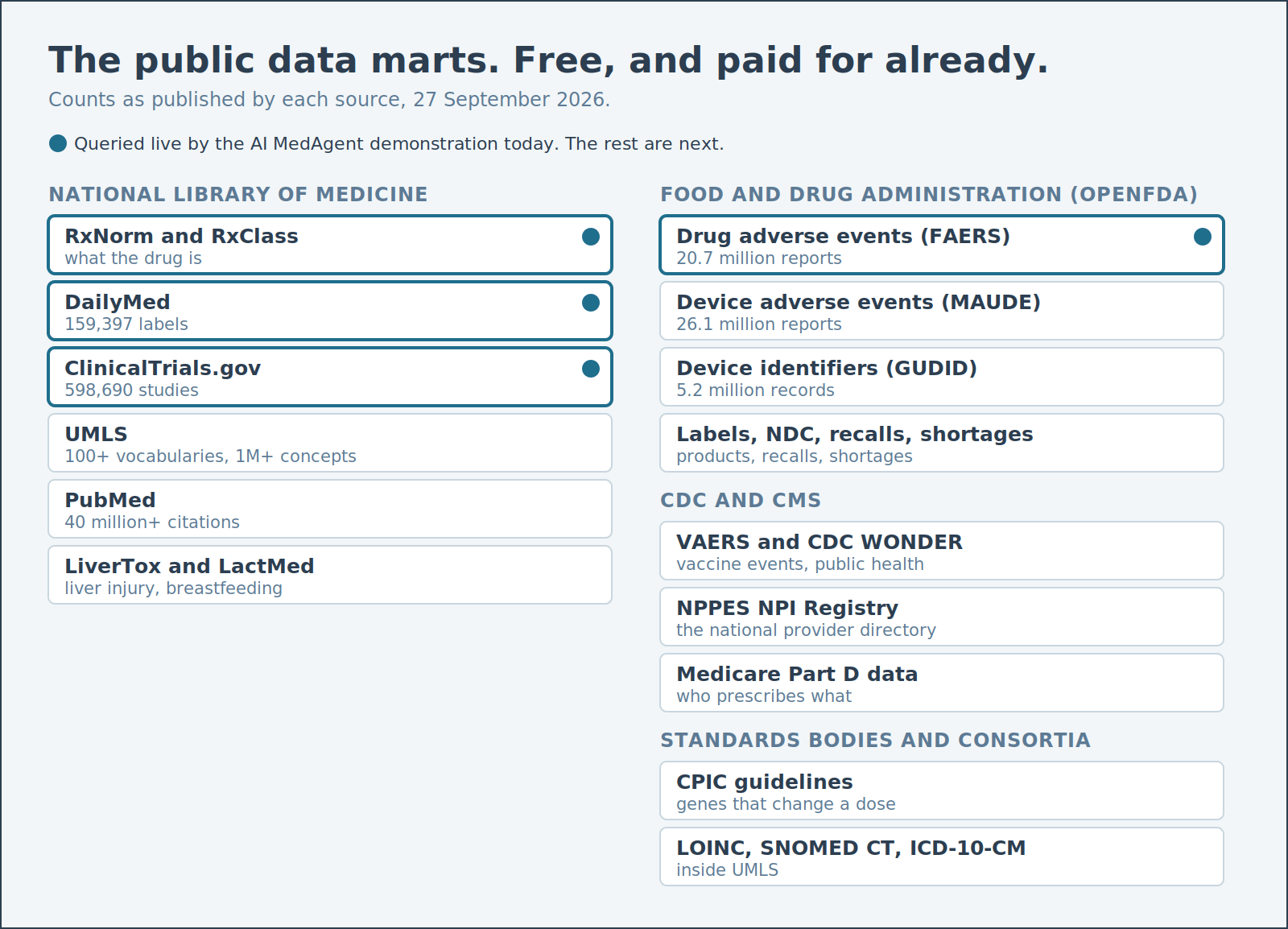
This is the part that still surprises people. Most of what a reasoning engine needs to know about drugs, devices, evidence and outcomes is published by the federal government, free, through public interfaces. Taxpayers paid for it years ago. Here are the public data marts, by who publishes them.
The National Library of Medicine. RxNorm and RxClass say what a drug is and what class it belongs to.[1] DailyMed holds 159,397 drug labels submitted to the FDA.[2] ClinicalTrials.gov lists 598,690 registered studies.[3] The Unified Medical Language System maps more than a hundred vocabularies, including SNOMED CT, LOINC and ICD-10-CM, into more than a million concepts.[4] PubMed indexes more than 40 million citations.[5] LiverTox and LactMed answer two questions every clinician eventually asks: can this drug hurt the liver, and is it safe while breastfeeding?[6]
The Food and Drug Administration, through openFDA. 20.7 million drug adverse event reports. 26.1 million medical device adverse event reports. 5.2 million device identifier records. And the working inventory of the drug supply: 262,887 labels, 138,184 product listings, 17,965 recall enforcement reports and a live list of shortages.[7]
The CDC and CMS. The vaccine adverse event reports and the CDC WONDER public health databases.[8] The NPPES registry, the national directory of provider identifiers.[9] Medicare Part D data on who prescribes what.[10]
The consortia. CPIC publishes guidelines on the genes that change how a drug should be dosed.[11]
Twenty-six million device reports. That is not a dataset you skim over coffee. That is twenty-six million times a device surprised someone enough to file a report, and it is sitting there, free, waiting for something that can read it all at once.
None of this is new. My own company loaded the federal reference data off CDs in 2001. What is new is a machine that can be handed the whole picture and reason over it in seconds. The data got fast. Healthcare did not.
In fairness to my own demonstration, it queries four of these live today: RxNorm and RxClass, the FDA’s drug adverse events, DailyMed and ClinicalTrials.gov. The rest are next. And one honest gap. The free source that mattered most for drug interactions is gone: the National Library of Medicine discontinued its drug interaction service on or about 2 January 2024.[12] Interactions now come from licensed drug knowledge bases. AI MedAgent has a socket for one, deliberately empty, and it says so on the screen rather than pretend.
Reasoning needs ears
Knowledge is half of it. The model also needs to listen, to the chart and to the machines at the bedside. A reasoning engine that knows every drug label ever written, but not that this patient’s creatinine doubled overnight or that her pump dropped to keep-vein-open an hour ago, is a very well-read bystander.
The EHR has a door now. Every certified EHR in the United States has had to offer a standardized FHIR interface since the end of 2022.[13] It is open. It is not free, and getting in is uneven: when I read live records from the Epic, Oracle Health and MEDITECH sandboxes, it took under an hour, a day, and a wait on a human being. But the door is there.
The devices are another story. Most infusion pumps, monitors and ventilators speak their manufacturer’s own protocol, through the manufacturer’s own gateway, reachable through agreements that take months and lawyers. The standards exist, and they are not new. The IHE Patient Care Device profiles for HL7 were first tested at a Connectathon in January 2007 and shown live at HIMSS in New Orleans a month later.[14] I sat in on that work. Nearly twenty years on, the standards are mature. Access is the problem.
And the device that matters most is the one hardest to reach. In 2010 the FDA reported more than 56,000 adverse event reports associated with infusion pumps over five years, more than 500 associated deaths, and 87 pump recalls between 2005 and 2009.[15] Pumps deliver the drugs with the least room for error, and they know exactly what is going into the patient right now. That makes the pump the most important feed a medication reasoning engine can have. I spent years inside the companies that build those gateways. I know how much work is in one, and why nobody gives them away.
I built the ears, and gave them away
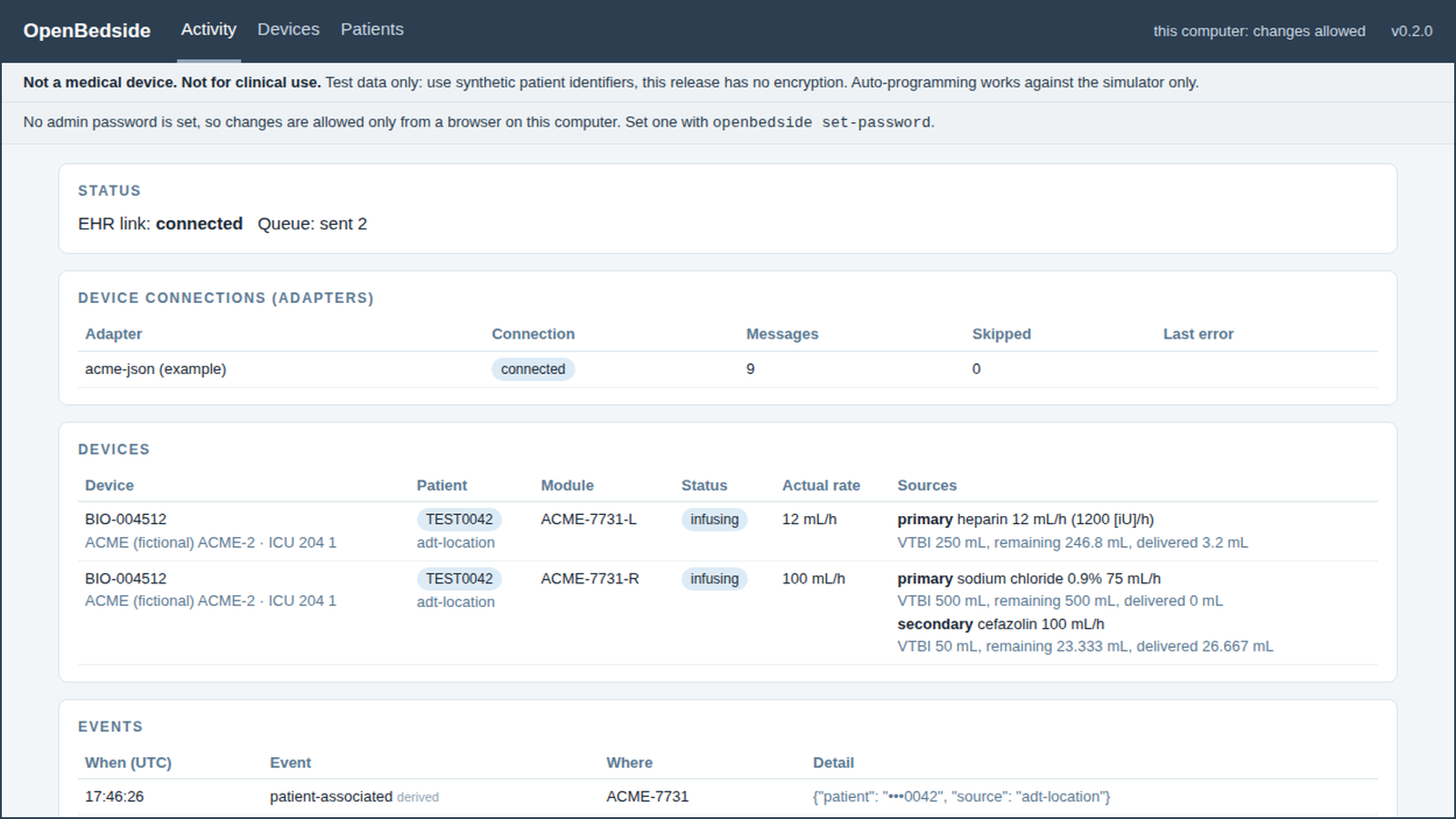
As newer device makers enter the market, I decided not to wait for the old doors to open. I built a medical device gateway and interface engine, called it OpenBedside, and released it as free, open-source software under the Apache License 2.0.[16] Anyone can download it, use it, change it and build it into a product. No fees, no royalties, no permission needed.
It takes data from an infusion pump, normalizes it, and delivers it to the hospital EHR as standard IHE HL7 messages. It stores and forwards, so nothing is lost when the network drops. It registers devices, so nothing unknown reaches a chart. It finds each device’s patient from the pump itself, from the hospital’s admission feed or from a nurse, and when those sources disagree it names nobody rather than the wrong somebody. It has a live web page that shows every device, every message and every decision. It is plain Python with no outside dependencies, and a device maker connects its own pump by writing a single adapter. It starts with IV pumps, and it is built for ventilators next.
Why would a retired guy give away the plumbing? Selfish. I need these feeds to close the reasoning loop, and waiting for every manufacturer to open its own door could take another twenty years. If OpenBedside helps a new pump company connect in a month instead of a year, some of that data may one day feed AI MedAgent. If it never does, it still helps somebody. I can live with either outcome.
What this is, and what it is not
AI MedAgent is a research demonstration: simulated patients, synthetic data, advisory only, not a medical device. OpenBedside is test software as well. It has no encryption yet, so it belongs on test networks with made-up patients. Reasoning at the bedside is a future capability that I am demonstrating now. It will take time, testing and investment, and the regulators will have their say, as they should.
It will happen. The data is free. The EHR door is open. And the device door now has a key anyone can copy.
See AI reasoning in action at aimedagent.net. Download the free, open-source gateway at github.com/danielpettus/openbedside. And if you make pumps or ventilators, fork it. I would rather be copied than ignored.
Daniel Pettus spent forty years in medical device and health IT leadership at Alaris, CareFusion and BD, contributed to IHE Patient Care Device interoperability standards, and is named on two United States patents. He writes Inside the Loop at insidetheloopdp.substack.com.
The serious version of the day job is a book. The Technology Was Never the Problem: forty years of trying to connect medical devices, what actually stopped it, and why the answer was never engineering. Paperback and ebook at pettusbook.com.
AI MedAgent is a research demonstration of a patent-pending method. Advisory only. Not a medical device. Not for clinical use. Simulated patients, synthetic data only. aimedagent.net
Notes
[1] National Library of Medicine. RxNav: RxNorm API and RxClass API, lhncbc.nlm.nih.gov/RxNav. Accessed 27 September 2026.
[2] National Library of Medicine. DailyMed, dailymed.nlm.nih.gov. Home page count of labeling submitted to the FDA, 159,397, accessed 27 September 2026.
[3] National Library of Medicine. ClinicalTrials.gov, application programming interface version 2, total registered studies, 598,690, retrieved 27 September 2026.
[4] National Library of Medicine. Unified Medical Language System (UMLS), nlm.nih.gov/research/umls. More than 100 source vocabularies, including RxNorm, SNOMED CT, LOINC and ICD-10-CM, and more than one million concepts. No charge for the license.
[5] National Library of Medicine. PubMed, pubmed.ncbi.nlm.nih.gov. Home page: more than 40 million citations. Accessed 27 September 2026.
[6] National Institute of Diabetes and Digestive and Kidney Diseases and National Library of Medicine. LiverTox: Clinical and Research Information on Drug-Induced Liver Injury, NCBI Bookshelf, ncbi.nlm.nih.gov/books/NBK548157. National Library of Medicine. Drugs and Lactation Database (LactMed), NCBI Bookshelf. Accessed 27 September 2026.
[7] US Food and Drug Administration. openFDA, open.fda.gov/apis. Totals from each endpoint’s meta record, retrieved 27 September 2026: drug adverse events 20,692,690 (data updated 30 July 2026); device adverse events 26,136,889 (8 September 2026); device unique identifiers 5,182,695 (2 September 2026); drug labels 262,887 (25 September 2026); NDC product listings 138,184 (23 September 2026); drug recall enforcement reports 17,965 (9 September 2026); drug shortages 1,601 (25 September 2026). openFDA states that its data are unvalidated and are not to be relied on for medical decisions.
[8] US Department of Health and Human Services. Vaccine Adverse Event Reporting System (VAERS), data sets, vaers.hhs.gov/data. Centers for Disease Control and Prevention. CDC WONDER, wonder.cdc.gov.
[9] Centers for Medicare and Medicaid Services. NPPES NPI Registry and API, npiregistry.cms.hhs.gov.
[10] Centers for Medicare and Medicaid Services. Medicare Part D Prescribers by Provider and Drug, data.cms.gov.
[11] Clinical Pharmacogenetics Implementation Consortium. CPIC Guidelines, cpicpgx.org.
[12] National Library of Medicine. RxNav Drug Interaction API notice: “The Drug-Drug Interaction API will be discontinued on or about January 2, 2024.” lhncbc.nlm.nih.gov/RxNav/APIs/InteractionAPIs.html.
[13] Office of the National Coordinator for Health Information Technology. 21st Century Cures Act: Interoperability, Information Blocking, and the ONC Health IT Certification Program, Final Rule, 85 FR 25642, 1 May 2020, and 45 CFR 170.315(g)(10), the standardized FHIR API criterion. Compliance deadline 31 December 2022.
[14] IHE International. IHE Patient Care Devices Domain: Rich History, Promising Future. 28 January 2019. First profiles tested at the January 2007 Connectathon at RSNA headquarters; demonstrated live at the HIMSS Annual Meeting, New Orleans, February 2007.
[15] US Food and Drug Administration. FDA Launches Initiative to Reduce Infusion Pump Risks. News release, 23 April 2010: more than 56,000 adverse event reports over five years, more than 500 deaths associated with infusion pump use, 87 recalls between 2005 and 2009.
[16] Apache Software Foundation. Apache License, Version 2.0, January 2004, apache.org/licenses/LICENSE-2.0. OpenBedside source: github.com/danielpettus/openbedside.