

You have heard the number from me before. The United States spends about $14,885 per person on healthcare, roughly twice what other wealthy nations spend, and the Commonwealth Fund still ranks us last among them on outcomes. [1] I have said this before. It is worth repeating, because nothing about it has changed. We pay the most. We get among the worst results.
So let me get past the number and to the point.
What 40 years taught me, and where I now think I was wrong
I spent four decades in this industry. For most of it, I believed the same value proposition everyone around me believed: more technology means a safer, better patient experience. I sold it. I built it. I believed it.
I am retired now, with no company to protect and no quota to make. And I have come to believe something close to the opposite. We may be solving the wrong problem with solutions that cost a fortune and return very little where it actually counts, in the patient’s experience and possibly their outcome. We spend double and get little back. At some point the honest thing is to ask whether the approach itself, not the effort, is the problem.
Then I started using AI. Not as a chatbot. As a development and research partner. And it changed how I see the whole thing.
The idea
Here is what I invented. A method with two moves, and both run the same direction, forward instead of back.
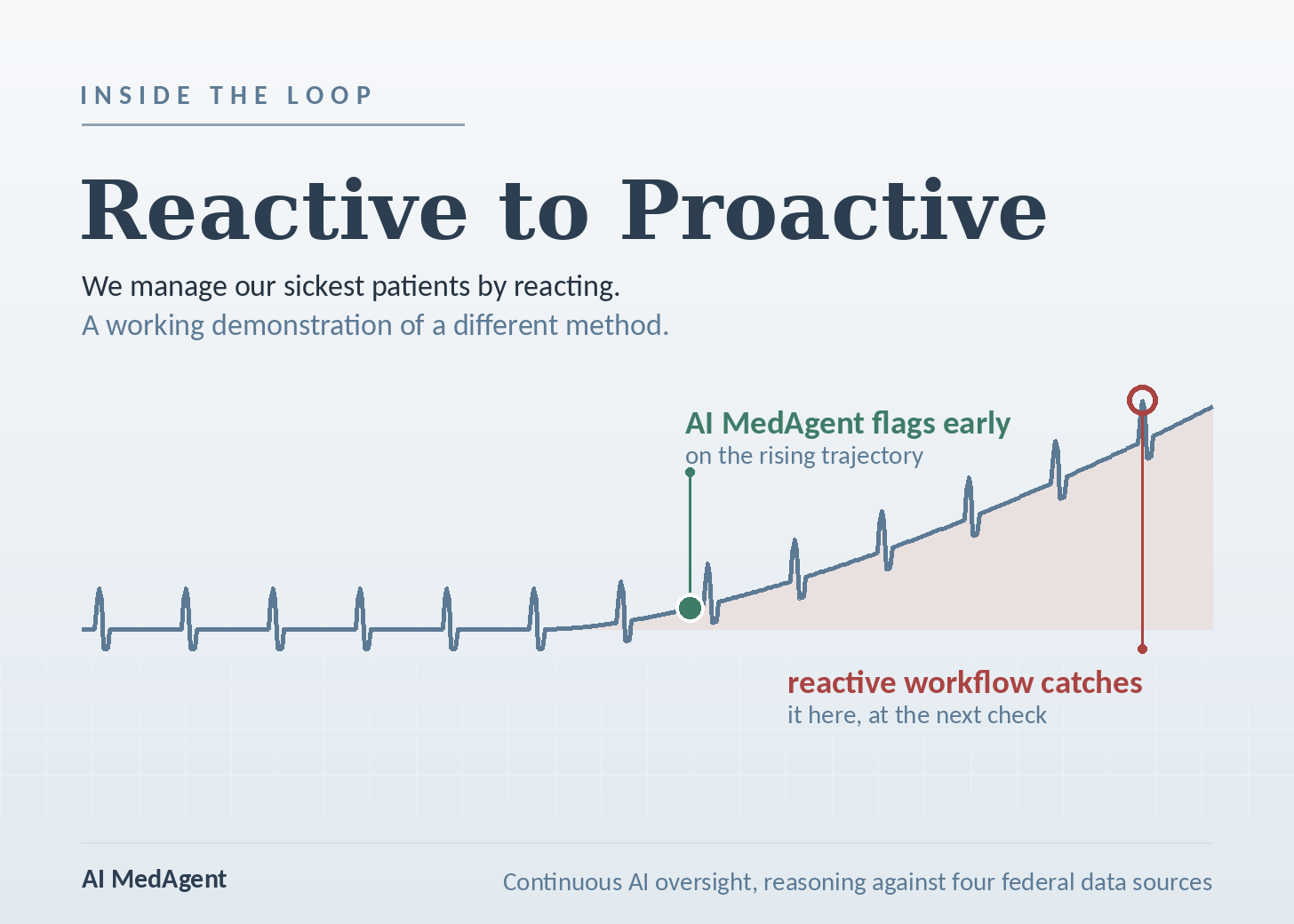
The first move inserts AI across the entire patient encounter. Continuous reasoning by a large language model, reading the data stream the whole time, looking for the chance to intervene early, before the crisis.
The second move inserts AI into the moment therapy changes. When a new or modified medication order is placed, the AI follows the clinical workflow, the ordering, the pharmacy, the dispensing, and reasons at each step, speaking up when something is wrong.
Both are a reversal of how we work today. Instead of waiting for a threshold to be crossed and then reacting, the method manages the patient and the clinical process proactively, with alerts and stops that fire before the retroactive scramble begins. That matters, because more than 75% of medication errors happen at the prescribing and administration stages, [2] and preventable drug events still contribute to tens of thousands of hospital deaths and tens of billions in cost every year in this country. [3]
I will go one step further, because I am retired and can. I believe this path leads, eventually, to semiautonomous care. I know that word is unsettling. So was a car with no driver, right up until the moment a robotaxi picked someone up and it became ordinary. [4] The direction of travel is the same.
I believed in this strongly enough to file a provisional patent. I think the method is unique, and I think it has merit. The method is called AI MedAgent.
How do I prove it works
Let me be crystal clear about what this is not. I am not building a product. I am not starting a company. As one retired person, that is simply not achievable, and I have no interest in pretending otherwise.
That does not mean I cannot show the functionality and the potential. It just means I show it a different way. I have been working with AI to build a working model and demonstration. Like any complex project, it had its false starts and its failures. I flushed an early version and started over. It is now at a place where it demonstrates well.
Here is what it does, and here is exactly what is real and what is not.
It simulates the hospital data feed coming from the EHR and the interface engines. That part is simulated. I am not a hospital and I am not an EHR company, and I will not pretend to be either.
That feed is then sent to Claude AI in the cloud, where the reasoning is real, no simulator. The AI reasons over the live feed against four public federal data sources: the NIH RxNorm and RxClass drug classification services, the FDA’s adverse event reporting system (openFDA FAERS), the FDA’s DailyMed structured product labeling, and ClinicalTrials.gov. [5] When it detects an issue, it responds in two parts. Part A is the alert. Part B is the reasoned suggestion for what to do about it. The demonstration shows you both.
In the real world, those alerts would need a home, most likely inside the EHR. And a future version could adjust the IV pump or the ventilator on its own. That is a conversation for another day.
The demonstration is available to a limited few, and there is a plain reason for that. As a single developer, I have only so many AI tokens to share.
So here is the deal. If you believe there is value in reviewing what I have built, click the button below to reach my request form. If accepted, I will send you the access code and the website, and I read every request myself and reply within one to three business days.
I spent a career watching good ideas die from apathy, caution, and turf. I would rather hand you a working idea and be told exactly why I am wrong than sit on it and never ask. The worst thing I could do with this is keep it to myself.
So I am not going to.
Dan
Sources
[1] Peterson-KFF Health System Tracker, US health spending versus comparable countries, 2024 (about $14,885 per capita, roughly twice the comparable-country average); Commonwealth Fund, Mirror Mirror 2024, which ranked the US last among ten high-income nations on health system performance.
[2] Reported in the clinical literature that more than 75% of medication errors occur at the prescribing or administration stages.
[3] StatPearls / NCBI: preventable adverse drug events are associated with an estimated 44,000 to 98,000 US hospital deaths annually and roughly $37.6 to $50 billion in added healthcare costs, disability, and lost productivity.
[4] Autonomous robotaxi services (for example Waymo) now operate as paid, driverless rides in multiple US cities, a capability widely considered science fiction until recently.
[5] Federal data sources queried live by the demonstration: NIH RxNorm / RxClass, FDA openFDA FAERS, FDA DailyMed, and ClinicalTrials.gov.