

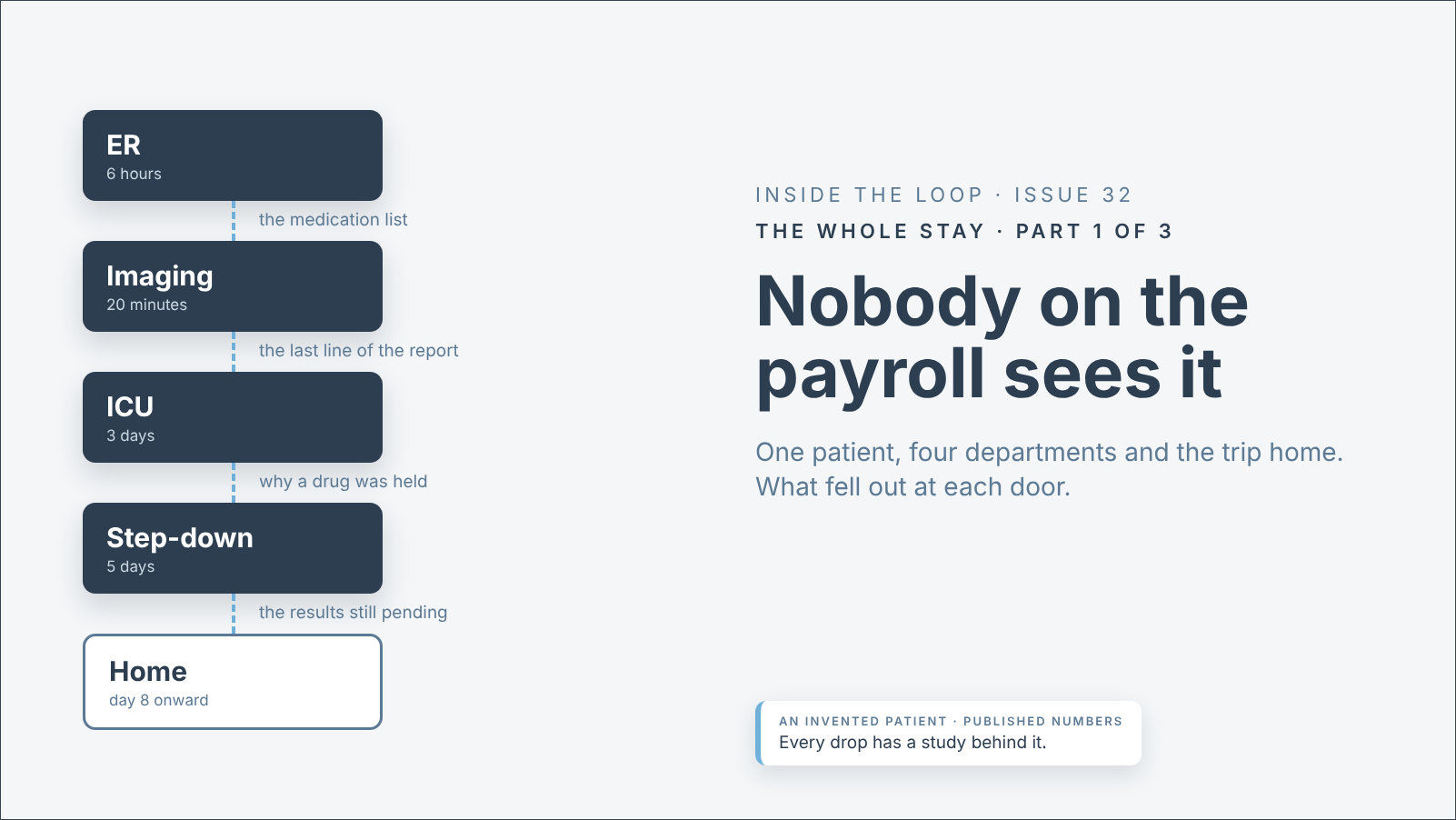
Inside the Loop, Issue 32 | Daniel C. Pettus | 19 November 2026
Part 1
Nobody decided to stop her blood thinner.
She came in with pneumonia and went home eight days later without the drug that lowers her risk of a stroke. Three teams each did their job well. No order, no note and no person records a decision to stop it. It fell between them.
She is not real. I assembled her from published studies of real patients, and each thing that goes wrong for her has a note number beside it. What happens to her is ordinary, and the notes show how ordinary.
This is the first of three issues under one name, The Whole Stay. Part 1 follows her through the building and counts what falls out at each door. Part 2 is about time, because nobody on a hospital floor has any. Part 3 is about who checks the AI now arriving in every department.
At every stop I ask the same two questions. What did this department never get told? What did it fail to pass on?
The emergency room
She is 74. She takes a blood thinner for an irregular heartbeat, a statin for cholesterol and a thyroid pill. She arrives at two in the morning with pneumonia, short of breath and confused. Her daughter lists the medications from memory and misses one.
What the ER never got told is her real medication list. It exists, in her pharmacy’s computer and in her family doctor’s record. What reaches the admitting team is what a frightened daughter can remember. At a Toronto teaching hospital, 54 percent of 151 admitted patients had at least one unintended difference between what they took at home and what was ordered for them. The most common was a drug left off, and 39 percent of the differences could have caused moderate to severe discomfort or clinical deterioration [1].
Imaging
A chest CT confirms the pneumonia. The last line of the report notes a small nodule in the other lung and recommends another scan in a few months. The report is accurate and on time, and its last line belongs to nobody. In a study of emergency patients, CT scans turned up 348 incidental findings. The discharge paperwork showed that 34 of them, under 10 percent, had been disclosed to the patient [2].
The ICU
By morning she is in septic shock and in intensive care. The team does everything right. They hold her blood thinner while she is unstable. They start an acid-suppressing drug to protect her stomach, a common ICU precaution. A pump runs a drug to hold her blood pressure up, and through the night her nurse adjusts it a dozen times.
This is the part of the building I know best. The record holds what somebody documented. The pump, the ventilator and the monitor hold what happened. Where pumps are integrated with the record, the infusion history reaches the chart once a nurse confirms it [3]. Where they are not, the chart holds what somebody had time to type, and the rest of that night stays inside the machine.
Step-down
Three days later she is better and moves to a step-down unit. A study of 58 ICUs looked at exactly this move and found a medication error in 46 percent of 985 patients. The most common error was continuing a drug that only made sense in the ICU. The second was a condition left untreated [4]. She gets both. The acid drug rides along with her. The blood thinner stays on hold, and the reason it was held does not make the trip.
Discharge, and home
On day eight she goes home. Her discharge list is built from what she was taking in the hospital, so the blood thinner is not on it. In Ontario, 19.4 percent of older patients on a blood thinner or an antiplatelet drug did not have it renewed within 90 days of a hospital stay, against 11.8 percent of people who were not admitted. After an ICU stay the figure was 22.8 percent [5]. The researchers could not see intent in pharmacy records, so they called these stops potentially unintentional. So will I.
A blood culture is still running when she leaves. In a Boston study of 2,644 discharged patients, 41 percent had test results come back after they had gone home. About 9 percent of those results could have changed the plan, and the physicians who were asked did not know about 62 percent of them [6]. Her family doctor sees her nine days later. A review of 55 studies found that the discharge summary was on hand at that first visit 12 to 34 percent of the time, and that the hospital doctor and the family doctor had spoken directly in 3 to 20 percent of cases [7].
Then she is home. In a study that followed 400 patients after discharge, 19 percent had an adverse event. Two thirds of those events involved a drug, and about a third could have been prevented [8].
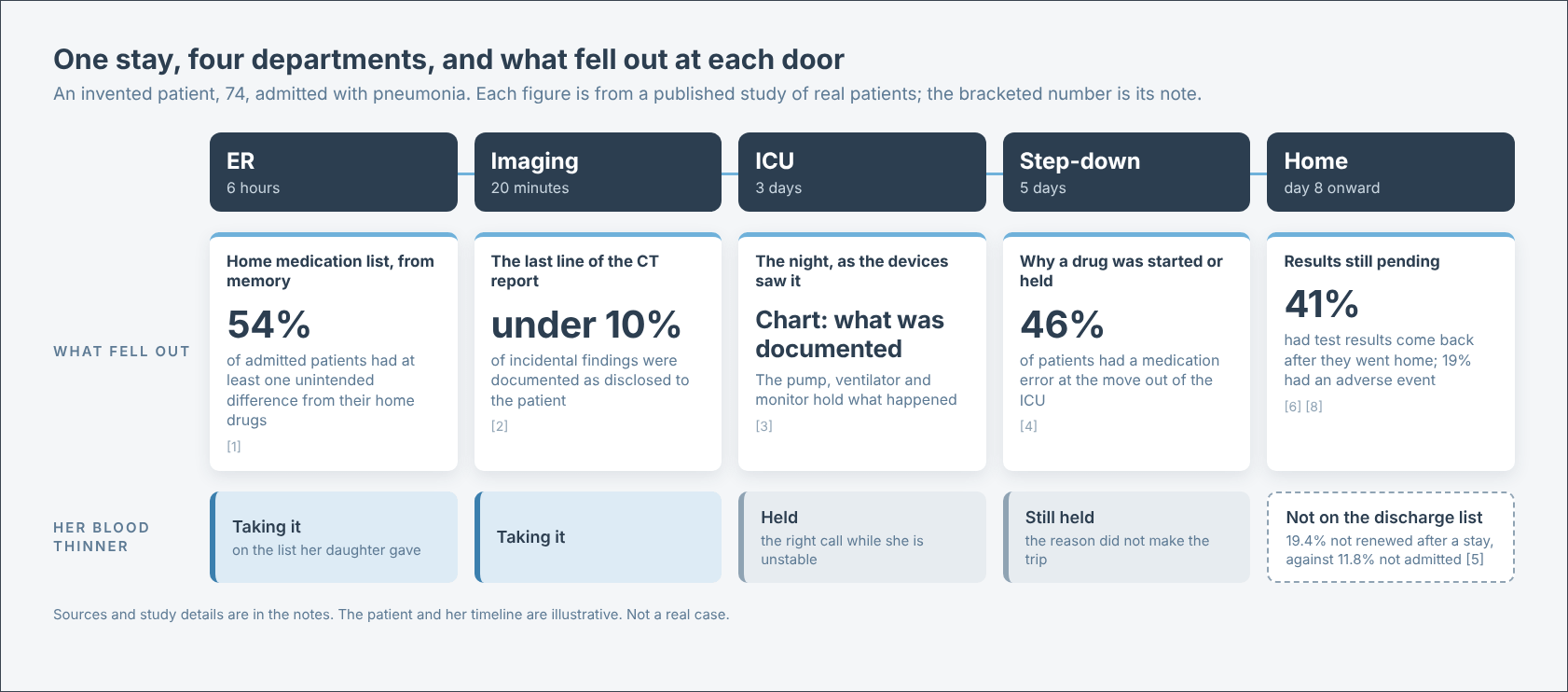
That is how she reached the first sentence of this issue. The nodule is in a report. The culture result is in a queue.
Who saw all of it?
The ER had her for six hours, imaging for twenty minutes, the ICU for three days and step-down for five. Each one finished its work and charted it. One person was present for the entire stay. She was the patient, and she was too sick to take notes.
I have no standing to lecture anyone about this. I write about silos, and recently I counted my own. Ai MedAgent is a demonstration that reasons over an infusion. My pump integration work connects the pump to the record. EveryWave, from Issue 31, is a concept for reading the brain in the operating room. Three projects, three departments, and none of them knows the other two exist. I am guilty of what I preach.
What already works, and it is not software
The best evidence on handoffs comes from a study of a habit. Nine children’s hospitals trained their residents in I-PASS, a structured way to hand over a patient in speech and in writing. Across 10,740 admissions, medical errors fell 23 percent and preventable adverse events fell 30 percent, and the handoffs took no longer than before [9]. What changed was mostly how people talked to each other. I wrote a book called The Technology Was Never the Problem, and this study could be its first exhibit.
I-PASS was tested where two people are in the room: one doctor going off shift, one coming on. My patient’s failures were somewhere else. They happened between departments and between systems, where nobody stands facing anybody. Nobody gives a spoken handoff for the last line of a CT report. A pump does not get a turn to speak.
What I would ask a machine to do
Something small. At every door, three lists, written down for the next team.
What was stopped. Which drug, who held it, why, and what brings it back.
What is still pending. Which results are out, and who owns the answer when it arrives.
What the devices saw. The part of the night that the chart does not tell.
A machine that never goes off shift can carry those three lists through four departments and out the front door. It advises. A named clinician decides. I am not building it and I have nothing to sell.
One more screen to feed
If you work a short-staffed unit, you stopped believing me a few paragraphs ago. Three lists sound like three more things to enter, confirm and sign, on a shift with no slack in it. That objection is correct, and a safety argument does not beat it.
I have seen it answered once. At Alaris we developed automated charge capture for IV therapy. Payment depends on a record of every time a nurse starts, stops or pauses an infusion. It sounds easy. It is not. So the pump reported those events itself, and the nurse typed nothing. Billing got its record, and the bedside got a side benefit: the running status of every IV was visible, and the documentation was done.
That is the test for everything in this issue. The record should come out of the care as a byproduct, and when all is well the system should be quiet. Airbus calls this the dark cockpit: “if all the lights are out, then the aircraft is ready to fly” [10]. Part 2 asks whether a hospital can have one, and what it would take for a clinician to trust the dark.
What I do not know
I have not found a test of anything that reasons across a whole hospital stay with the device data included. If one exists, I want to read it. I have no evidence that it would save anyone a minute. Most of the studies above are more than ten years old, and hospitals have added medication reconciliation and shared records since then. Today’s rates may be better. Somebody should measure them again.
One number I left out on purpose is the claim that 80 percent of serious medical errors involve miscommunication between caregivers. It is a Joint Commission estimate, and the announcement I read gives no study for it [11].
The Whole Stay: what comes next
Part 2, One More Thing to Feed. Time and labor. How much of what clinicians type is for billing and the lawyers, what the first AI time-savers have actually measured, and what a dark cockpit would demand before anyone could trust it.
Part 3, Who Checks the Checker. AI is arriving in notes, billing and insurance one desk at a time, with no national standard for what safe use means. Who should own the whole encounter, who inspects it, and a bill I drafted to answer that.
A vote, and a reason to look over the wall
The hard part of all this is interest. A pharmacist has little reason to read about imaging. An ICU nurse is not graded on what happens in step-down. Each department’s job gets done inside its own walls, which is why the walls last. Until somebody makes a way across, the status quo wins.
So I am asking you to look over one. Which door worries you most: home to hospital, ICU to the floor, hospital to home, or device to record? Vote below, and tell me what you watched fall through it. I will report the count in Part 2.
Written with AI assistance. Concepts, sources and conclusions are the author’s, and every source was checked by the author.
Daniel Pettus spent forty years in medical device and health IT leadership at Alaris, CareFusion and BD, was a founding member of the iMetrikus team, and contributed to IHE Patient Care Device interoperability standards. He is co-inventor on US patent 7,375,647 and has filed five provisional applications on the reasoning method behind Ai MedAgent™. He writes Inside the Loop from Murrieta, California.
The serious version of the day job is a book. The Technology Was Never the Problem: forty years of trying to connect medical devices to the record, and what finally changed. pettusbook.com.
Ai MedAgent™ is a research demonstration of a patent-pending method. Advisory only. Not a medical device. Not FDA cleared. Synthetic patients and simulated feeds. See it at aimedagent.net. Ami is an unreleased experiment and is not available to download.
Notes
[1] Cornish PL, Knowles SR, Marchesano R, et al. Unintended medication discrepancies at the time of hospital admission. Arch Intern Med. 2005;165:424-429. 151 patients at a University of Toronto teaching hospital; 81 (53.6 percent) had at least one unintended discrepancy; omission was the most common; 38.6 percent of discrepancies had the potential to cause moderate to severe discomfort or clinical deterioration.
[2] Thompson RJ, Wojcik SM, Grant WD, Ko PY. Incidental findings on CT scans in the emergency department. Emerg Med Int. 2011;2011:624847. https://doi.org/10.1155/2011/624847 . One trauma center; 600 adults sent home from the emergency department; 682 scans; 348 incidental findings; 34 (9.8 percent) documented in the discharge paperwork as disclosed. My patient was admitted; these patients went home.
[3] Pettus DC, Vanderveen T. Worth the effort? Closed-loop infusion pump integration with the EMR. Biomed Instrum Technol. 2013;47(6):467. https://doi.org/10.2345/0899-8205-47.6.467
[4] Tully AP, Hammond DA, Li C, Jarrell AS, Kruer RM. Evaluation of medication errors at the transition of care from an ICU to non-ICU location. Crit Care Med. 2019;47(4):543-549. 985 patients, 58 ICUs; 450 patients (45.7 percent) had a medication error at transfer. Of the errors, 28.4 percent were continuing a medication with an ICU-only indication and 19.4 percent were an untreated condition. Three quarters of the errors reached the patient without causing harm.
[5] Bell CM, Brener SS, Gunraj N, et al. Association of ICU or hospital admission with unintentional discontinuation of medications for chronic diseases. JAMA. 2011;306(8):840-847. Ontario residents aged 66 and older, 1997 to 2009; 187,912 hospitalized and 208,468 not. Antiplatelet or anticoagulant agents: 19.4 percent against 11.8 percent, adjusted odds ratio 1.86; after an ICU stay 22.8 percent, adjusted odds ratio 2.31.
[6] Roy CL, Poon EG, Karson AS, et al. Patient safety concerns arising from test results that return after hospital discharge. Ann Intern Med. 2005;143(2):121-128. 2,644 patients; 1,095 (41 percent) had results return after discharge; 191 of 2,033 results (9.4 percent) were potentially actionable; physicians were unaware of 65 of the 105 they were surveyed about (61.6 percent).
[7] Kripalani S, LeFevre F, Phillips CO, et al. Deficits in communication and information transfer between hospital-based and primary care physicians. JAMA. 2007;297(8):831-841. A review of 55 observational studies published from 1970 to 2005, so most of it predates today’s electronic records.
[8] Forster AJ, Murff HJ, Peterson JF, Gandhi TK, Bates DW. The incidence and severity of adverse events affecting patients after discharge from the hospital. Ann Intern Med. 2003;138(3):161-167. 400 patients sent home from a general medical service; 76 (19 percent) had an adverse event; 23 were preventable and 24 more could have been made less severe; 66 percent of the events were adverse drug events.
[9] Starmer AJ, Spector ND, Srivastava R, et al. Changes in medical errors after implementation of a handoff program. N Engl J Med. 2014;371(19):1803-1812. A before-and-after study in nine pediatric residency programs. Medical errors fell from 24.5 to 18.8 per 100 admissions and preventable adverse events from 4.7 to 3.3.
[10] Airbus. A330neo cockpit commonality with A350 innovations. airbus.com. The rule applies to the overhead systems panel, where a light shows only where an action is required.
[11] Healthcare Innovation. Joint Commission Center for Transforming Healthcare tackles miscommunication among caregivers. 24 June 2011. https://www.hcinnovationgroup.com/home/news/13013873/joint-commission-center-for-transforming-healthcare-tackles-miscommunication-among-caregivers