

Inside the Loop // Issue 09
In the spring of 1995 I stood in the parking lot of my own company and bought a laser printer.
Diatek was selling itself off a folding table. I paid cash, carried the printer to my car, and drove home with my gut hurting. Not about the printer. About what I knew we had built, and what I knew it could do.
Two years later the Journal of Clinical Monitoring published a study of the system I had spent the back half of that decade on. Duke University Medical Center bought our ARKIVE anesthesia information management system for six cardiothoracic rooms in 1987, installed it in August 1988, and on May 25, 1992 rolled it out hospital wide to every anesthetizing location in the main and auxiliary suites. Duke had built its own system years earlier and abandoned it in 1983. Ours stuck. [1]
On the first page of that paper there is a footnote. It reads: “Arkive Information Systems, Inc. has changed corporate identity.” [1]
The product worked. The company was in the parking lot.
This is an article about why that keeps happening, and it is going to name names. Not to blame anyone. The opposite. I want to give credit to the people who taught me this business and who changed the practice of medicine for the better, and who mostly did not get rich doing it. Early entrepreneurs pay the price. That is not a complaint. It is the job description.
1985: Tom Gregory Puts Me in Charge of Software
It was 1985 and it was my first job in healthcare technology. My mentor was Thomas K. Gregory, PhD, and he was the perfect mentor at exactly the right moment.
In June of that year an investor group consolidated three San Diego medical technology companies, Diatek Inc., Neurometrics, and Diatek Medical Technology, formerly Dade Medical, into a single entity called Diatek Corp. Phil Faris was chief executive. We operated out of a 69,000 square foot plant in Sorrento Valley, and we grew into the second largest manufacturer of electronic thermometers in the country, behind our crosstown rival IVAC, with roughly forty percent of the market and about 180 employees. [2]
Neurometrics was the piece that mattered to me. The Lifescan EEG monitor was just getting started as a project and Tom handed me the software. I later hired Dave Geving, and together we extended Lifescan with an evoked potential option, which turned it from a passive monitor into something closer to a diagnostic instrument. In 1986 Tom and I published the acquisition algorithm behind it. [3]
Understand what Lifescan did. It gave the anesthesiologist a continuous, readable picture of depth of anesthesia, in an era when that was substantially a matter of judgment and experience. It was also an early indicator of potential brain injury. A signal that had not existed before, at the head of the table, while the patient was still on it.
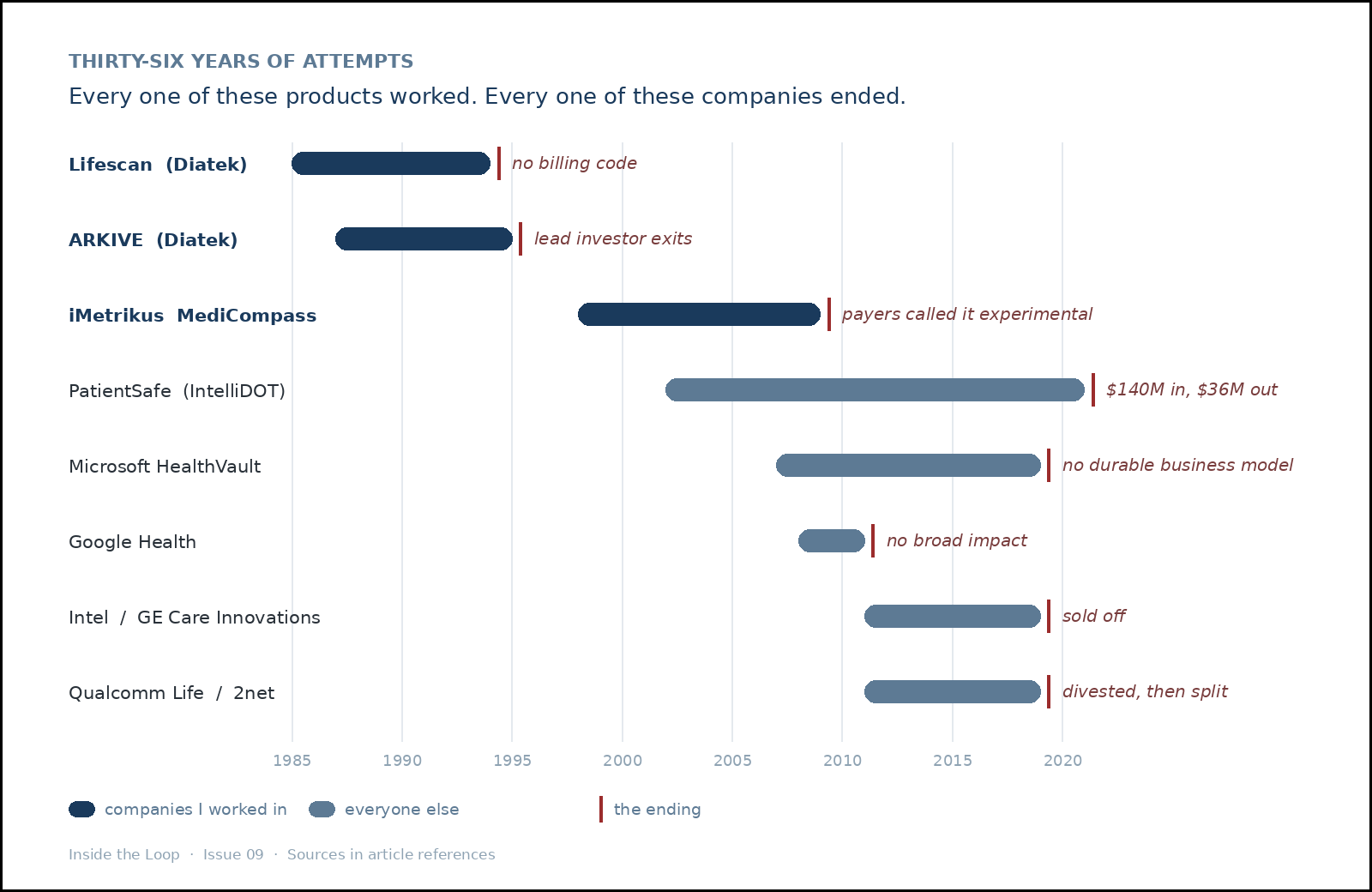
Lifescan did not make it. Not because it did not work.
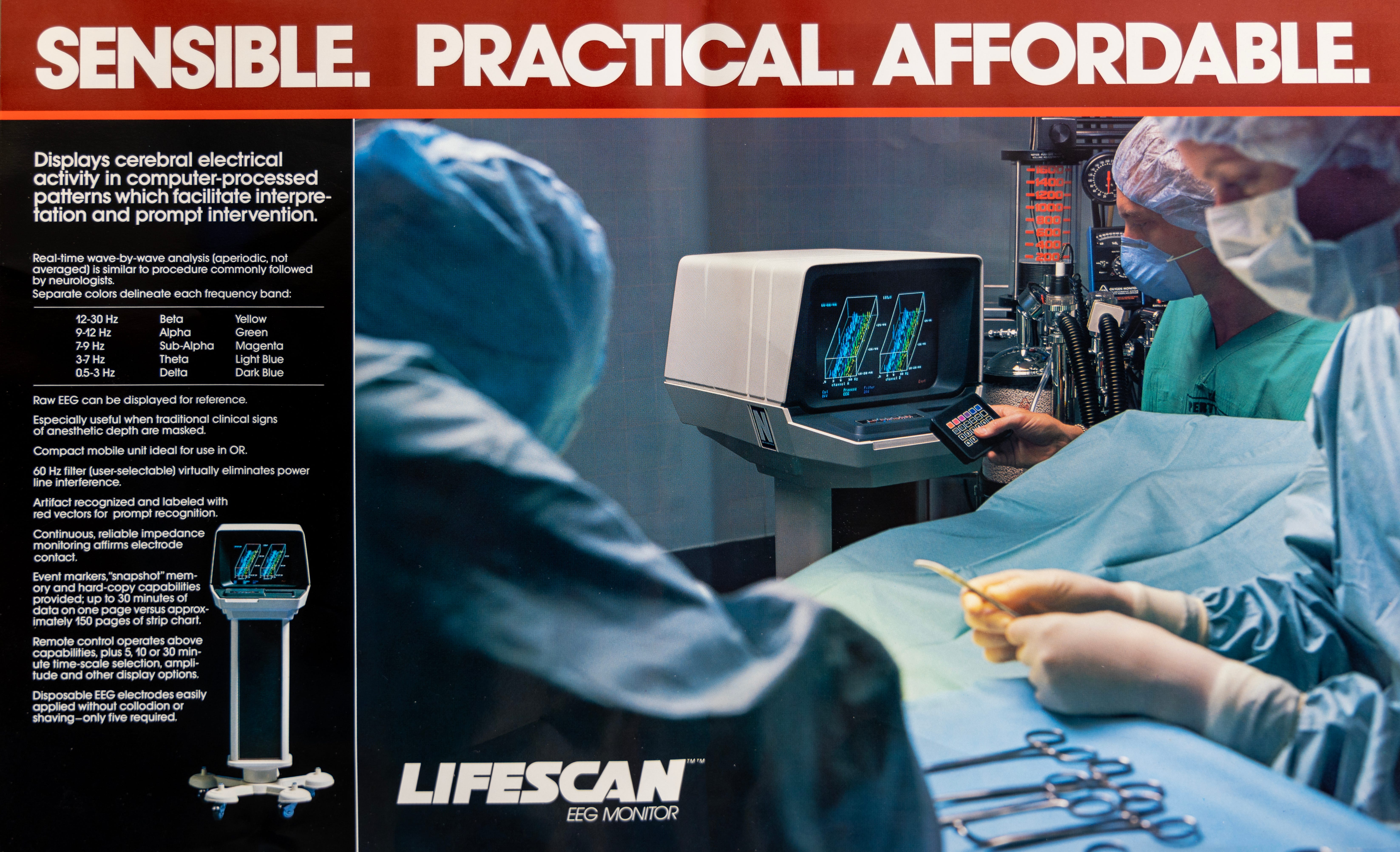
Between 1985 and 1994 there was no clear billing code for brain monitoring during anesthesia. No code, no payment. No payment, no adoption. It did not matter that it improved outcomes. It did not matter that it could catch injury early.
I was thirty something and I did not understand yet that I had just met the single most important fact in this industry. I would meet it again three more times.
ARKIVE, and What $10.5 Million Bought
I moved onto the anesthesia information system in 1991 until 1994. I have written about ARKIVE before and I will not repeat all of it here, because Issue 08 covers the machine in detail and I gave it its due there. [4] The short version for anyone landing here first.
ARKIVE was a full anesthesia information management system, not a data logger. Touch and voice sensitive workstations on articulated arms sat at the anesthesiologist’s side, wired into the anesthesia machines and the physiologic monitors, capturing inspired and end tidal gases, drugs, infusions and vital signs automatically, and assembling the anesthesia record as the case unfolded. Getting devices from a dozen manufacturers to speak to one system in 1988 was genuinely hard. We did it. I put that product into Ohio State, Duke, University Nijmegen in the Netherlands, and UCSD.
Development of ARKIVE cost an estimated $10.5 million. [2] In late 1980s dollars, for a company of 180 people, that is not a side project. That is the company betting itself on an idea.
The autopsy
Diatek’s lead backing came from Douglas J. Dayton of the Minneapolis Dayton Hudson retail family. [2] If the name is unfamiliar, the store is not. Dayton was the first president of Target, ran it through its early expansion, left Dayton Hudson in 1972, and formed a venture capital firm in 1974 that he ran until he retired in 1994. [5]
He sat on our board, and this is the part that matters. He was not a line item in a fund. He was personally responsible for the continued infusion of capital. He was the money.
In 1995 he ended the relationship for family reasons and gave us a short window to find a replacement lead. Phil Faris ran that search. It did not pan out. Dayton’s public record shows him retiring from venture capital in 1994. Faris’s record shows him as president, chief executive and director of Diatek Corporation and Subsidiaries from 1982 to 1995. Three separate timelines, none drawn from each other, all landing inside the same eighteen months.
A company with peer reviewed clinical adoption at a top academic medical center ended because one board member stopped writing checks and nobody else picked it up.
As for Duke, they never went back to paper. In October 2006, fourteen years after our hospital wide rollout, Duke University Health System implemented Dräger’s Innovian Anesthesia across more than 150 point of care locations, described at the time as the largest upgrade in Dräger Medical’s history and the most extensive Innovian installation in the world. [6]
The department that took a chance on six operating rooms in 1987 became the global flagship for a German multinational. Just not for us.
The Second Company, and the Man Who Brought Me Into It
Joseph Condurso was executive vice president and managing director at Diatek Medical and Arkive Information Systems from 1993 to 1995. [7] Where Tom Gregory was my technical mentor, Joe was my business mentor, and my recollection of those years is that he saw where this market was going well before the rest of us did.
He brought me into the formation of iMetrikus. The seed financing came from Dr. William J. Rutter, and I want to be clear about who that is, because it tells you this was not a couple of guys with a slide deck.
Bill Rutter took over an undistinguished biochemistry department at UC San Francisco in 1968 and turned it into one of the best in the world. In 1977 he and his colleagues isolated the rat insulin gene and put it into bacteria, one of the first real triumphs of genetic engineering. In 1981 he cofounded Chiron, which produced the first recombinant hepatitis B vaccine, completed the first sequencing of the HIV genome in 1984, and discovered, sequenced and cloned hepatitis C in 1987. He died on July 11, 2025. [8]
Rutter’s original vision for iMetrikus was a system to help manage HIV and AIDS for patients being cared for primarily in primary care. Look at that against his own science and it is not a coincidence, it is a straight line. Joe and the rest of the team expanded it to chronic care generally.
MetrikLink was my idea and my invention, a home connectivity hub that pulled readings off more than thirty consumer medical devices and sent them to our data center. Jae Evans led platform development. Peter Thompson extended the product schema to incorporate the UMLS public data mart, and if you want the full breakdown of what public data marts are and why that mattered in 2003, it is in Issue 08. [4] I hold two patents from that work. [9]
Why iMetrikus did not make it
Payers, both commercial insurance and CMS, looked at what we were doing and saw an experiment.
This was while our early clinical users were giving talks and publishing on how the technology was improving lives and saving time and money. A UC San Diego endocrinologist presented our remote monitoring results in an underserved diabetes population in 2003. [10] None of it moved the payment question, because the payment question was not being asked by the same people who were impressed by the results.
Startups have to move fast. Healthcare payers move at a snail’s pace, and that is being generous. A company with a two year runway cannot outlast a five year coverage debate. That is not a business failure. That is arithmetic.
So I Went Where the Runway Was Longer
After iMetrikus I made a deliberate choice, and I would make it again. I joined the larger forces in medical technology, the ones with balance sheets that can absorb the pace and the risk aversion. Alaris, then Cardinal Health, then CareFusion, then BD.
We did genuinely innovative work there. I spent those years on the fringe, building and promoting the case that clinical care improves when the devices talk to each other, and doing it without being strangled by the culture of the status quo. It still had problems with pace and with protectionism.
And it taught me the barrier I did not fully appreciate from inside a startup.
Healthcare technology that generates a wealth of data mostly does not share it, or does not share it without a substantial toll.
This is where the industry conversation usually turns into shouting. Giving the data away is not the answer either. Nobody develops anything if there is no return on developing it. That is how the business works and I am not going to pretend otherwise after spending my career inside it.
But holding it back and charging a toll for access slows the whole field to a crawl. We built the connectivity. The value was in the data, and the data sat behind a gate with a price on it. Every founder reading this already knows what I am describing, because they got the quote.
Qualcomm Life Had Every Part, and It Still Did Not Work
Qualcomm Life set out to do essentially what iMetrikus had attempted, at a scale we could never have reached, with research dollars we could not have imagined. Several people from the BD world moved over to help jump start them into healthcare.
They had all the pieces. Cellular connectivity built for home health by a company that understood cellular better than anyone. The 2net Hub, which was a modern version of what MetrikLink had been. And Capsule Tech, a hospital gateway product, brought in to bridge from the hospital to the home. On paper it is the correct architecture, and it is the architecture I had been arguing for since 2003.
I will note, because it is a matter of public record rather than an accusation, that I am a named inventor on United States patent 7,375,647 covering a method and apparatus for communicating data between a medical device and a central data repository. [9] I never tested it against anyone. I make no claim here, and I never filed one.
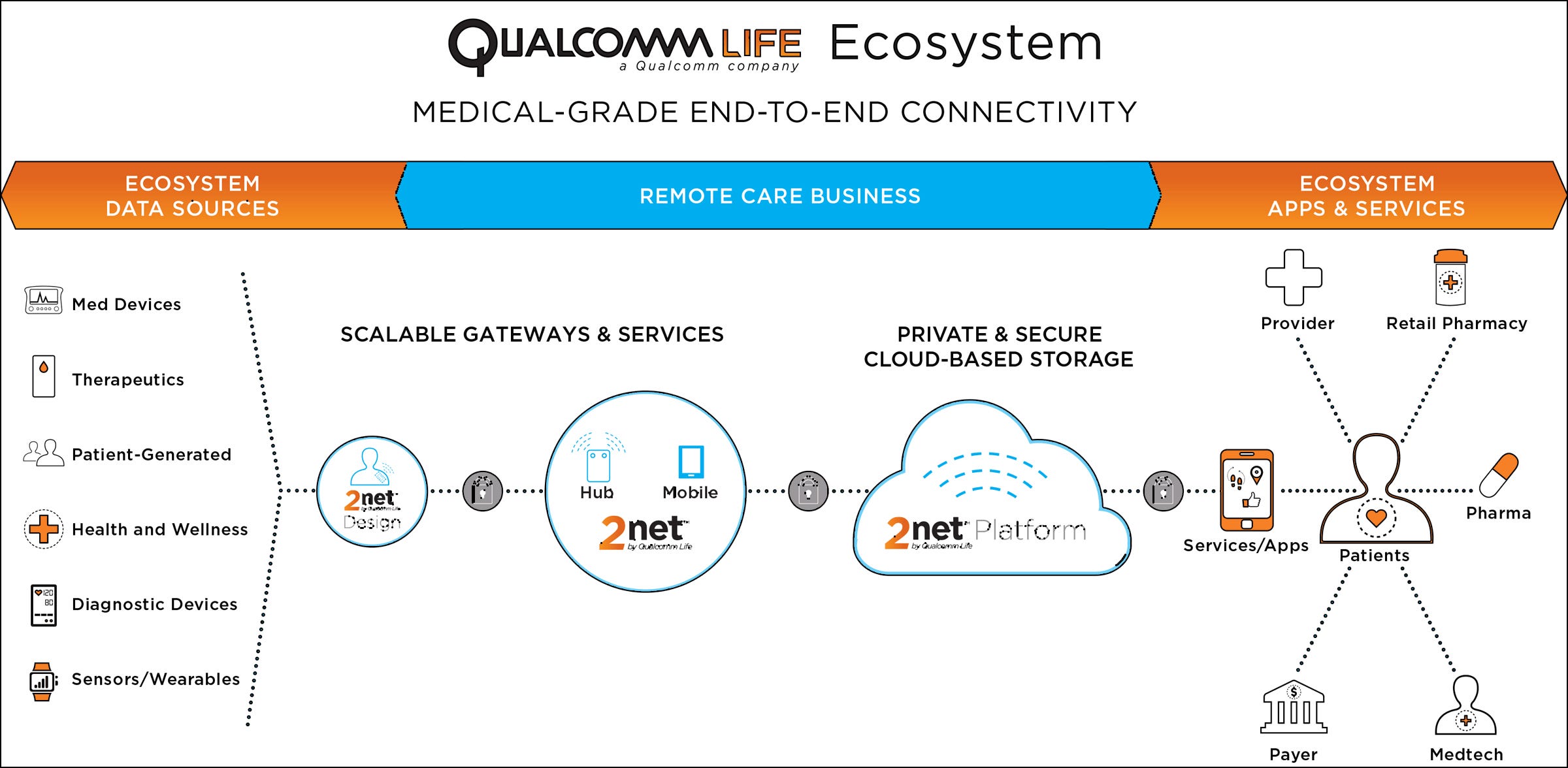
It did not matter. The closed, siloed structure of American healthcare never produced a revenue stream of any consequence for it. Then the Qualcomm board changed direction. Qualcomm Life was divested to a private equity firm in February 2019 and renamed. The remote monitoring business went to Philips in 2020. [11]
And If You Still Think It Is a Money Problem
Look at PatientSafe Solutions, here in San Diego.
PatientSafe was founded in 2002 as IntelliDOT and built PatientTouch, a mobile platform putting barcode medication administration, secure messaging, alerts, record data and documentation into a clinician’s hand. It is a good idea aimed at a lethal problem. Over nineteen years and eleven rounds it raised somewhere between $135 million and $143 million from about a dozen investors including TPG Biotech, the Merck Global Health Innovation Fund, HighBar Partners and Telus. Institutional money, strategic pharma money, telecom money.
In April 2021 Vocera acquired it for $36 million. [12]
Roughly $140 million in, $36 million out, nineteen years. That is not a funding problem.
Now hold that against Google Health, which launched in 2008 and was gone by 2011 because it never achieved what Google called broad impact. [13] Against Microsoft HealthVault, which lasted twelve years and shut down in November 2019 on low usage and no durable business model. [14] Against Intel, which spent nineteen years on this, launched a fifty fifty joint venture with GE in January 2011, took full control in 2016, and sold the remains to a contract research organization at the end of 2019. [15]
Diatek ended with one angel and no institutional capital. PatientSafe ended with everything Diatek never had. Google, Microsoft, Intel and Qualcomm had more money than all of them combined. If the variable were capital, those endings would not rhyme.
The Six Gates
Here is what actually stops things, in roughly the order founders underestimate them.
Gate 1. The buyer is not the user, and neither one is the payer.
Three parties, three incentive structures, one signature. The nurse who benefits does not buy. The system that buys does not get paid more for having it. The insurer that pays was never in the room.
Gate 2. No reimbursement code means no revenue.
Clinical benefit and revenue are separate questions and founders keep collapsing them into one. Lifescan is my proof. It read the brain during anesthesia and it could flag injury early, and there was no code for that, so it did not matter.
Gate 3. The sales cycle outlasts the funding round.
Enterprise hospital implementations routinely run eighteen months and longer, and slow provider sales cycles are the most cited barrier to growth among digital health companies. [16] A seed round is not eighteen months long.
Gate 4. The data is a toll booth.
Integration is not a technical problem, it is a permission problem, and permission usually has a price. Frequently it is set by someone who would rather sell the hospital its own version of you.
Gate 5. Liability lands on the clinician.
Adoption asks a physician or a nurse to accept personal professional risk for software written by strangers. This is the gate that kills pilots after they succeed.
Gate 6. The capital itself is fragile.
Healthcare payback periods break fund economics, so the patient money has historically come from individuals rather than institutions. That makes a company hostage to one person’s private circumstances. Ask me how I know.
What a Silo Actually Costs You
Gate one deserves more than a paragraph, because the abstraction hides how bad it is.
Selling a single product line into an acute care hospital, one product, meant roughly a year of interaction before anyone signed anything. Not a year of negotiation. A year of interaction. The rooms I had to satisfy included executive management, medical strategy under the chief medical officer, pharmacy under the director of pharmacy, technology under the chief information and chief technology officers, nursing, biomedical engineering and maintenance, finance under the chief financial officer, and legal and regulatory. There were more.
Every one of those departments ran its own way, with its own reason to say yes and its own reason to say no. Most were nominally aligned to an institutional strategy and the walls between them were still nearly impossible to manage. It was inefficient, and sometimes it was open infighting over whose priority came first.
This is not only my experience. It is not uncommon for a hospital value analysis committee to seat twelve to twenty four people. [17]
Consumer technology has sprinted past healthcare over the same forty years for a reason that has nothing to do with engineering talent. In consumer, one person decides. In acute care, twenty four people decide, and any one of them can end it.
How Far Behind Is Healthcare, Really
People in this industry like to say healthcare runs about twenty years behind everybody else. I have said it myself. I want to be careful with the number, because it is an aphorism rather than a measurement, and nobody has ever shown me the arithmetic underneath it.
So instead of asserting it, let me hand you one receipt and you can do the subtraction yourself.
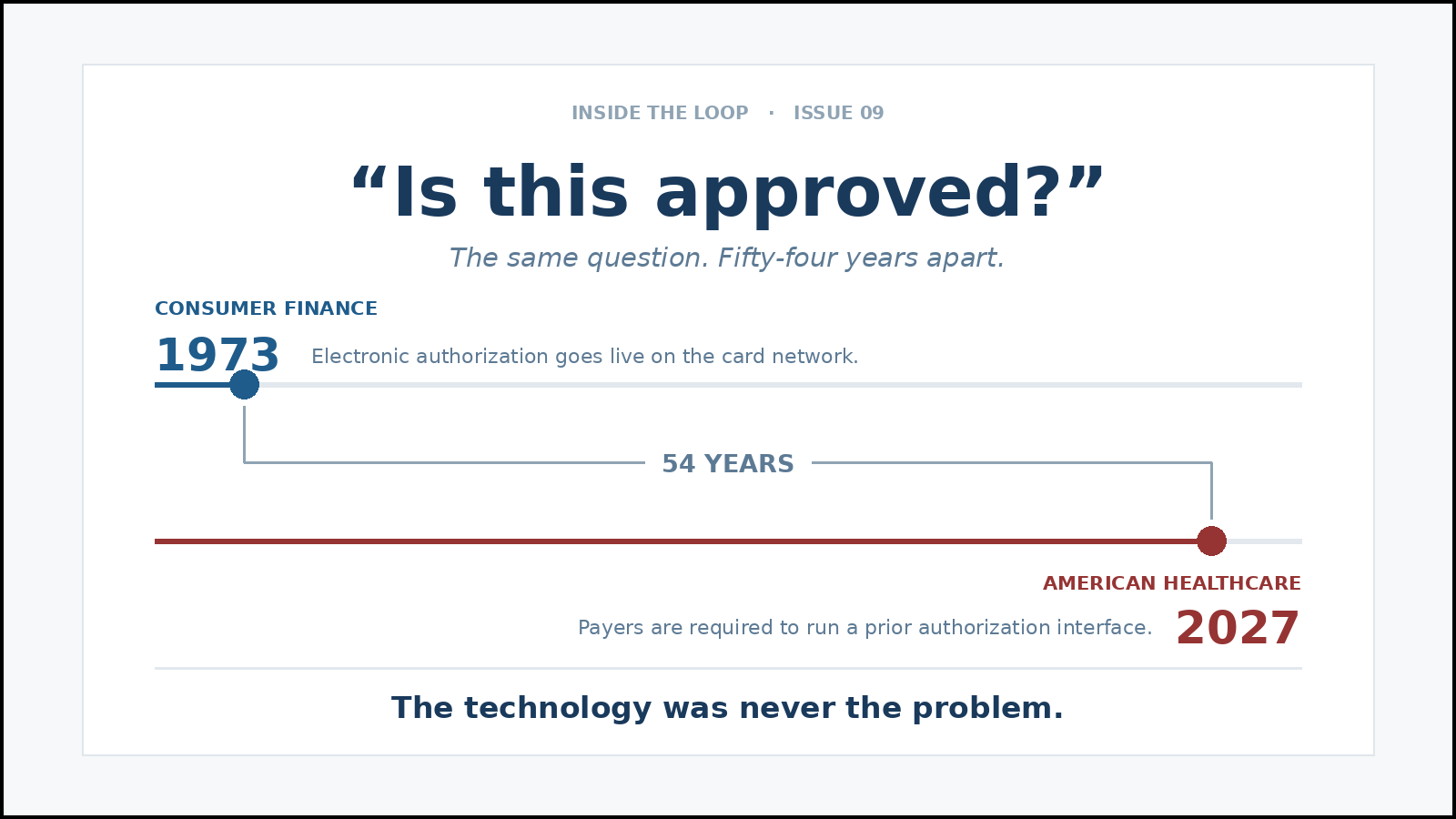
Take the question “is this approved?” In consumer finance the card networks began answering it electronically in 1973, when the authorization system that became VisaNet went live. [24] Half a century later you tap a card in a coffee shop and have your answer before you have put your phone back in your pocket. Nobody thinks about it. Nobody markets it. It is plumbing.
Now ask the same question inside American healthcare. Is this treatment approved? That question still produces phone calls, faxes, forms, peer to peer reviews and appeals. Medicare Advantage insurers alone issued nearly 53 million prior authorization determinations in 2024, and hospitals spent roughly $43 billion in 2025 chasing money that was already owed to them. [19][20]
The federal requirement for payers to run a standards based prior authorization interface takes effect January 1, 2027. [22]
1973 and 2027. Fifty four years to get an electronic answer to the same four word question.
I am not going to tell you healthcare is exactly twenty years behind, because I cannot measure it and neither can anyone else who says it. What I will tell you is that I have been watching from inside the building since 1985, and twenty years is the number that feels right to me. Call that my estimate rather than a finding. The fifty four years is the finding.
The One Serious Attempt to Fix It
Darren Dworkin, then chief information officer at Cedars-Sinai, built the most credible bridge anyone has built. He founded the Cedars-Sinai Accelerator with Techstars, and the first class kicked off in March 2016: eleven companies, one hundred twenty thousand dollars apiece, three months inside a real health system with real clinicians and real data. [18] It has run at least ten classes since.
I retired from BD in April 2019. About a month later Darren invited me to a Demo Day and raised the idea of my serving as an industry mentor for future classes. I went. I thought the concept was brilliant and I still do.

The accelerator fixed access, which was real and worth fixing. It could not fix reimbursement, procurement, liability, or the fragility of the capital. No accelerator can. Those are properties of the market.
So Why Am I Optimistic
There is a version of this ending I refuse to write. The popular version says artificial intelligence unlocks what was previously impossible and therefore the time is finally right.
That does not survive the evidence above. Not one company in this article failed for lack of capability. Lifescan worked. ARKIVE worked. MetrikLink worked. PatientTouch worked. Google, Microsoft, Intel and Qualcomm all shipped functioning products. AI does not repeal a single one of the six gates. Reimbursement does not care how good your model is.
Here is the narrower claim, and it is the one I will defend.
Every previous wave sold the hospital a new capability. AI is the first wave aimed at the hospital’s largest expense.
Workforce is the biggest line on the hospital income statement. American hospitals spent more than one trillion dollars in 2025 paying health care workers, with workforce costs up 5.6 percent against total expense growth of 7.5 percent. [19]
Now look at what a meaningful slice of that labor is doing. Hospitals spent roughly $43 billion in 2025 trying to collect money insurers already owed them, including nearly $18 billion just overturning denials. The average hospital employed about sixty four administrative and billing staff for that work, roughly 6.5 percent of total employment. Medicare Advantage plans denied about 17 percent of initial claims and 57 percent of those denials were eventually overturned, which means most of that labor produced delay rather than a decision. Those same insurers issued nearly 53 million prior authorization determinations in 2024. [19][20]
Fifty three million determinations is not a technology gap waiting for a breakthrough. It is a labor problem waiting for automation, sitting inside the workflow rather than bolted onto the outside of it. No previous wave went near it.
What Actually Changed
Go back to the six gates and ask a different question. Not whether they are gone. Ask which ones you have to pass through before anyone can find out whether the thing works.
Every product in this article had to get inside the building. Lifescan was a monitor at the head of the table. ARKIVE was a workstation on an arm in an operating room. MetrikLink was a box in a living room. PatientTouch was a device in a nurse’s hand. Hardware, on the network, inside the perimeter. Security review, biomedical engineering, an asset tag, a maintenance plan, an integration project, the value analysis committee, and a department that had to agree to staff it. Every gate cleared before the first result.
The reasoning layer is not in the building. For the most part it sits outside the gates.
It does not get installed on the hospital network. It does not sit on a cart. It needs no asset tag and no preventive maintenance schedule, and nobody has to be hired to push it down a hallway. That does not make the gates disappear. It moves most of them from before the evaluation to after it, and that reordering is the whole difference.
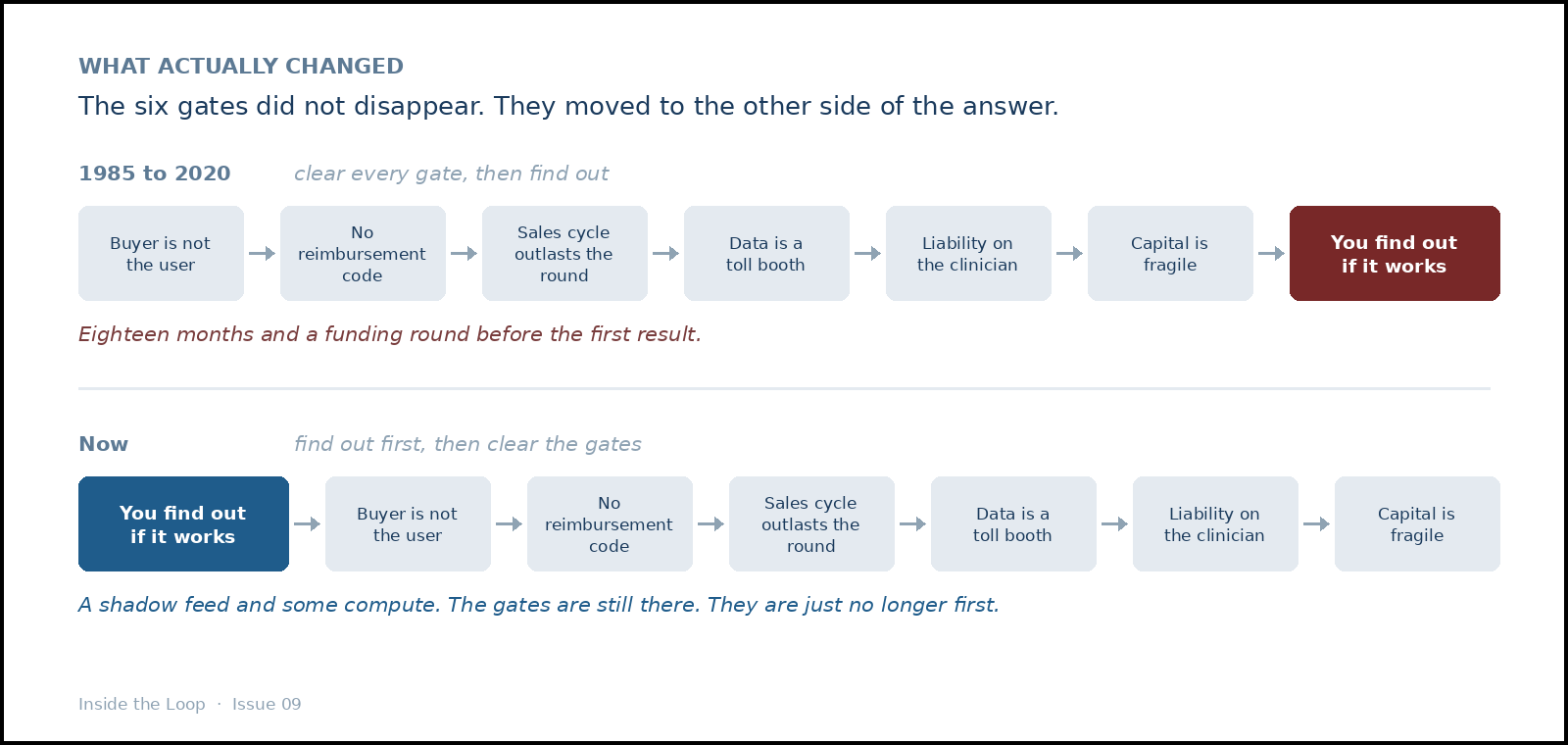
What Still Has to Be Solved
The remaining barrier is inbound, and it is gate four. Getting the data out of the hospital still costs money. That toll booth has not been dismantled and I am not going to pretend it has.
Regulation may finally do some of the work. Certified electronic health records have been required to expose standardized FHIR application programming interfaces since January 1, 2023. [21] Under the CMS Interoperability and Prior Authorization Final Rule, published in February 2024, affected payers including Medicare Advantage organizations, Medicaid and CHIP programs and managed care plans, and qualified health plans on the federal exchanges must run four production FHIR interfaces by January 1, 2027, one of them a prior authorization interface, with operational provisions phasing in from January 2026. [22]
Read that against the numbers above. The federal government has now placed a dated, standards based interface requirement directly on top of the largest pile of wasted administrative labor in American healthcare.
Now the honest caveat, because this is the part optimists skip. Information blocking has been prohibited since the Cures Act, and as of the most recent assessment I could find there had been no federal enforcement of those rules at all. The claims were surfacing in commercial disputes rather than in penalties. [23] A mandate with a date is not a mandate with teeth, and the rulemaking here keeps moving in both directions. Budget for the interface cost. Do not assume Washington will delete it for you.
So Can It Work Now
Here is the practical version, and it is why I am spending my retirement on this instead of on a boat.
The cost to trial an AI reasoning layer in a non production environment is a rounding error against the cost of installing a product on a hospital network. No cart, no asset tag, no downtime window, no go live weekend, no training the night shift. You run it against a shadow feed or a de-identified extract, and you find out.
For years the only way to learn whether something worked was to put it in the room first. Now you can find out first and negotiate second. That is the inversion, and it is the first genuinely new thing I have seen in this industry since 1988.
Which brings me back to Darren.
An accelerator embedded in a real health system was the right idea in 2016 and it was constrained by the same physics as everything else. Everything it incubated eventually had to go through the doors. But an AI reasoning layer that can be evaluated outside the production network is exactly the kind of thing a program like that can now test at a speed it could never manage with hardware. Real clinical questions, real data, real clinicians, and a trial that does not require a go live weekend or a capital request. If I were still building, that is where I would want to be standing.
Can the Culture Change
I have been asking myself that for a very long time and I want to answer it honestly, which means answering it in two parts.
The culture will not change because we ask it to. It never has. Silos exist because the incentives inside them are real, and every one of those twenty four people has a legitimate reason for the veto they hold. Telling them to be less cautious is not a strategy, it is a complaint.
But cultures do change when the economics change underneath them, and they change fast when they do. That is the whole history of this industry and it is the whole history of every other one. The reason I am hopeful is not that AI is impressive. It is that for the first time the technology, the economics and the entry path are pointed the same direction, and the cost of finding out has collapsed.
None of this excuses founders from the work. Every failure in this article was engineered competently and defeated structurally, which means the scarce skill is not engineering. It is comprehensive knowledge of the space. Who signs, who pays, who is liable, which code applies, which committee can kill it, and which department will quietly refuse to staff it. That is not a caveat on top of the job. That is the job.
Nobody in this article failed for lack of talent. Tom Gregory, Bill Rutter, Phil Faris, Joe Condurso, Dave Geving, Jae Evans, Peter Thompson. They were right, and they were early, and being early is indistinguishable from being wrong right up until the moment it is not.
Some of what we built became ordinary. Duke never went back to paper. Every anesthesia department in the country runs an information management system now. Home monitoring is not experimental anymore, it is a product category. We were not wrong. We were early, and the bill for being early came to us instead of to the people who arrived later and got it right.
That is a fair trade, and I would take it again.
The structure has shifted in one specific place, for one specific reason, and the cost of testing that claim has collapsed. I have been wrong about timing before. I have a laser printer that proves it.
Worth a try. After watching better ideas than mine die in that parking lot, that is not a small sentence. It is the boldest one I have.
About me

Daniel Pettus is the founder of Inside the Loop and the inventor of AI MedAgent, a proof of concept for continuous, AI driven medication oversight, free and public at aimedagent.net. He spent forty years in medical device and health IT leadership at Alaris, CareFusion, and BD, co-founded iMetrikus in 1998, and contributed to IHE Patient Care Device interoperability standards. He holds two issued patents and has filed three provisional patents on the continuous reasoning method behind AI MedAgent. In November 2026 he will present “The dark cockpit: AI sits at the core of care, not at its edge” at AI.Care 2026 in Melbourne.
This newsletter is now read inside the companies that can build what it describes: the cloud platforms, the medication and device leaders, and the investors deciding where AI belongs in clinical care. He is available to industry, acute care organizations, and investors in an advisory capacity, as a subject matter expert in applying AI to proactive clinical care and medical device integration. The public data was never the hard part. The reasoning was, and that is the work he has spent a career on.
References
[1] Coleman RL, Stanley T III, Gilbert WC, Sanderson IC, Moyer GA, Sibert KS, Reves JG. The implementation and acceptance of an intra-operative anesthesia information management system. Journal of Clinical Monitoring 1997;13:121-128. Corporate identity footnote, p. 121.
[2] Contemporaneous San Diego business press on the June 1985 consolidation of Diatek Inc., Neurometrics and Diatek Medical Technology (formerly Dade Medical) into Diatek Corp., including market position, employment, the Sorrento Valley facility, ARKIVE development cost and Douglas Dayton’s backing.
[3] Gregory T, Pettus DC. An electroencephalographic processing algorithm specifically intended for analysis of cerebral electrical activity. Journal of Clinical Monitoring and Computing, 1986.
[4] Pettus D. The Data Was Public. The Reasoning Wasn’t. Inside the Loop, Issue 08. Full detail on ARKIVE, MediCompass and the UMLS public data mart.
[5] Yardley W. Douglas J. Dayton, First President of Target, Dies at 88. New York Times, July 10, 2013. See also Star Tribune, July 8, 2013.
[6] Anesthesia Information Management System Implemented at Duke. Imaging Technology News, October 17, 2006.
[7] Public professional record of Joseph Condurso: executive vice president and managing director, Diatek Medical and Arkive Information Systems, 1993-1995; cofounder and chief operating officer, iMetrikus; president and chief executive officer, PatientSafe Solutions.
[8] William J. Rutter (1927-2025), University of California San Francisco. See UCSF, Remembering William J. Rutter, PhD, and A History of UCSF biography.
[9] United States Patent 7,375,647, Method and apparatus for communicating data between a medical device and a central data repository. See also United States Patent 8,010,717.
[10] Bailey TS. Remote monitoring with MetrikLink improves diabetes care in an ethnic underserved population. Healthcare Across Borders, September 2003.
[11] Francisco Partners Acquires Qualcomm Life. Francisco Partners, February 2019. Divestiture of the 2net remote patient monitoring business to Philips Healthcare, 2020.
[12] Vocera to Acquire PatientSafe Solutions. BusinessWire, April 29, 2021. Funding history per PitchBook and Tracxn company profiles.
[13] Google Shuts Down Medical Records And Health Data Platform. TechCrunch, June 24, 2011.
[14] Microsoft HealthVault is officially shutting down in November. MedCity News, April 2019. Service ended November 20, 2019.
[15] Intel, GE launch telehealth joint venture. MobiHealthNews, January 2011. Intel Corporation Form 10-Q, FY2016. FTC early termination notice, December 17, 2019.
[16] Digital health growth hit by slow provider sales cycles. Modern Healthcare annual Digital Health Survey. See also Rock Health, Streamlining enterprise sales in digital health.
[17] Inside the Hospital Value Analysis Committee. Medical Product Outsourcing, March 2023.
[18] Launch of the Techstars Healthcare Accelerator in partnership with Cedars-Sinai. Cedars-Sinai Accelerator, April 2016. See also Los Angeles Business Journal, April 5, 2016.
[19] Costs of Caring: Challenges Facing America’s Hospitals as They Care for Patients in 2026. American Hospital Association, March 2026.
[20] Medicare Advantage Insurers Made 53 Million Prior Authorizations in 2024. KFF, January 28, 2026, as cited in AHA Costs of Caring, March 2026.
[21] Application Programming Interfaces, ONC/ASTP HealthIT.gov certification companion guide. Standardized FHIR requirement for certified health IT effective January 1, 2023.
[22] CMS Interoperability and Prior Authorization Final Rule (CMS-0057-F), Centers for Medicare & Medicaid Services. Federal Register, February 8, 2024.
[23] End of Year Regulations on Interoperability. Crowell & Moring client alert, December 2024, noting the absence of federal enforcement of information blocking rules to date.
[24] Visa, Inc. history. National BankAmericard launched BASE I, the first electronic authorization system and the precursor to VisaNet, in 1973. See Britannica Money, Visa, Inc.