

INSIDE THE LOOP // ISSUE 11
In Issue 09 I laid out six gates that stop good technology from reaching a patient. I left one out. It is the gate that holds the other six shut, we solved it once, in 1988, in a room in San Diego with a flip chart, and almost nobody remembers that it worked.
Here is the statement, and the rest of this is the argument for it.
Nothing in American healthcare is going to improve at scale until we change the culture it sits in.
Not the technology. The technology has been ready for a while, and it is about to be more ready than most people have absorbed. Not the evidence either. We are not short of evidence. What we are short of is any working method for moving a large hospital, made of deep and separately governed departments, through a change that is real.
I spent forty years in the medical technology sector and one year, a long time ago, succeeding at it. I would like to tell you about the year that worked.
Six gates, and the one I did not count
In Issue 09 I set out six gates. The buyer is not the user and neither one is the payer. No reimbursement code means no revenue. The sales cycle outlasts the funding round. The data is a toll booth. Liability lands on the clinician. The capital itself is fragile.
I still believe all six. I have been through every one of them personally and I have the scar tissue to prove it. But I have been reading them again this year while finishing a book, and something bothered me about the list, and it took me a while to name it.
Every one of those gates is a symptom.
A buyer who is not the user is a description of a building where the people who buy and the people who use do not sit in the same room and do not answer to the same person. A toll booth on data is a description of a building where one department owns a thing another department needs and has no incentive to hand it over. Liability landing on the clinician is a description of a building where the person carrying the risk was not consulted about the machine that creates it.
Those are not six independent obstacles. They are six visible consequences of one invisible thing, and the invisible thing is how the institution is organized and how it behaves.
Call it the seventh gate. It is the only one that is not economic, and it is the one that keeps the other six locked.
What a silo actually costs, in units you can count
Culture is the sort of word that lets everybody nod and change nothing.
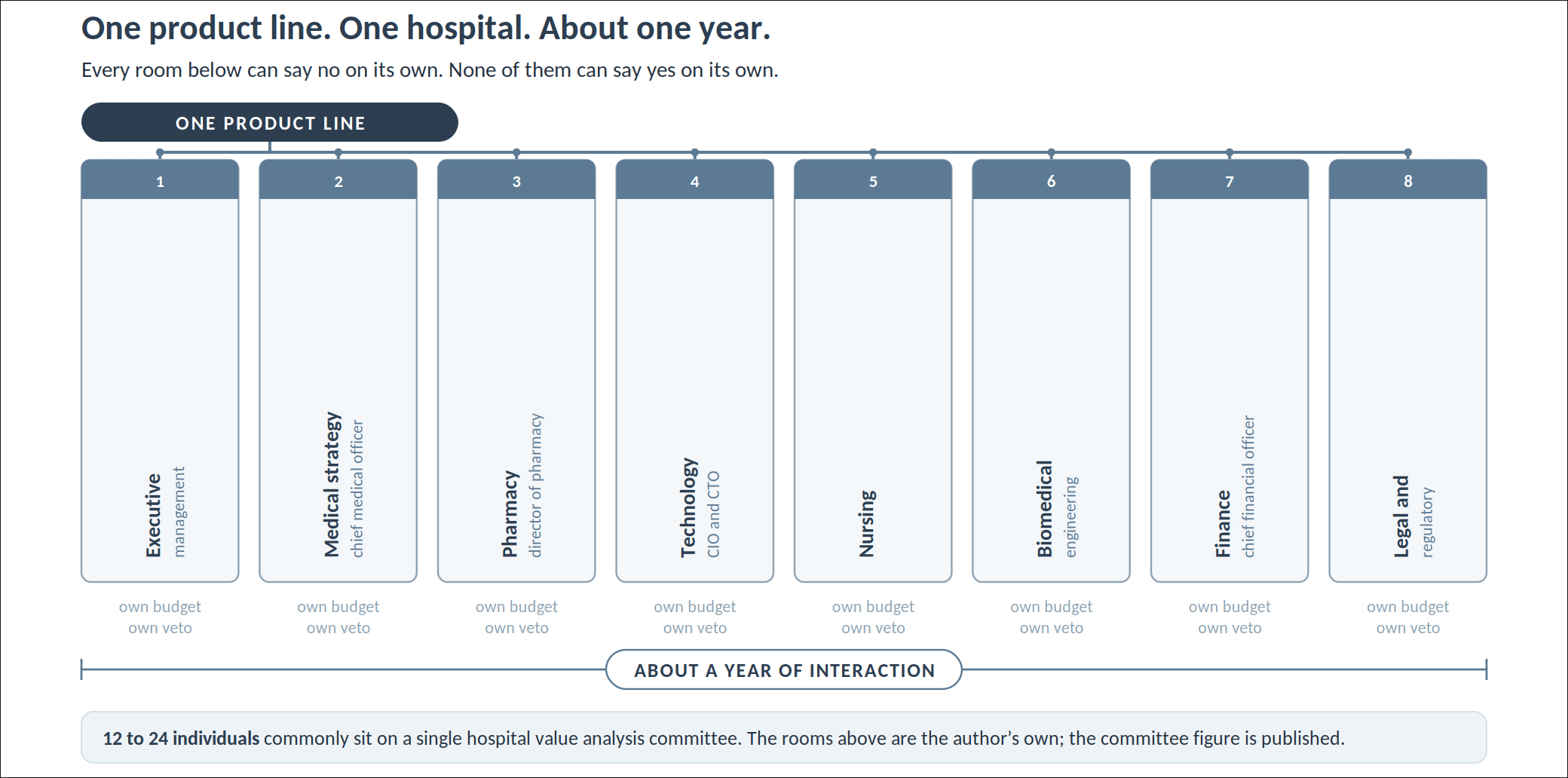
Selling one product line into one acute care hospital took me roughly a year. Not a year of negotiation. A year of interaction. In that year the rooms I had to satisfy included executive management, medical strategy under the chief medical officer, pharmacy under the director of pharmacy, technology under the CIO and the CTO, nursing, biomedical engineering, finance under the CFO, and legal and regulatory.
There were more. Every one of those departments ran its own way, with its own reason to say yes and its own reason to say no. Most were nominally aligned to an institutional strategy. The walls between them were still nearly impossible to manage, and on a bad day it was open infighting about whose priority came first.
That is my experience, so I went and checked whether it was just me. It is not. It is not uncommon for twelve to twenty four individuals to sit on a single hospital value analysis committee. Operating room managers, supply chain, clinical leaders, service line leaders, materials and purchasing, value assessment analysts, department chairs, nursing, finance, administration, and value analysis coordinators.
Twenty four people. One product. And every one of those twenty four has a legitimate job, a real budget, and a real reason to be careful.
Now hold that number in your head and consider what we are about to ask of them. Not a new pump. A reasoning layer that reads across every one of those departments at once and hands somebody a recommendation. There is no single department that owns that. There is no committee shaped like that. The thing we are building does not fit the organizational chart, and the organizational chart is older and stronger than the thing.
We have done this before and it worked
In 1988 I was thirty six years old and I was in San Diego at a company called Diatek Corp. It is worth two sentences on what that actually was, because the shape of it is part of the argument.
In June of 1985 an investor group had consolidated three San Diego medical technology businesses into one entity: Diatek Inc., Neurometrics, and Diatek Medical Technology. What Diatek did, in the main, was make thermometers. We were the second largest electronic thermometer manufacturer in the country, around forty percent of the market. That is what paid the building and the payroll.
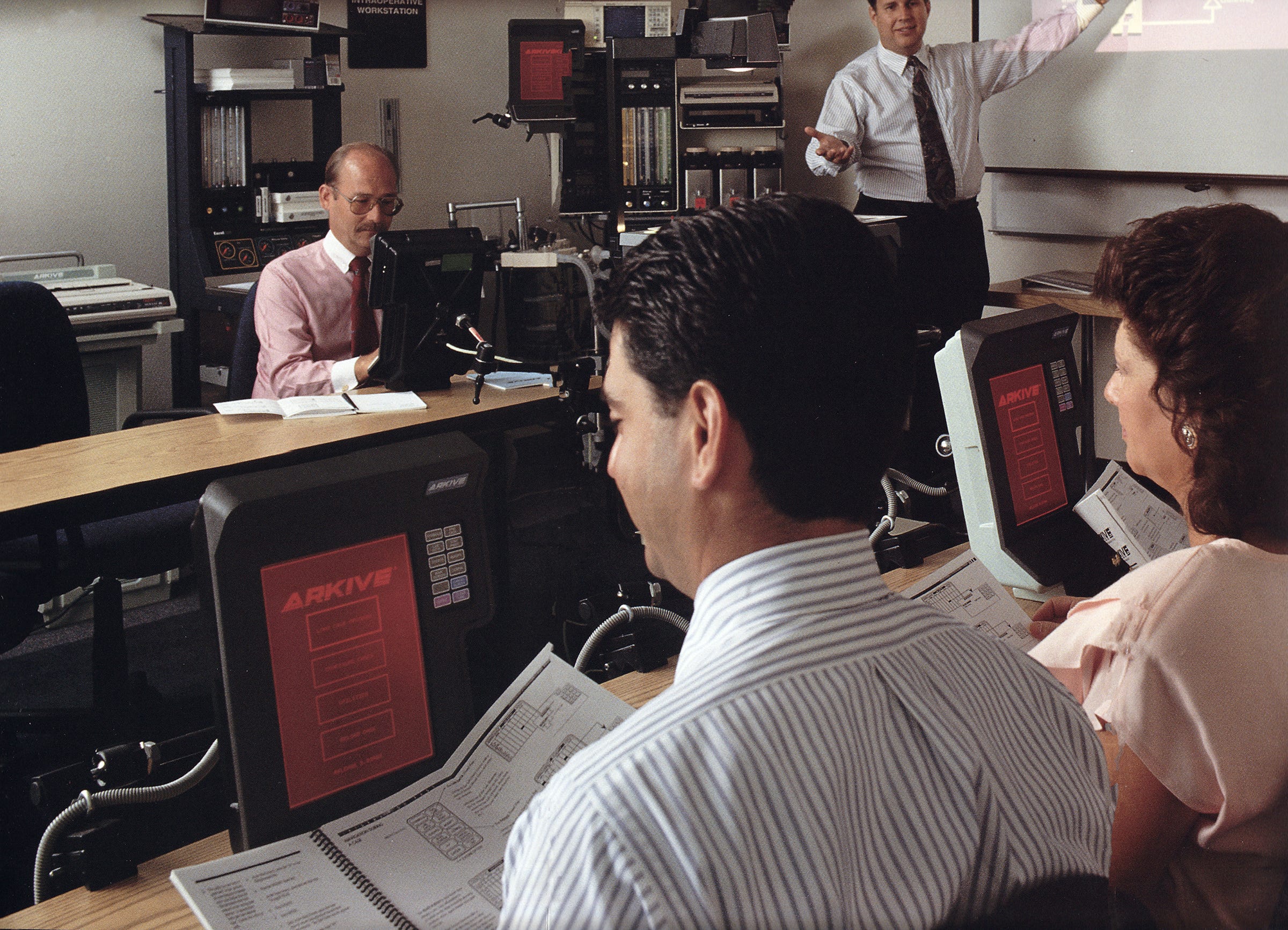
The interesting part was the other two lines. Neurometrics, where I started, built the LIFESCAN, a processed EEG monitor that read the brain during anesthesia. I had walked across a parking lot to consult for them and within a month I was running their software. Then there was ARKIVE, an anesthesia information management system, which is a long way of saying it produced the anesthesia record automatically instead of by hand. I moved onto ARKIVE and stayed with it for the next several years.
Two products that were going to change how anesthesia was practiced, financed out of the margin on a device that takes your temperature. Hold that thought, because it comes back.
In 1988 we were about to put ARKIVE in front of the most change resistant audience in any hospital, which is a room full of attending anesthesiologists. And I did the thing I am proudest of in that whole period without understanding at the time why it mattered. I went outside for help.
I hired an agency called Skillbuilders, whose owner was a man named Jeff Levin, and the two of us spent the better part of a year designing a five day course. Not a year writing screen instructions. A year working out how to take a room of senior professionals through a change in how they did their work every single day.
Most of those five days were not about the machine.
They were about how to handle change inside an organization when the change is large, and correct, and unwanted. That third word is the one people skip. Resistance is not usually a sign that you are wrong. It is very often a sign that you are right and early and have not yet given anybody a reason to carry the cost of you being right.
The same machine, two buildings, opposite endings
Before the formula, the evidence, because I do not want this read as nostalgia.
I have watched the same product go into hospitals that gave it a proper rollout and reach ninety percent of cases, and I have watched it go into hospitals that did not and be wheeled out inside two years. The machine was identical in both buildings.
That is as close to a controlled experiment as anybody gets in this business. Same software. Same screens. Same manual. Same company standing behind it. The only variable was whether the institution did the work, and the outcomes were not slightly different, they were opposite.
So when somebody tells me their pilot failed because the technology was not ready, I have one question, and it is not about the technology.
The formula, which is not complicated and is not easy
Four parts. I have watched all four of them fail when one was missing.
One. Executive leadership, first and in public.
Not a memo. Not a budget line. A named senior person who says out loud that this is happening, that it is going to be uncomfortable, and that they expect it to be uncomfortable. Everything downstream is negotiable except this. Without it, every department gets a free option to wait you out, and departments are extremely good at waiting.
Two. Train preceptors, not users.
At the end of our five days each anesthesiologist received a paper certificate. It said ARKIVE Preceptor Training Program. Preceptor, not user. We were not teaching people to operate a machine. We were teaching them to teach everybody else in their department, which is the only way a hospital has ever actually adopted anything. An outside trainer leaves on Friday. A preceptor is still there in March.
Three. Put your champions in the room.
We asked each department to send people who were already behind it. Not to flatter ourselves. Because a champion is the person who will still be arguing for you six months later in a meeting you are not invited to, and champions are made in the first week or they are not made at all.
Four. Put your skeptics in the room too, and mean it.
This is the part that gets cut, every time, by people who think they are running a rollout when they are actually running a marketing campaign. We asked for one or two genuine skeptics in every course.
Not to convert them. To find out what they knew.
A skeptic in a hospital is usually skeptical for a reason, and the reason is usually a specific thing that went wrong to a specific patient on a specific shift. That is intelligence you cannot buy and will not otherwise receive, because nobody volunteers it to a vendor. The skeptics were not fools. A department head protecting a committed release from a director with a big idea and no authority over him is doing his job correctly. If you cannot hear that without getting defensive, you are not ready to change anybody’s culture.
Pagers in the basket
One detail, because it is the one that tells you what the course actually was.
In the late eighties an anesthesiologist wore a pager the way everybody now carries a phone. It was exactly the same distraction and nobody had a word for it yet. So I put a large basket by the door of the training room and asked for pagers in the basket, every morning, five days running.
You can imagine how that landed. Who is this equipment man telling a room full of attending physicians that they cannot have their pagers.
It was awkward every single time and I did it anyway, because you cannot teach somebody a machine while a device in their pocket is asking them to be somewhere else.
That is an argument about attention and interruption that I would not be able to make properly for another thirty years. In 1988 it was a plastic basket by a door, and I thought I was solving a nuisance.
How I know it worked
Years later I was at Duke, in the office of Tom Stanley, the anesthesiologist who made that product possible. Along the wall were the framed things a man like that accumulates. Medical school. Residency. Board certification.
And there, in a frame, under glass, with the rest of them, was the ARKIVE Preceptor certificate.
A physician at one of the great American teaching hospitals had framed a certificate from a thermometer company. Not because the paper was worth anything. Because the five days were.
I have thought about that wall more than almost anything else I have written this year.
And then, this week, from the largest company in this business
I wrote most of this before Epic’s user meeting. Then Judy Faulkner gave her executive address, and a good part of it was about the thing I have been describing.
Not the AI. The adoption.
Epic announced a service called Guides, which gives an organization personalized one to one help turning on a single feature. A program called Level Up, roughly twenty ways Epic can help a customer switch something on that they already own. And Epic Rangers, which embeds Epic-hired, Epic-trained staff directly and long term inside a customer’s own IT department.
Read those three together and see what they are conceding. The most successful company in the history of health information technology, at its own conference, in front of its own customers, spent part of its keynote on the fact that people are not using what they already bought. And its answer is not another feature. Its answer is to put human beings in the building for a long time.
That is the 1988 course, at corporate scale, thirty eight years later.
Preceptors then, Rangers now. I take no satisfaction in that. I take it as confirmation from the one organization with both the data and the money to know better.
One difference, and it is the one that still worries me. Rangers embed in information technology. Guides help implement a feature. Both of those work inside one vendor’s footprint. The wall I described earlier does not run between a hospital and its software vendor. It runs between pharmacy and nursing and biomedical engineering and finance and legal, and no vendor can staff its way through that. Only the institution can.
Where it all came from, and where it has to go
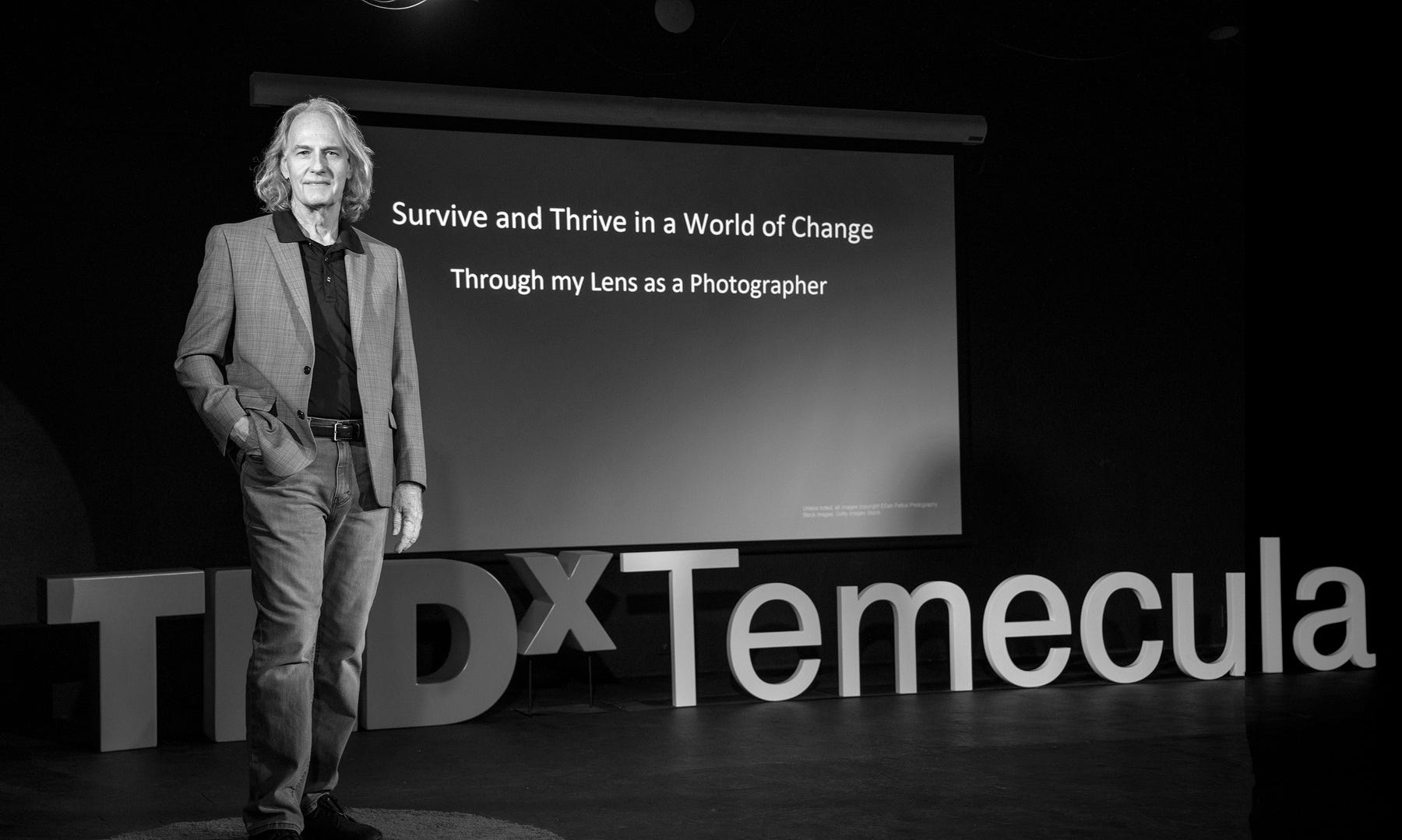
In 2020 I stood on a TEDx stage under a theme called Against the Grain and argued that unwanted change can be the best thing that ever happens to you. TED published it as “Change and disruption can be terrifying, or an entry-point.”
I was talking about photography, because that is the industry that took my hobby apart in front of me and because a room full of people who have never seen an infusion pump have all held a camera. But every word of that talk came out of that room in San Diego with Jeff Levin and a flip chart. I used that one transferable skill for the next four decades and never once named where it came from.
Four things came out of it, and they have held up.
Do not waste time on blame. The move from film to digital was nobody’s fault. Nobody at Kodak woke up wanting to end a hundred and thirty years of history. The world moved faster than a large organization could decide, which is a structural fact and not a moral one. I have now written that same sentence about four failed companies.
Do not be encumbered by the past. Holding on to the old method as a point of pride does not slow the change. It only removes you from it.
It will not be free and it will not be easy. New skills, new equipment, real work on top of whatever you were already doing. Riding a wave is not a passive activity.
Follow the thing you care about, stay in it, and expect delays. Change arrives, stalls, and surges again. Most people leave during the stall.
Take that talk, cross out photography, write artificial intelligence in its place, and every sentence underneath still stands. The enablers are the same. The blockers are certainly the same. Only the people who get to feel superior about it change.
So here is what I actually think, and it is the reason I am writing this issue instead of another one about a number.
Artificial intelligence is about to arrive in hospitals with a value proposition that is, for the first time in my career, genuinely strong. Not a faster way to write things down. A layer that reads the whole picture and reasons about it, in the time a person actually has. I have built a working demonstration of it and I still think that is the real news of this decade.
And it will fail exactly the way ARKIVE failed, and the LIFESCAN failed, and every good thing I ever carried into a hospital failed, unless somebody does the unglamorous part.
The unglamorous part is a five day course, at house scale, with a named executive standing behind it, preceptors instead of users, your champions in the room, and your skeptics in the room being taken seriously.
We knew how to do this in 1988. One anesthesia department at a time, one flip chart, one basket of pagers by the door.
What we did not have was time. Culture change takes patience, and patience is money, and we had a thermometer company’s patience and about thirty months of runway. That is the thought I asked you to hold. With time, we would have made it. What killed ARKIVE was not the screen in the dark or the fee we paid on every unit. It was that we ran out of the one thing a culture change actually requires, and nobody in that industry has ever been given enough of it.
So it is not a new problem and it does not need a new answer. It needs the old answer, run at a scale nobody has been willing to pay for, because the training line is the first thing cut from every implementation budget I have ever seen.
Buy the technology. Fine. It works.
Then spend the same money again on the culture it has to live in, or watch it sit there, correct and unused, the way I have watched four of them sit there.
The technology was never the problem. It still is not.
References
[1] Inside the Loop, Issue 09, “The Six Gates.” The six are restated here in brief; the full case for each is in that issue and in Chapter 13 of the book.
[2] “Inside the Hospital Value Analysis Committee.” Medical Product Outsourcing, March 2023. Verbatim: it is not uncommon for 12 to 24 individuals to sit on a single committee. Typical composition includes operating room managers, supply chain, clinical leaders, service line leaders, materials and purchasing, value assessment analysts, department chairs, nursing, finance, administration, and value analysis coordinators.
[3] The list of departments, and the figure of about a year of interaction per product line, are the author’s own firsthand account. A twelve to eighteen month healthcare technology sales cycle in front of a buying committee of roughly eight to twelve stakeholders is consistently reported across healthcare business-to-business sources, but those sources are agencies and consultancies whose business is selling to healthcare vendors. Treat it as a consistent report rather than an audited statistic.
[4] Skillbuilders, and its owner Jeff Levin, engaged in 1988 to design the ARKIVE Preceptor training curriculum. This account is the author’s own and no corporate record of the engagement survives.
[5] In June 1985 an investor group consolidated three San Diego medical technology businesses, Diatek Inc., Neurometrics, and Diatek Medical Technology, which had been Dade Medical, into one entity called Diatek Corp. Phil Faris was chief executive; about a hundred and eighty people in a sixty nine thousand square foot plant in Sorrento Valley. Diatek was the second largest manufacturer of electronic thermometers in the United States, behind IVAC. Neurometrics built the LIFESCAN processed EEG monitor. Diatek ceased business operations in 1995.
[6] The author’s own titles in this period are documented in STA Interface, Volume 5 Number 1, January 1994, Society for Technology in Anesthesia: “Mr. Pettus is currently the Director of Customer Education and Professional Services at Arkive Information Systems and has participated in the growth of that company since its inception.”
[7] The comparison of two hospitals receiving the identical product with and without a proper rollout, one reaching ninety percent of cases and one removing it inside two years, is the author’s firsthand account across multiple installations. It is not drawn from a published study.
[8] Coleman RL, Stanley T III, Gilbert WC, Sanderson IC, Moyer GA, Sibert KS, Reves JG. “The implementation and acceptance of an intra-operative anesthesia information management system.” Journal of Clinical Monitoring 1997;13:121-128. Thomas E. Stanley III was an anesthesiologist at Duke University Medical Center and the clinical champion of the ARKIVE program.
[9] Pettus D. TEDxTemecula, 2020, event theme Against the Grain. Published by TED as “Change and disruption can be terrifying, or an entry-point.” The speaker’s own title slide read “Survive and Thrive in a World of Change, Through my Lens as a Photographer.” The four things are given here in the same form and the same words as Chapter 12 of the book, so that the article and the book do not disagree.
[10] The four part structure set out here, executive sponsorship, preceptors, champions and invited skeptics, is the author’s reconstruction of the 1988 curriculum from memory. The five day length, the preceptor certificate and the balance of the course toward change management rather than operation are firsthand and are documented in the book. The deliberate inclusion of skeptics is recollection only.
[11] Images. The 1989 training room photograph is Diatek material with no known successor. The 2020 TEDx photograph is the author’s own. The silo figure is original to this issue.
[12] Faulkner J. Executive address, Epic Users Group Meeting 47, Verona, Wisconsin, 18 August 2026. Guides, Level Up, Epic Rangers and Agent Factory are as reported by Becker’s Hospital Review, Naomi Diaz, and corroborated in part by Fierce Healthcare, which adds that Agent Factory becomes widely available in 2027. Both are secondary accounts of a live speech and they do not agree on every figure. The characterization of what those three services concede is the author’s own.
Daniel Pettus spent forty years in medical device and health IT leadership at Alaris, CareFusion and Becton Dickinson. He contributed to IHE Patient Care Device interoperability standards and is named on two US patents. He is the inventor of AI MedAgent and the founder of Inside the Loop. His book, The Technology Was Never the Problem, is out on 15 September.
insidetheloopdp.substack.com