

Update, 28 August 2026
A correction to the infusion event section below, found while researching the follow-up.
I wrote that rate change, secondary-to-primary switchover and transition to keep-vein-open are three states that “IHE’s own infusion event profile does not carry, and that a reader currently has to infer from periodic observations.” I finished with “nobody has ever asked it to say so.”
The first half is half right. The last sentence is wrong.
IPEC has no dedicated event type for any of the three, and that much holds. It does not need one. The supplement specifies each transition as an ordered pair of the three required delivery events, with the clinical meaning carried in the pump status and mode attributes. A rate change is a stop followed by a start. A transition to keep-vein-open is a completion followed by a start in KVO status. A secondary finishing and the primary resuming is a completion in piggyback mode followed by a start in nominal mode. It is in Table X.1.2.1-3 of the IPEC supplement, revision 1.4, published in 2014. No inference from periodic observations is required.
And somebody did ask. BD and Baxter both publish IHE integration statements claiming IPEC conformance. I spent part of my career at the first of those, on the system that did it, and I should have remembered that before writing the sentence.
What survives is sharper than what I wrote. Delivery Stop does not mean the infusion stopped. It fires on a rate change, a secondary start, a bolus, a VTBI change and a delayed start. A receiver that reads it as an ending is wrong more often than it is right, and it is wrong silently. The meaning is in the attributes, and knowing which attribute to read takes a mapping table that does not travel with the message.
INSIDE THE LOOP · ISSUE 13
This one is free. No paywall, no email required, nothing behind it. Read on.
Two numbers
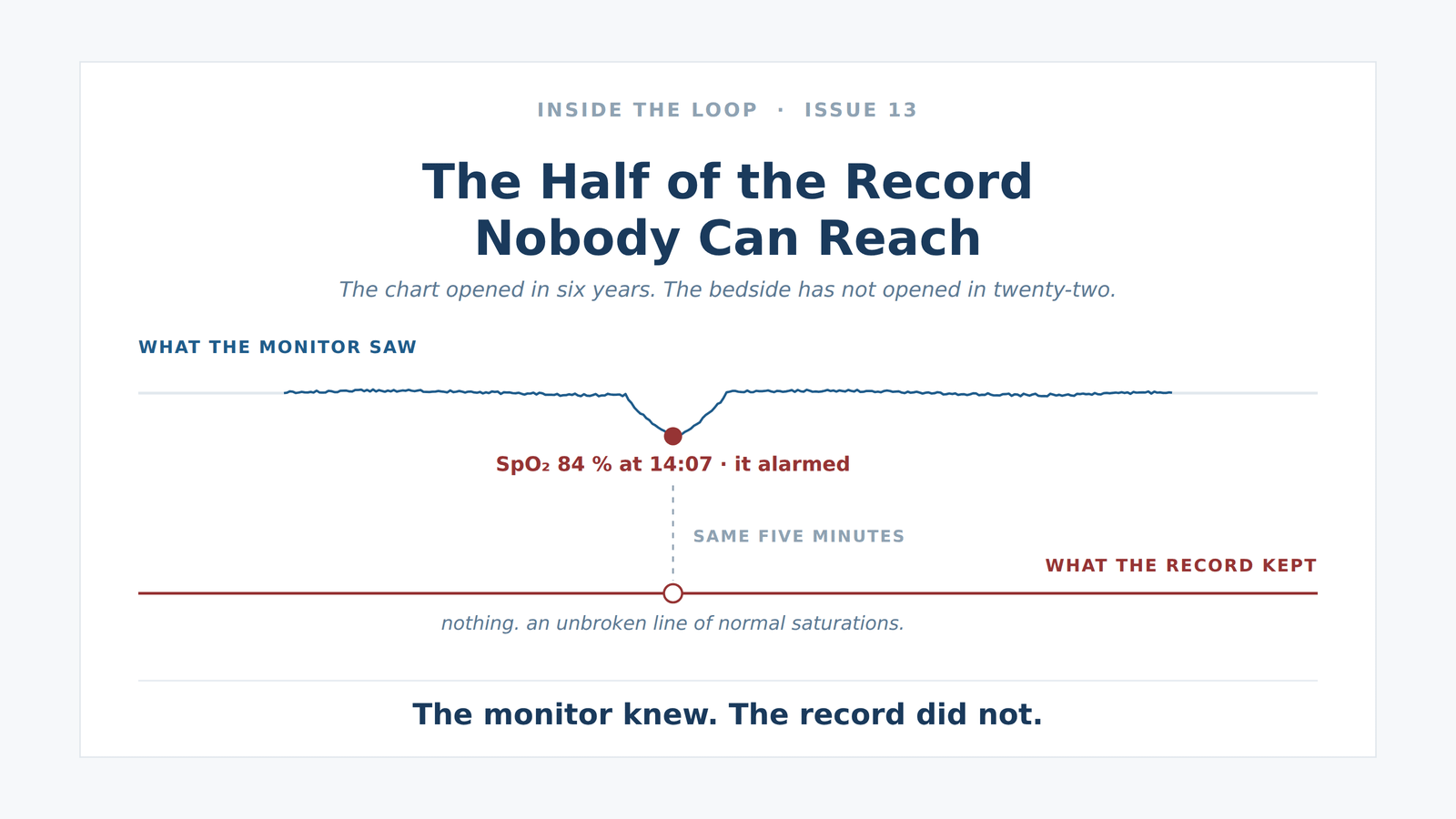
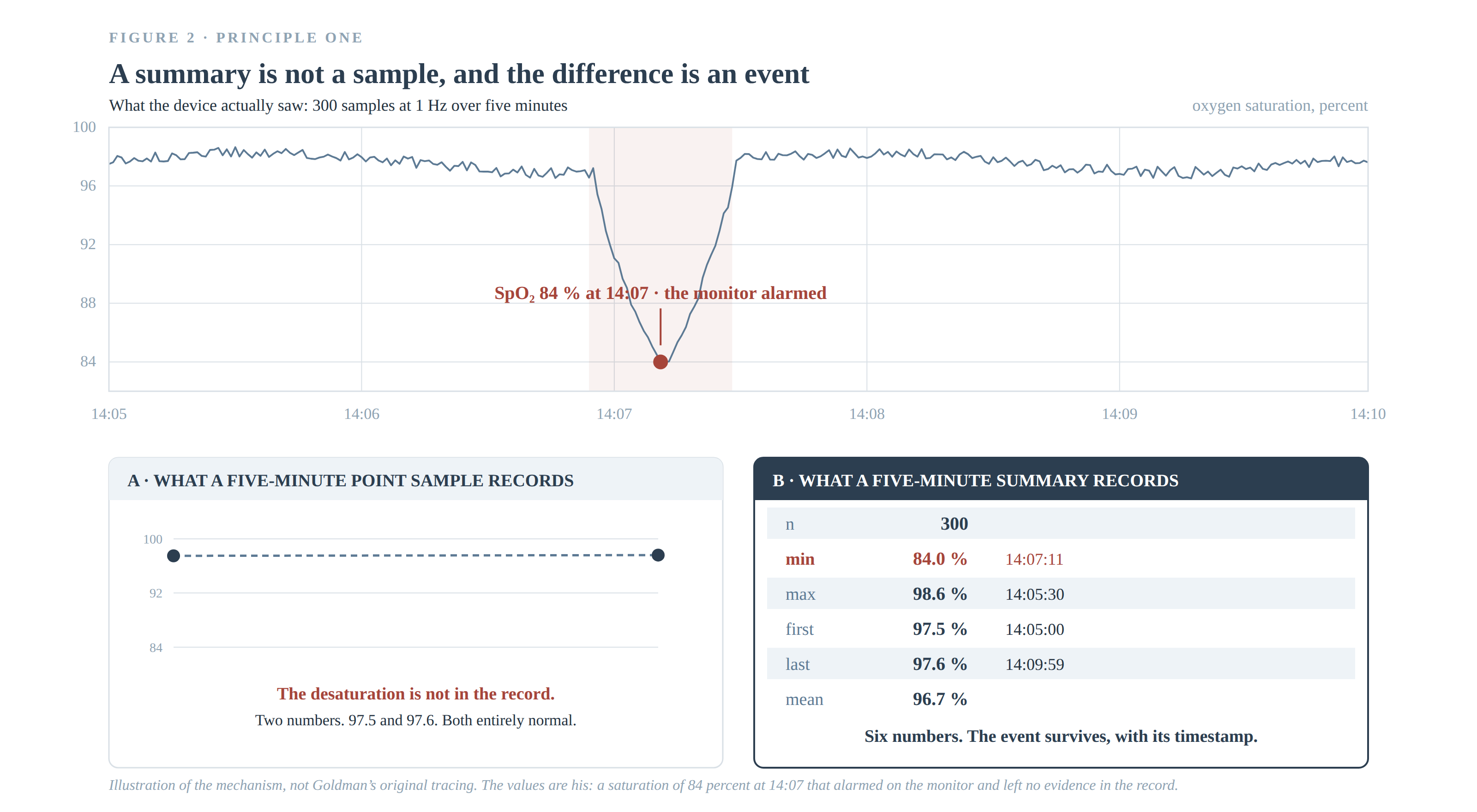
At 14:07 a patient monitor showed an oxygen saturation of 84 percent. It alarmed. A clinician was standing there.
The anesthesia record for that same five minutes shows an unbroken line of normal saturation.
That is not my case. It is a slide Julian Goldman put in front of an audience in 2016, and his caption on it is two words: sampling error. The monitor knew. The record did not. Nothing was broken and nothing warned anybody, because the record was built to store a reading every so often and the event happened in between.
I have been carrying that slide around for a while. This month I finally went and found out why, twenty-two years after this problem was named, nothing has fixed it.
The part that worked
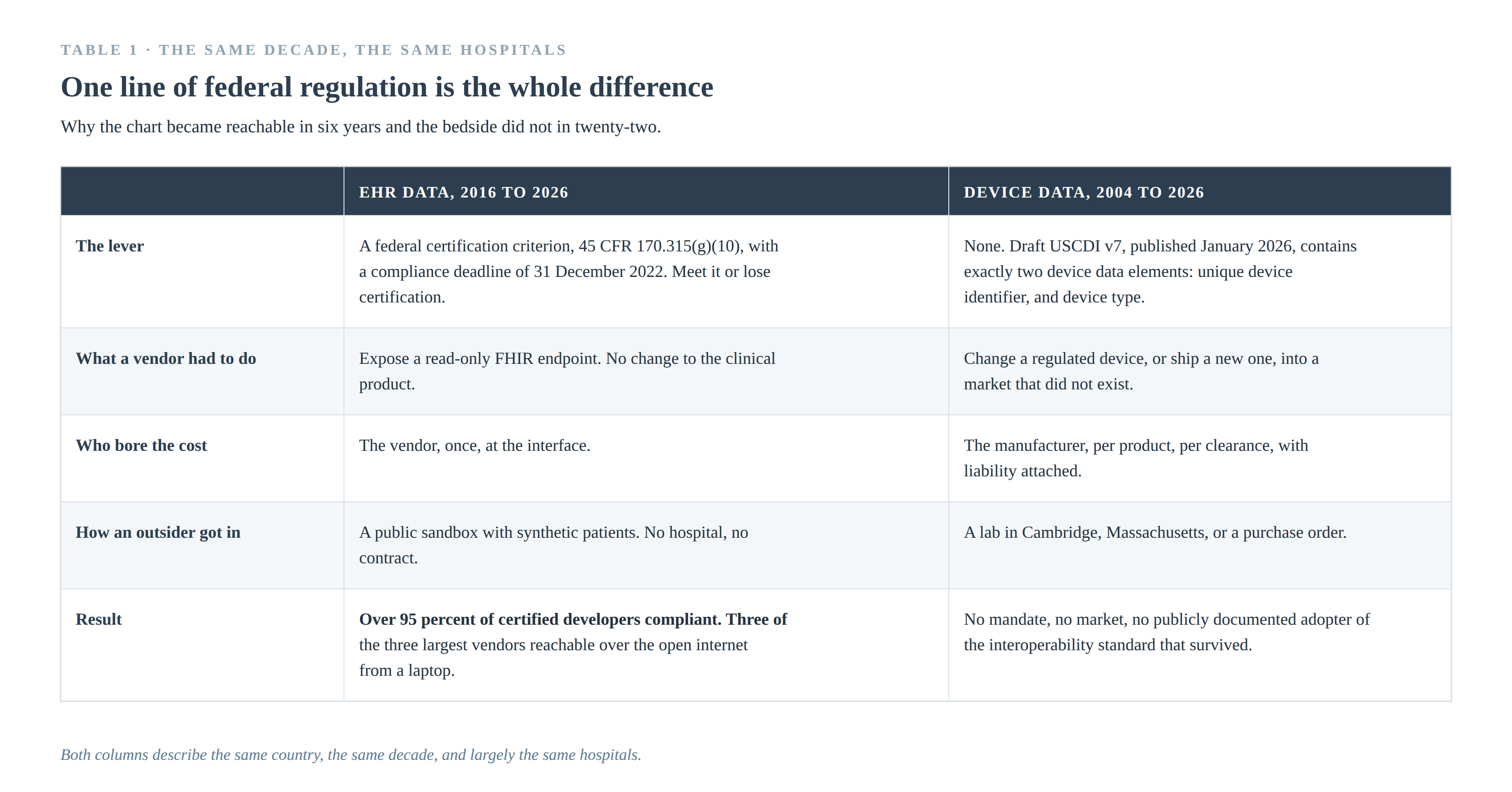
This summer I connected a reasoning demonstration to live records at Epic, Oracle Health and MEDITECH. Epic and Oracle took a laptop and an afternoon. MEDITECH took a form, a welcome packet, a license agreement and a wait. None of the three took money, and none of them required a hospital, a contract, or knowing anybody.
That is remarkable and almost nobody says so. Fifteen years ago the idea that an unaffiliated retired person could read a structured patient record from the three largest electronic health record companies in the country, from a kitchen table, would have been absurd. It happened because of one line of federal regulation, 45 CFR 170.315(g)(10), with a compliance deadline of 31 December 2022. Meet it or lose certification. Over 95 percent of certified developers complied.
The part that did not
Now try the other half. There is no endpoint, anywhere, at any price, that will tell a piece of software what an infusion pump has been doing for the last five minutes in a form it can reason over. Not a hard endpoint. Not an expensive one. Not a slow one. There is no endpoint.
My demonstration can read that a physician ordered vancomycin. It cannot read whether the pump delivered it, paused, ran at keep-vein-open for forty minutes, or was switched to a secondary line. It can see what was intended. It cannot see what occurred.
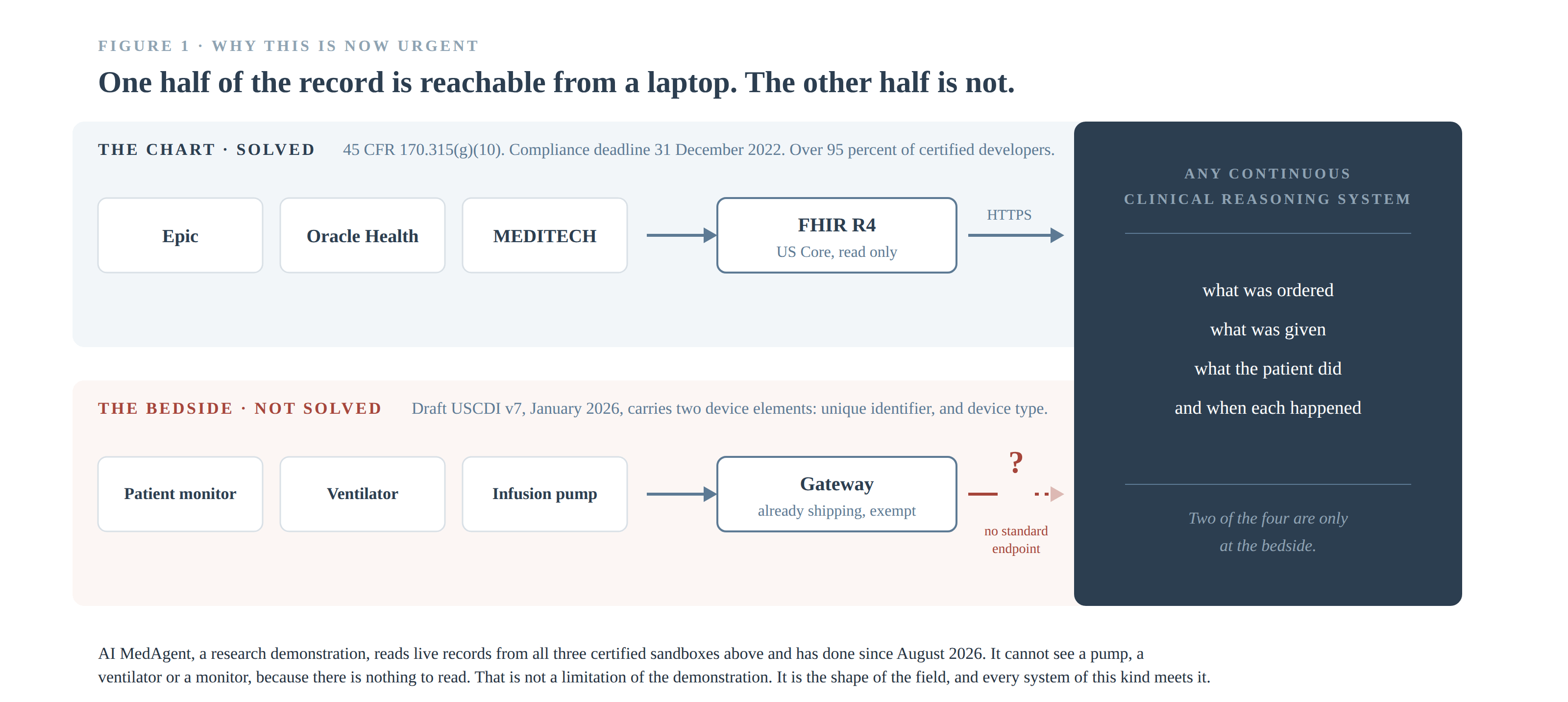
Any continuous reasoning system needs four things: what was ordered, what was given, what the patient did in response, and when each happened. The first two are in the chart. The second two are only at the bedside.
This is not a complaint about my own project. Every serious continuous-reasoning system now being built for critical care arrives at the same wall, and most of them are being built by people with far more money than me.
Why it never got fixed, in one table
The tempting answer is that the economic case was never made. It was, and finding the paper that made it was the most useful hour of the month.
In March 2013 the West Health Institute in La Jolla published a study putting the annual addressable waste from the lack of medical device interoperability at 36 billion dollars. On the day it came out, their chief medical officer testified to the House Energy and Commerce Subcommittee on Health and the paper went into the record. FDA still links to it today, calling it the business case for medical device interoperability.
It failed anyway. The reason is in the same paper, in a figure almost nobody quotes.
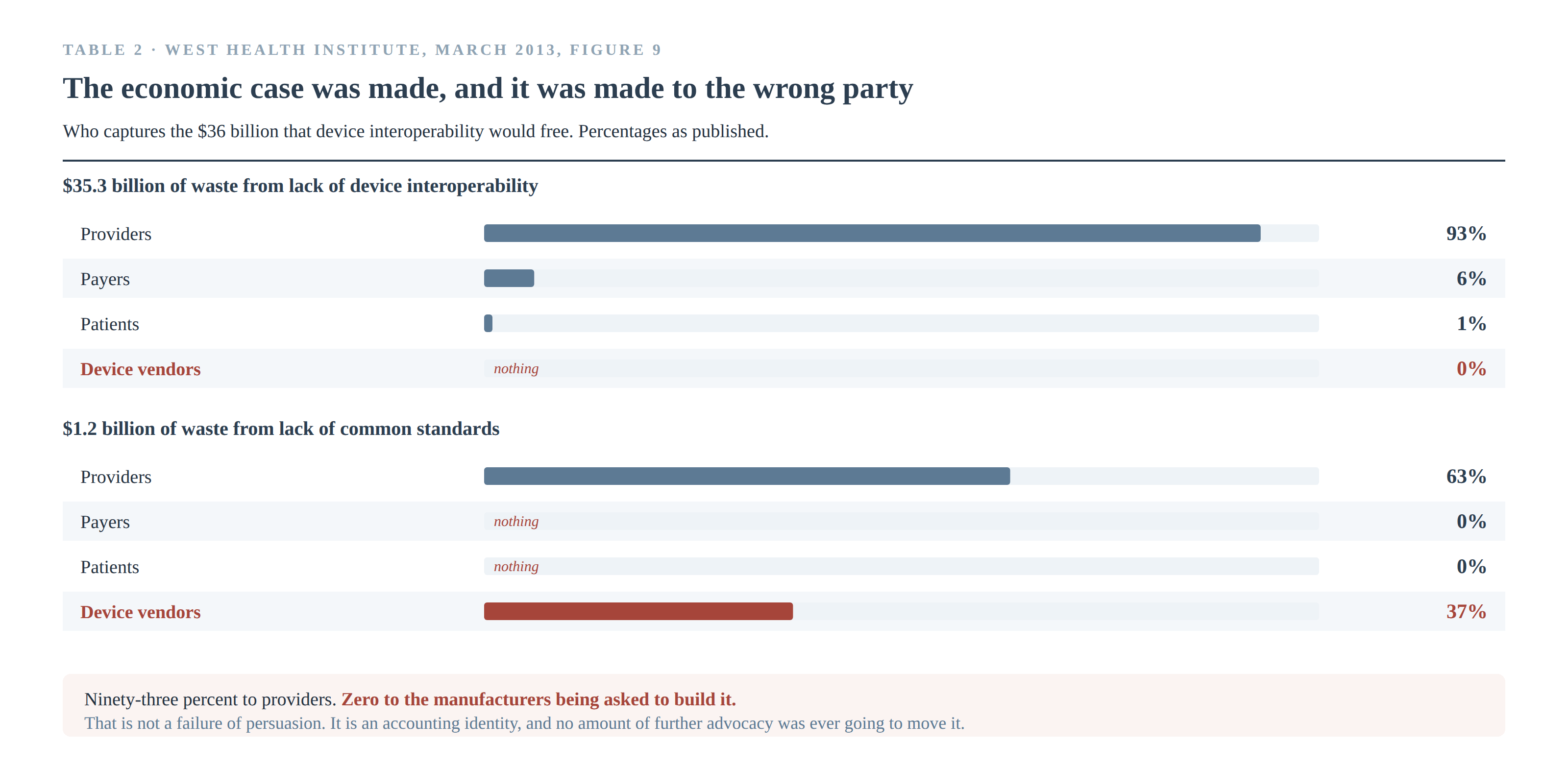
Ninety-three percent of the benefit accrues to providers. Zero percent accrues to the device manufacturers who were being asked to build it. That is not a failure of persuasion. It is an accounting identity, and no amount of further advocacy was ever going to move it.
West Health left the field in 2015. Their site today is about aging and healthcare affordability, and device interoperability appears nowhere in its nine initiatives. The 2013 paper is still on their server. Every internal link to it is gone.
What I am proposing, and the one correction that makes it work
A five-minute summary from the gateway that manufacturers already ship. Not a stream, which nobody wants to carry. Not a sample, which brings me back to Goldman’s slide.
A five-minute point sample reproduces his failure exactly. It misses every event shorter than the interval, which is most of the events worth reasoning about. A five-minute summary does not. Per metric: the count of samples the device actually took, the minimum and the timestamp of the minimum, the maximum and its timestamp, the first value, the last value, and the mean. Seven or eight numbers where a one-hertz stream would have produced three hundred.
Under that scheme Goldman’s missing de-saturation is not missing. It is a minimum of 84 with a timestamp of 14:07 inside an otherwise unremarkable epoch, and any engine reading the record can see both the excursion and the fact that the patient recovered. Roughly a forty-fold reduction in volume that increases rather than decreases what a reader can conclude.
And one thing nobody currently carries: a context block. What else did the device know about itself during that interval? Sensor attached or detached. Cuff cycling on the same limb. Service or calibration mode. Channel switched from primary to secondary. Transition to keep-vein-open.
Look hard at those last two. Rate change, secondary-to-primary switchover and transition to keep-vein-open are precisely the three infusion states that IHE’s own infusion event profile does not carry, and that a reader currently has to infer from periodic observations. The pump knows all three. Nobody has ever asked it to say so.
Then it stops asking
Everything above still asks a manufacturer to build something. Twenty-two years of history says any ask of a manufacturer, however small, does not get answered.
So turn it around. I build the receiver. A public endpoint, the schema published beside it, an API key by email, and a standing invitation to every pump, ventilator and monitor manufacturer to point a simulator at it. Not a product. Not a hospital. Not a patient. The output of the test rig already sitting on their integration bench.
The ask collapses from “implement a profile and ship it” to “POST a JSON body to a URL with one header.” An engineer can try it on a Friday afternoon without telling anybody, and that clause is not a joke. Every path this field has offered for twenty-two years required a public commitment: join a consortium, sign the procurement language, register a system for a Connectathon, ballot a profile. A test endpoint requires none.
What it costs is the part that should embarrass all of us. Twenty participants sending one bundle every five minutes is about five dollars a month. Registering one system for the IHE North America Connectathon last published at 8,500 Canadian dollars, plus 2,000 per participant per week, in person, once a year. A year of the endpoint costs less than two minutes of that. The reason this was never built is not cost, and has not been for at least a decade.
Three things that did not survive checking
Nobody works at the front of a field without this happening, and a field where it never happens to anybody is a field where nothing is being attempted. All three are in the memorandum with the evidence attached.
The premise I started from was that Goldman had given up and the program was dead. He has not and it is not. He won the 2026 J.S. Gravenstein Award, and in February 2025 he was named principal investigator on an ARPA-H award of up to 20.8 million dollars. The confusion is real and it is the program’s own fault: there are two websites and the abandoned one ranks first.
A five-minute interval looked like it might sit outside FDA’s definition of a device function. It does not. FDA reissued its clinical decision support guidance on 29 January 2026 and the language now reads “continuous, near-continuous, or otherwise streaming measurement.” One of its own worked examples is hourly pulse oximetry read out of an EHR, and FDA calls that a device function. The epoch does not escape it, and the memorandum says so.
A lapsed domain belonging to one of the dead organizations was reported here as pointing at an offshore gambling site. It points at a village hall in Oxfordshire. Fixed, and dated in the text, because it will move again.
The part I would like you to argue with
The memorandum is twenty pages, thirty-seven sources, and every claim in it was checked directly this month rather than taken from the literature. It is free, there is no paywall on it either, and it is at aimedagent.net/epoch .
One claim in it I would especially like tested. I searched 135,000 lines of OpenICE, the field’s reference open-source interoperability platform, for any code that computes a summary over a window of time. There is none. Not deprecated, not half-built. Absent. If prior art exists for an interval-summary device interface and my search missed it, now is the useful time to say so, before I put it in front of a standards body.
Corrections get published with the name of whoever caught it. That is how the Epic finding in my last issue got fixed, and the person who caught that one asked exactly one good question.
Daniel Pettus spent forty years in medical device and health IT leadership at Alaris, CareFusion and BD, contributed to IHE Patient Care Device interoperability standards, and is named on two United States patents. He is the author of The Technology Was Never the Problem, at pettusbook.com, which is about this subject and how forty years of it actually went. AI MedAgent is a research demonstration. Advisory only. Not a medical device. Not for clinical use.