

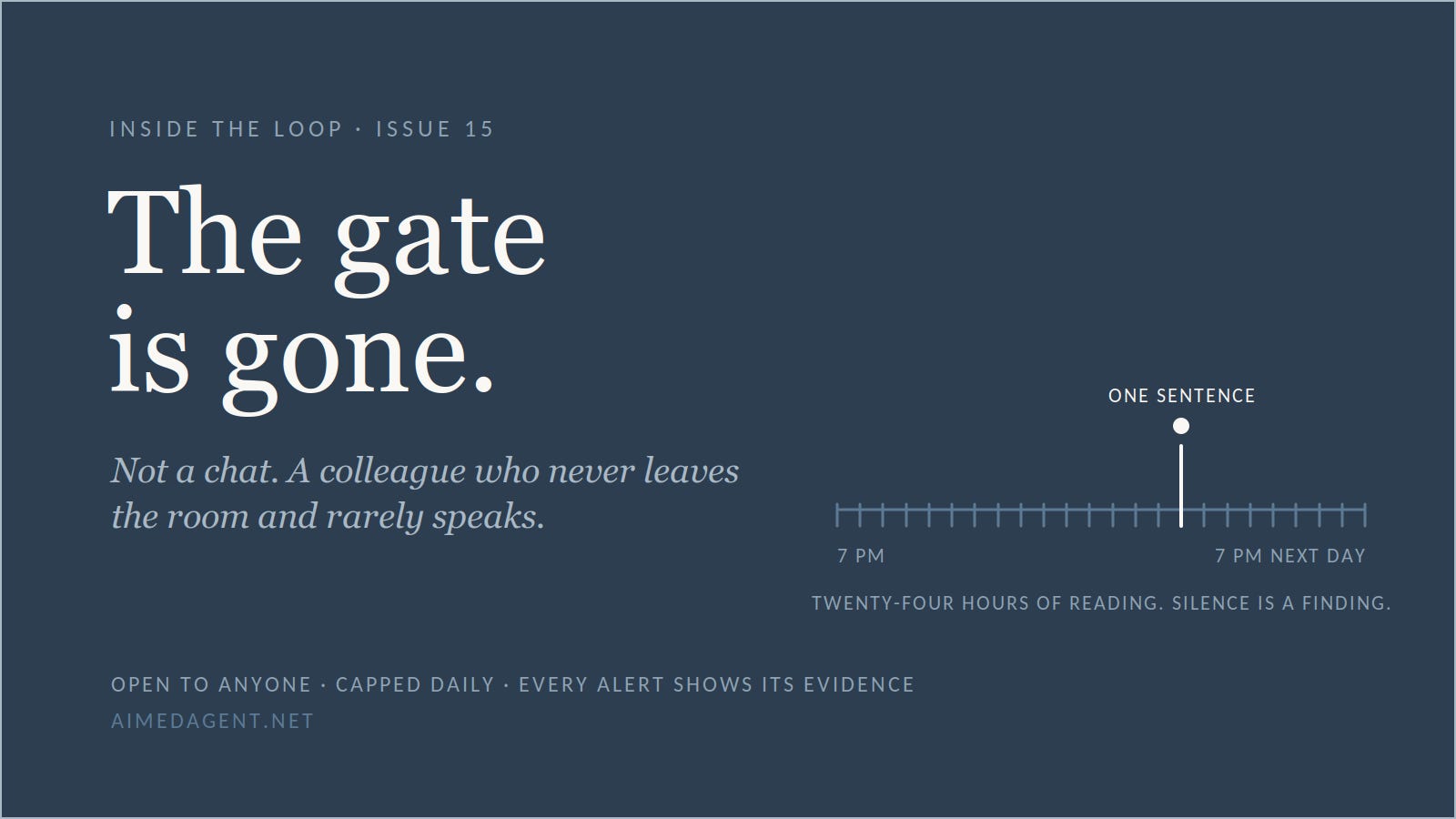
INSIDE THE LOOP · ISSUE 15
As of this week anybody can run AI MedAgent. No access code, no form, no email to me. There is one catch, and it belongs at the top: every live run costs me money, real money, paid to a cloud AI company out of a retired engineer’s pocket. So instead of a gate there is now a daily allowance, 150 runs a day and six to a visitor, and when it is used the page says so in plain words and labels anything it shows after that as a note written in advance, not generated live.
The last part matters. The one time a screen of mine pretended, it pretended to me. The first version of this demonstration displayed traffic to the public data sources that was not happening, and said in text that it was live. I believed it for three days. I pulled it, rebuilt it, and wrote a chapter about it.[1] Nothing on the site pretends any more. Every alert now shows the federal data it read, with the date of the data and the exact web address that produced it, so you can open a second tab and check me. That is why the gate had to go.
The hypothesis, in one paragraph
A large language model, reasoning continuously over a patient’s live data and the free federal reference layer, can see a trajectory before any threshold is crossed and say so, once, in time to change the therapy. It can hold the whole picture, the numbers and the sentences and the timing, and ask the question nobody wrote down in advance: is what we are doing for this person still the right thing to be doing? And it can do that at a marginal cost close to nothing, because the knowledge is public and the reasoning is a commodity. That is the claim. It is testable rather than proven, and the site exists so that people can test it.
Where it came from
Not from a lab. From the book, and from the forty years underneath it. My industry spent those years getting very good at two things: acquiring data from machines and making one system’s words mean the same as another’s. We called those two things the whole job. In 1989 I sat in a hospital cafeteria and watched a resident get his Saturdays back from a ten-second query against data that had been sitting unread for years. In 2001 a woman typed my feet hurt today into a system I helped build and it sat in a text field, in her own words, for years, because nothing in the building could be curious about it. The machine that could read it did not exist at any price.
Then it did, and it came from outside medicine. So I went to work the only way a retired man can: at a desk at home, with a cloud model, a credit card, and the public data marts the taxpayer built and gives away. RxNorm for what a drug is. openFDA for what has gone wrong with it across the population. DailyMed for the approved label. ClinicalTrials.gov for what is being studied.[2] All free, all machine readable, all ignored by an industry whose picture of clinical knowledge is shaped by the products that have salespeople.
Why this is not the AI you have been reading about
Three kinds of medical AI have earned their headlines this year. All three are valuable and I hope all three keep going. The first reads the chart and writes the summary, so the physician does not spend the evening typing. The second is the chat in the office or on your phone, which answers the question you asked. The third reads the image and finds the cells a tired eye would miss. Good, good, and good.
They share a shape. Each one is asked. Each one answers about something that has already happened, or a question already formed. Each one answers once. Every one of them is a superb version of the thing my industry has always built: a machine that responds when a human turns to it.
AI MedAgent is the other shape. Nobody asks it anything. It reads the stream continuously, every few minutes, all night, at the same level of attention on the two hundredth pass as on the first. It is not looking at what happened; it is looking at what is happening and where it is heading. It reasons against the largest clinical reference library in the world, which is public. It projects: at this trajectory, on these drugs, with this kidney function, is the therapy still right, and if not, what is the smallest change worth making now. And it is judged on its silence as much as its speech. A threshold alarm has no basis for silence; it only has a basis for noise. A system that holds the whole picture can look at a patient at three in the morning and conclude that everything is consistent, and say nothing, and that silence is a finding.
Not a chat. A colleague who never leaves the room and rarely speaks.
How it grew
It started with a synthetic patient and real reasoning. The patient was invented and labeled as such on every screen; the reasoning was generated live over the values on the screen and the federal sources. That proved the method was doable and credible, which was the scope I had set myself, and it proved nothing about a real hospital.
So the next step was the chart. This summer, from a laptop, with no hospital relationship, I connected to the developer sandboxes of Epic, Oracle Health and MEDITECH over FHIR, the standard interface federal certification requires every certified vendor to expose.[3] Those are vendor test records, not real patients, and I say so wherever the results appear. What came back was an education. Getting in was three completely different jobs, one under an hour, one a day, one waiting on a human being to answer an email. One vendor lists in writing which resources a key opens and then does not open two of them, and the refusal arrives with nothing attached. And the data itself: a pulse of 1, a temperature of 47.5 degrees Celsius, a patient who lost 37.6 kilograms in a single second, every one of them stored and served back without complaint. That is why the engine now reports, on every single call, how many of the eight standard medication checks it was actually able to perform. On one certified record the answer was two.[4]
The chart, it turned out, is only half of the patient. It says who this is and what was ordered. It cannot say what the infusion pump did between the moments somebody looked, or that a channel went to keep-vein-open, or what the ventilator was set to at 2:14. No open requirement covers that data; the device standards exist and are thinly adopted, and after two decades of asking manufacturers to change regulated products nothing is coming. So rather than wait, I built the receiving end. There is now a public inbound endpoint that accepts infusion pump and ventilator data, either as the HL7 messages a device gateway already emits or as a five-minute summary in plain JSON, mints its own key with nothing but an organization name, and returns a conformance report on what it received. The specification is open, free and unencumbered, and if it takes a team more than an afternoon to implement, I have written it wrong.[5]
And so that the reasoning can land where a decision is made rather than on a page of mine, the engine also answers as a CDS Hooks service, the published mechanism by which an electronic record calls out to an outside service at the moment an order is selected. Anyone can verify that endpoint from a browser without asking permission.[6]
Why the gate went
The access code was never about protecting anything. It was about the meter. A demonstration that queries a cloud model on every alert costs a few cents an encounter, which is nothing until a link leaks and the nothing starts to multiply. So I put a code on the door and a form behind it, and then I watched what a form does to a reader who arrived from a link with thirty seconds of curiosity. It ends the visit. I had built a gate to save pennies and it was costing me the only thing the site is for, which is a stranger seeing the method run.
So the gate is gone and the meter is capped instead, twice: a hard spend limit at the cloud provider that no traffic can exceed, and the daily allowance on the site that tells you when it is reached. When the allowance is used, you will see a red notice, and every note after it will carry the words validated note, not live. I would rather you see less and know exactly what you are seeing.
What I would like you to do
Go to aimedagent.net and press Start. When the encounter pauses, read the advisory, then read the gray panel under it. That panel is the federal evidence the reasoning used: the drug class from RxNorm, the top reported reactions from the FDA with the report counts and the data date, whether the label is on file, how many trials are registered. Click any of the source links and compare the numbers in the other tab. Then read the line that says how many checks it could not perform, because that line is the half of the design I am proudest of.
If you work near an operating room, watch this space; the next case I am building runs during a procedure, where the clinician already reasons in real time and is busiest at exactly the moments that matter.
The technology was never the problem. The gate was, and it is gone.
References
[1] Pettus D. The Technology Was Never the Problem. Inside the Loop Press, 2026. Chapter 21, “It Said It Was Live.”
[2] RxNorm, National Library of Medicine, nlm.nih.gov/research/umls/rxnorm. openFDA, U.S. Food and Drug Administration, open.fda.gov. DailyMed, National Library of Medicine, dailymed.nlm.nih.gov. ClinicalTrials.gov Data API, National Library of Medicine, clinicaltrials.gov/data-api/api.
[3] 45 CFR 170.315(g)(10), “Standardized API for patient and population services,” adopted in the ONC 21st Century Cures Act Final Rule, 85 FR 25642, 1 May 2020. ecfr.gov.
[4] AI MedAgent EHR Integration Datasheet, v0.3, 25 August 2026, and “The connection was the easy part,” 25 August 2026, both at aimedagent.net/docs.html, with every request and response recorded.
[5] PCD-E Sandbox Ingest Specification, v0.4, 31 August 2026, aimedagent.net/epoch. Built on IHE Devices Technical Framework Rev 10.0 (Final Text, 4 November 2024) and ISO/IEEE 11073-10101:2020.
[6] HL7 CDS Hooks specification, cds-hooks.hl7.org. Service discovery for this demonstration at aimedagent.net/cds-services.
Daniel Pettus spent forty years in medical device and health IT leadership at Alaris, CareFusion and BD, contributed to IHE Patient Care Device interoperability standards, and is named on two US patents. He is the author of The Technology Was Never the Problem, available in paperback and Kindle, and the builder of the AI MedAgent research demonstration at aimedagent.net. Advisory only. Not a medical device. Patient shown is synthetic.