

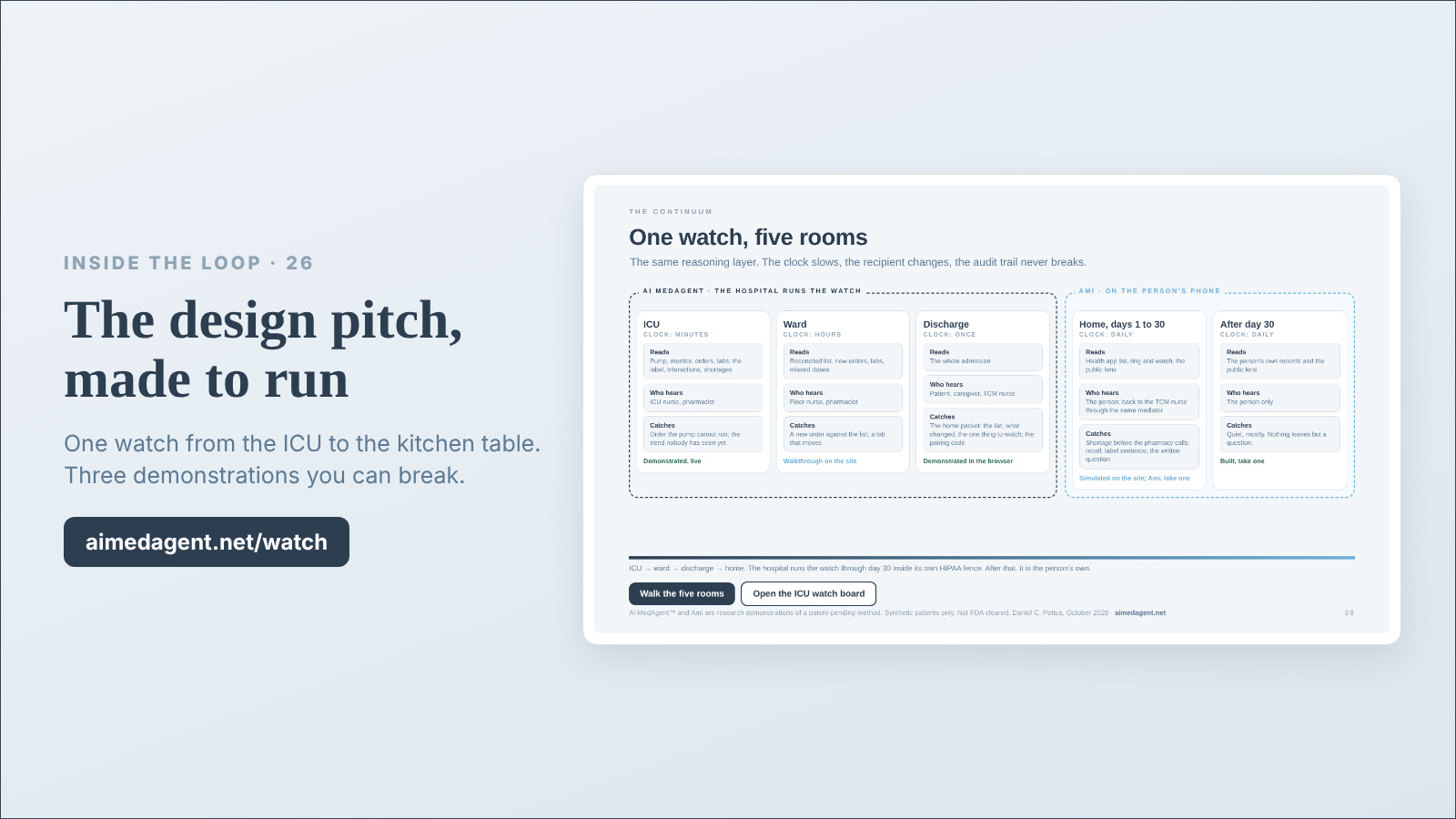
Inside the Loop, Issue 26 | Daniel C. Pettus | 18 October 2026
Last week I wrote a pitch deck. Thirteen slides that say the hole in medication safety is not inside any one room. It is between them. Then I did the thing I watched vendors avoid for most of my career. I built the deck so it runs.
Between the rooms, nobody is watching
The ICU watches everything, every minute. The ward watches less. Discharge is one conversation, one stack of paper, and a ride home. At home, the watch is a pill organizer and a worried daughter. The evidence has been sitting there for more than twenty years. In a study of 400 patients sent home from a teaching hospital, 19 percent had an adverse event after discharge, and two thirds of those were drug events [1].
The money noticed eventually. For fiscal 2027, 2,334 hospitals, 80 percent of those eligible, are penalized by Medicare for readmissions, up to three percent of their Medicare payments [2]. Transitional care, the follow-up call and visit after discharge, has been billable since January 2013 [3]. The incentive exists. The watch does not.

The method, in four steps
Acquire the data. Normalize the data. Reason over the data. Connect it to a human. I spent most of my career on the first two, and so did everyone else. We built the plumbing, called it interoperability, and wondered why outcomes did not move.
Step two is where every earlier try drowned, so I gave it a name: the Rosetta layer. Whatever the EHR, whatever brand of pump, one meaning comes out the other side. It is invisible on purpose, like the translator inside a new Mac that lets old software run on a new chip. Nobody sees it. Everybody depends on it.
Step three is the part that did not exist until recently, and I am not going to be shy about it. A large language model can now read a patient’s record, the pump, the labs and the free public drug data the way a clinician would, across rooms, at three in the morning, and say plainly what it could not check. AI is the enabler. Everything else on this page is plumbing I have been laying for decades.
Step four is where the watch earns its keep.
Room one: the watch board
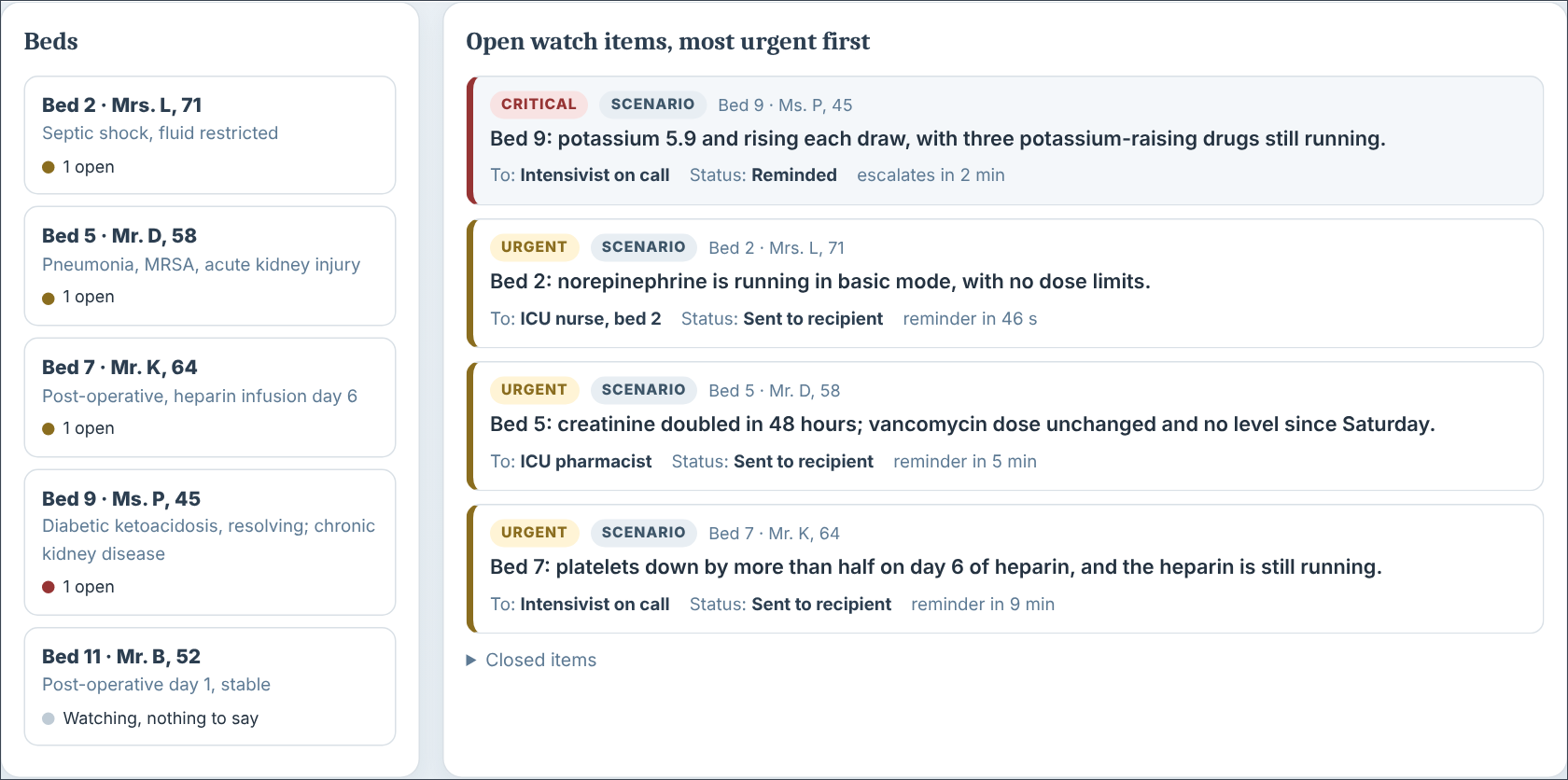
An alert nobody owns is just noise with a timestamp. So every finding in Standing Watch travels inside what I call the mediator. It knows who should hear it, by role, and who is next if they do not answer. It knows how urgent it is and why. It sets a reminder timer and an escalation timer. It records what the recipient did: respond, defer, reject, or nothing. And it writes down every step.
None of that is a private format. The finding, the work and the trail are standard FHIR resources (FHIR is the standard way health records travel between computer systems): DetectedIssue, Task, CommunicationRequest and AuditEvent [4]. For alerts that start on a device, IHE already published the path, Alert Communication Management, transactions PCD-04 to PCD-07 [5]. I was part of the IHE Patient Care Device work in its early years. It is nice to finally have something worth sending through those pipes.
Open the board and five synthetic patients start talking. A norepinephrine drip running with no dose limits because the ordered concentration is not in the pump’s library. A creatinine that doubled in two days under an unchanged vancomycin dose. Platelets down by half on day six of heparin. A potassium of 5.9, rising every draw, never crossing the lab’s panic line, so nobody was called. Answer them, or do nothing and watch them climb the chain. Then pick a bed and press the button that sends its chart to the live AI reasoning. Whatever it finds gets the same mediator.
One patient, five rooms
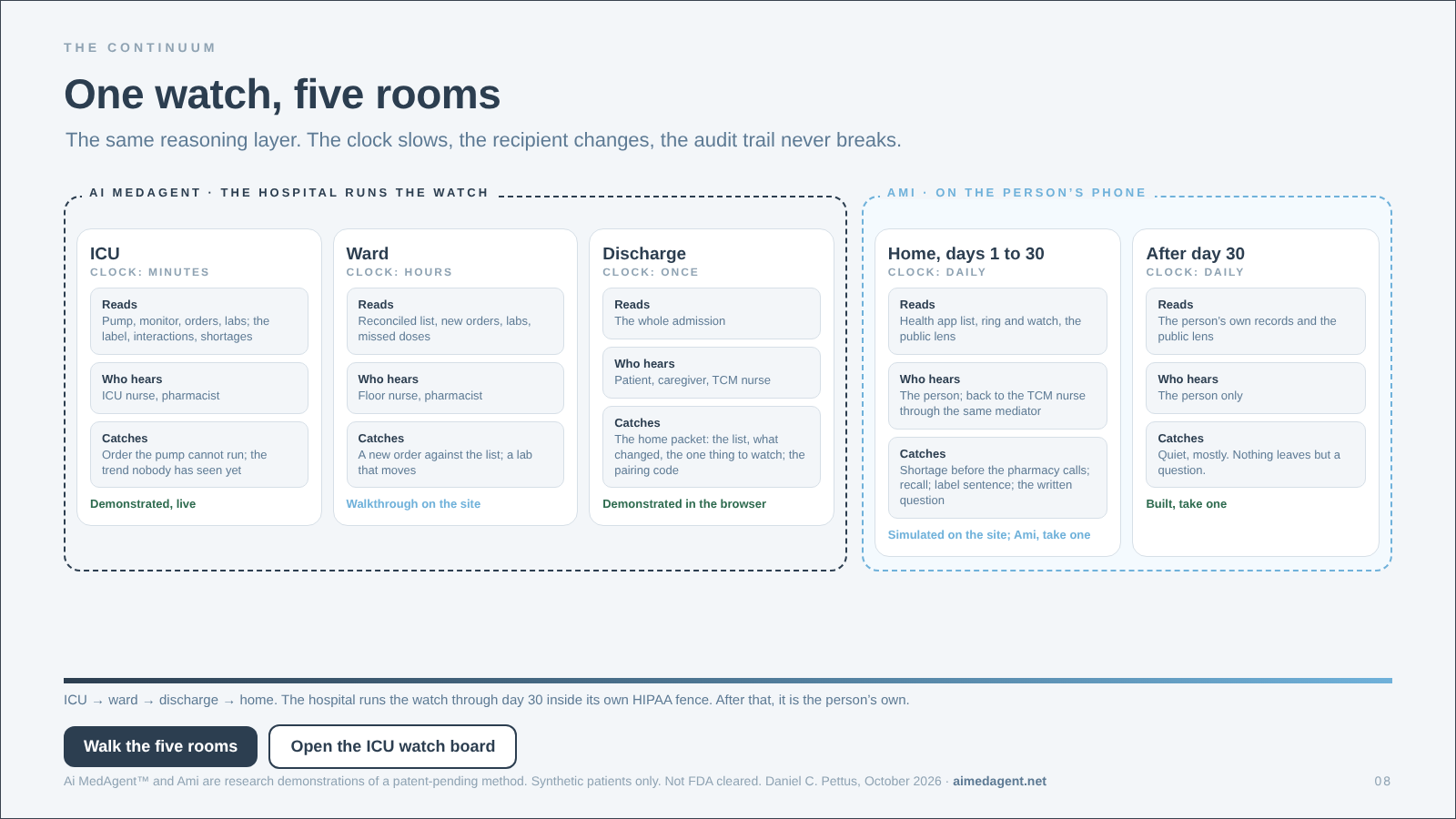
Mrs. H is 74, with heart failure, diabetes and kidneys that do not like either. She is synthetic, and she is busy. In the ICU her potassium is falling on a diuretic drip. On the ward, the transfer orders restart her home metformin with an eGFR of 28, below the line where the FDA label says it is contraindicated [6]. At discharge, two potassium-raising drugs land on the same going-home list. At home, on day four, ibuprofen shows up on her phone’s medication list, and the FDA label for NSAIDs says they raise the risk of heart failure [7].
The clock slows from minutes to hours to once to daily. The person who hears it changes from the ICU nurse to the pharmacist to the hospitalist to Mrs. H herself. The audit trail never breaks, and you can download it at the end.
The bridge nobody has built
The hard part of going home is not the medicine list. It is identity. The hospital knows exactly who Mrs. H is. Her daughter’s phone should not have to.
So the going-home packet travels as a SMART Health Link [8]. In plain words: a QR code that carries its own key. The packet is encrypted before it leaves the hospital. The server in the middle holds only scrambled text and never sees the key. Ami, on the phone, holds a pseudonymous watch number and the encrypted packet. No name, no record number, no account. The hospital keeps the map from number to patient inside its own walls, and when Mrs. H sends a question, it comes back addressed to the number and rides the same mediator to her transitional care nurse.
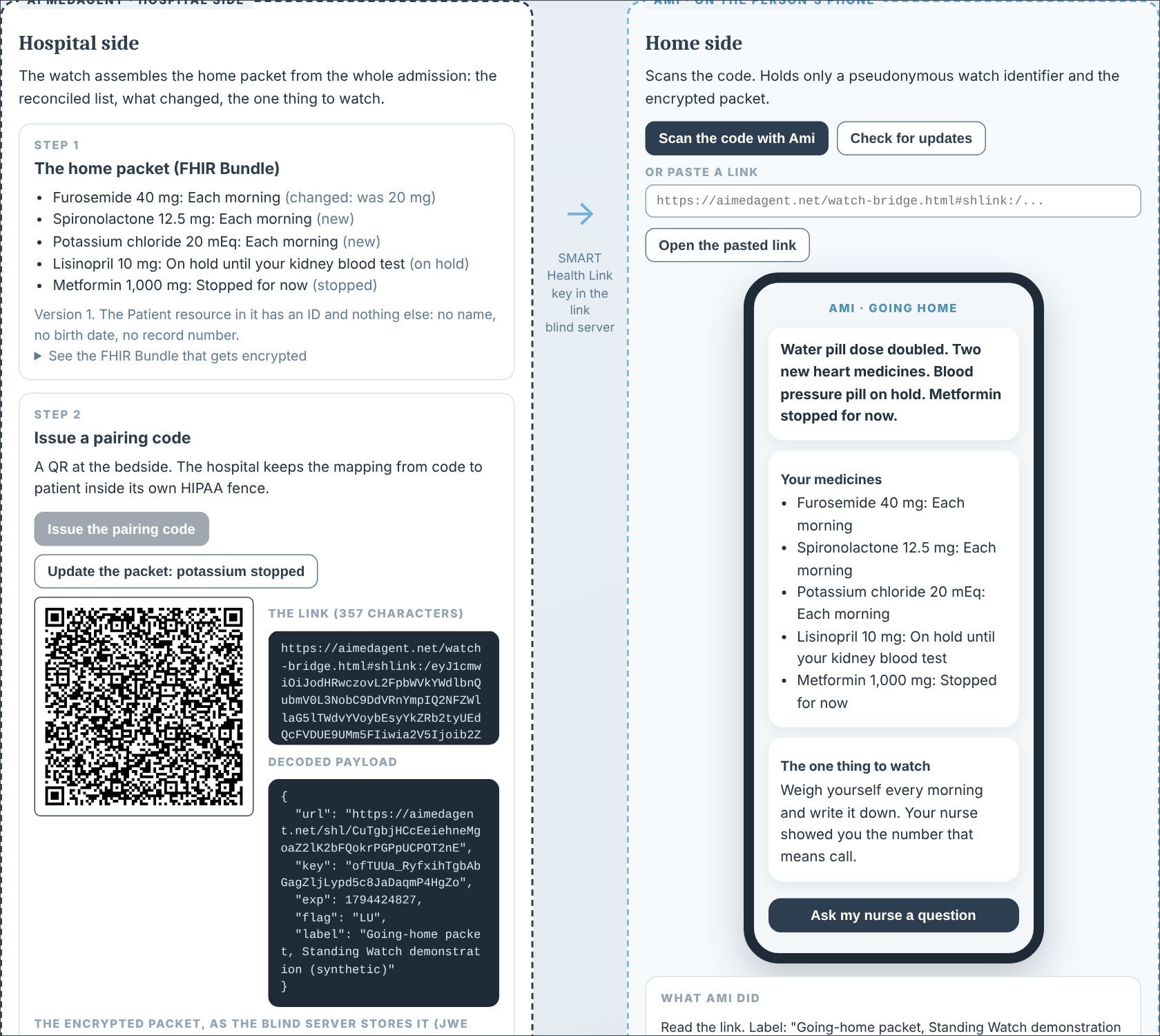
One honest limit. On the website, the server in the middle is your own browser, so the link opens only in the browser that made it. Scan the QR with your phone and the page will tell you exactly that. The format and the encryption are the real specification. A hosted server is the next build.
And the one you can use free
Smart Formulary went live the same week. It checks that the order screen, the pharmacy, the label and the pump’s drug library all say the same thing, because when they do not, the pump drops to basic mode and runs with no limits. It is free, open source, and runs in your browser. Next to it, Smart Orders drafts one IV order for a synthetic patient from published pharmacokinetic models, the math of how a body moves a drug, with a goal, a flow pattern and a time not to give more. It is built on the lesson of my old mentor Dr. N. Ty Smith and his BODY simulation [9]. BODY could teach that lesson. It could never reach a real patient. Now it can get closer.
What this is not
It is a research demonstration of a patent-pending method, on synthetic patients, built and funded by one person at one desk. It is not a medical device and it is not for clinical use. Software that calculates a patient-specific dose is a device function under FDA’s clinical decision support guidance [10], and a hospital that ran the watch for real would set its own recipients and timers and validate the whole thing before anyone relied on it. I am not selling anything today.
Come test it
aimedagent.net/watch. Three demonstrations, a datasheet, and the pitch itself, all public. Press every button. Let a finding go unanswered and see who gets paged. Try to read the packet without the key. Then tell me where it is wrong. That is how it gets better.
Next up: the mediator sends a real card into an EHR, and the bridge gets a server of its own. Has the time finally arrived? I think it has. The demonstration is the argument.
Since last issue
Ami, the phone end of this watch, has had its second take. It now checks your own medicine list against the FDA’s public recall and shortage lists every day, on the phone, with nothing about you leaving it, and it went to friends and family for testing this week. And the audiobook of The Technology Was Never the Problem is out on Audible, read by Anthony Proctor, for those of you who said you would get to the book eventually.
I will also be at the HIMSS AI in Healthcare Forum at the Omni San Diego on 22 and 23 October, on a press credential for this newsletter, with Ai MedAgent™ on a laptop and Ami on a phone. If you are there and want fifteen minutes with either, write to dan@aimedagent.net and we will find a quiet corner.
Daniel Pettus spent forty years in medical device and health IT leadership at Alaris, CareFusion and BD, was a founding member of the iMetrikus team, and contributed to IHE Patient Care Device interoperability standards. He is co-inventor on US patent 7,375,647 and has filed five provisional applications on the reasoning method behind Ai MedAgent™. He writes Inside the Loop from Murrieta, California.
The serious version of the day job is a book. The Technology Was Never the Problem: forty years of trying to connect medical devices to the record, and what finally changed. pettusbook.com.
Ai MedAgent™ is a research demonstration of a patent-pending method. Advisory only. Not a medical device. Not FDA cleared. Synthetic patients and simulated feeds. See it at aimedagent.net. Ami is an unreleased experiment and is not available to download.
References
[1] Forster AJ, Murff HJ, Peterson JF, Gandhi, Bates DW. The incidence and severity of adverse events affecting patients after discharge from the hospital. Ann Intern Med 2003;138(3):161-167.
[2] Pifer Parduhn R. Medicare penalizes more hospitals for readmissions. Healthcare Dive, 8 October 2026. healthcaredive.com/news/hospital-readmission-reduction-program-penalties-rise-2027-cms/832473/
[3] Centers for Medicare and Medicaid Services. Transitional Care Management Services, CPT 99495 and 99496, payable from 1 January 2013. Medicare Learning Network.
[4] HL7 FHIR Release 4 (4.0.1): DetectedIssue, Task, CommunicationRequest, AuditEvent. hl7.org/fhir/R4.
[5] IHE Devices Technical Framework, Revision 10.0, Final Text, 4 November 2024. Alert Communication Management (ACM), PCD-04 to PCD-07.
[6] US Food and Drug Administration. Drug Safety Communication: FDA revises warnings regarding use of the diabetes medicine metformin in certain patients with reduced kidney function. 8 April 2016.
[7] US Food and Drug Administration. Drug Safety Communication: FDA strengthens warning that non-aspirin nonsteroidal anti-inflammatory drugs (NSAIDs) can cause heart attacks or strokes. 9 July 2015. The revised labeling also states that NSAID use increases the risk of heart failure.
[8] SMART Health IT. SMART Health Links Protocol. docs.smarthealthit.org/smart-health-links/spec.
[9] Smith NT. PC-based “BODY” simulation presents anesthesia learning chance, challenge. APSF Newsletter 1999;14(2).
[10] US Food and Drug Administration. Clinical Decision Support Software: Guidance for Industry and FDA Staff. Revised January 2026.