

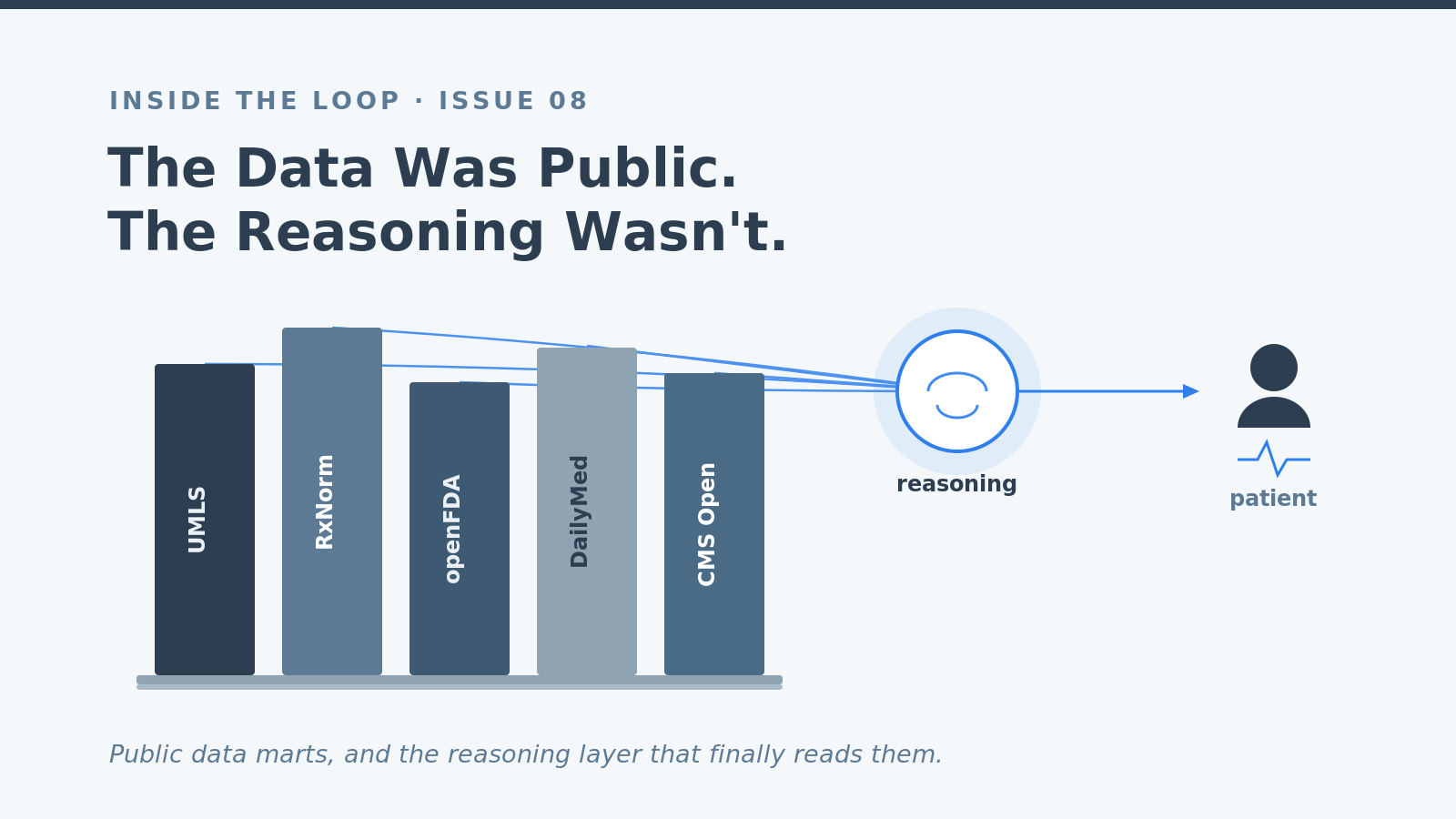
Every drug label the FDA has ever cleared is sitting on a public server right now. Free, structured, machine readable. So is a normalized map of nearly every medication name used in American medicine, built and kept current by the National Library of Medicine. So is the adverse event history of the country. You paid for all of it with your taxes, and for most of my career almost none of it was read while a patient was still in the bed.
I know how far ahead of the tools this idea can run, because I tried to build it more than twenty years ago, with SQL scripts and a room full of servers, and it was not enough.
I want to talk about the public data marts that have been hiding in plain sight, why I reached into them long before it was fashionable, and why an AI reasoning layer finally changes what they are for.
A Confession: I Tried to Build This in 2003
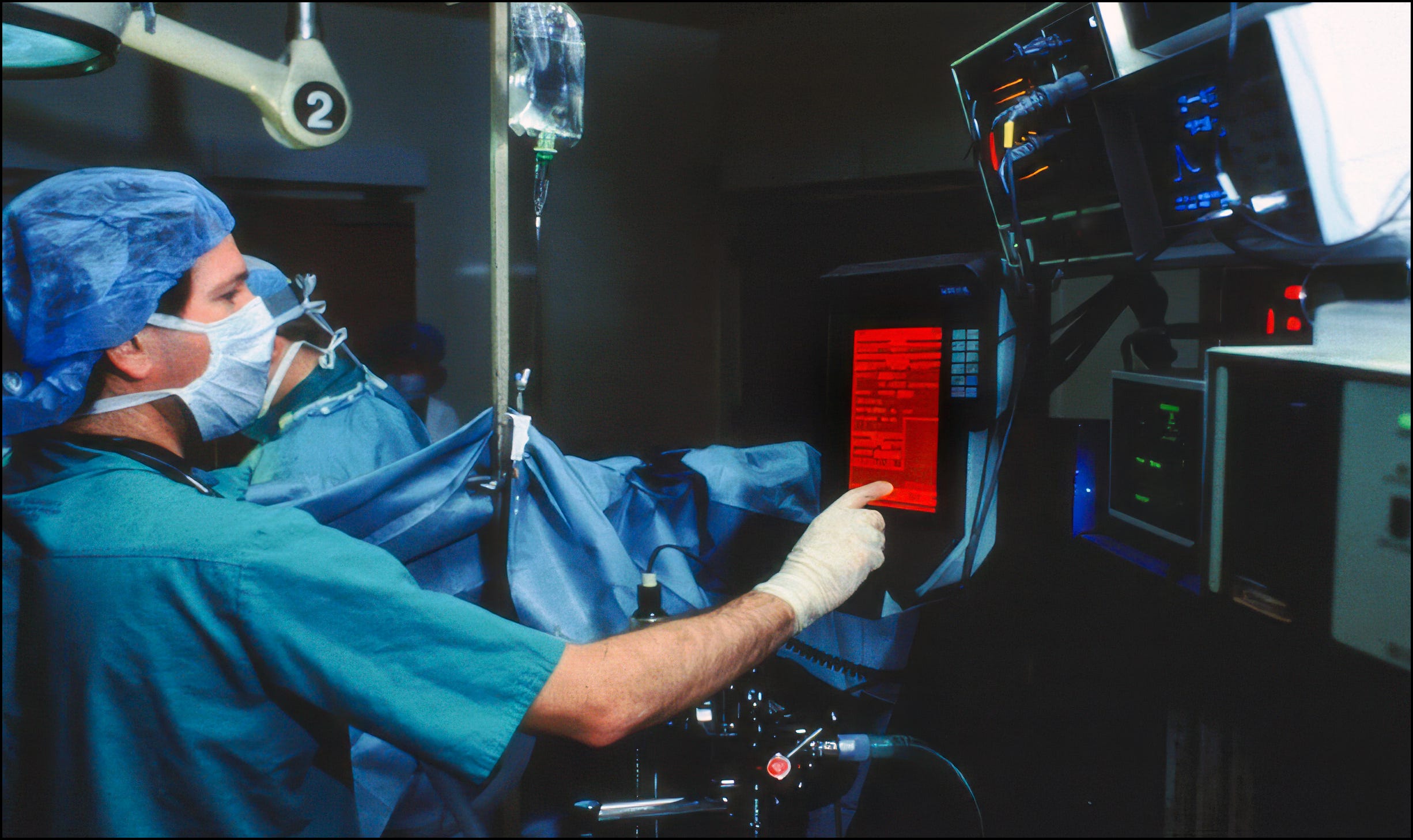
Long before I was connecting infusion pumps to the medical record [1], I helped build the Diatek Arkive, and I want to give that machine its due, because it was more than a data integrator. It was a full Anesthesia Information Management System, an electronic medical record built for the anesthesiologist and wired directly into the room. Touch screen workstations sat at the clinician’s side, integrated with the anesthesia machines and the physiologic monitors, capturing end tidal and inspired gases, drugs and infusions, and vital signs automatically, and assembling the anesthesia record as the case unfolded. [2] Commercial adoption began in 1988. Getting devices from a dozen manufacturers to speak to one system was hard in 1988, and the result was one of the first electronic records a specialty actually trusted.
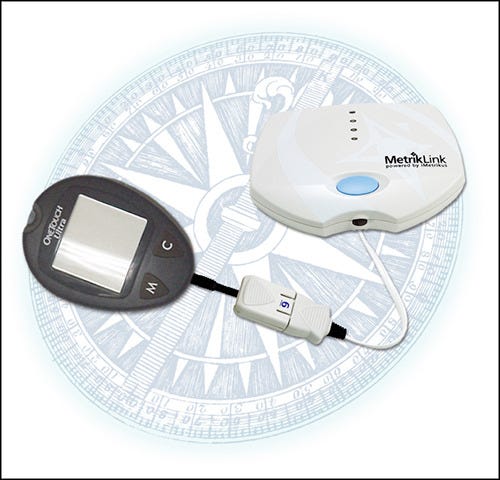
Years later, at iMetrikus, I took the same idea home. I led the design of a device we called MetrikLink, a small gateway hub that sat in a patient’s house and captured readings from more than thirty home monitoring devices, glucose meters, blood pressure cuffs, scales, and sent them to our data center over a phone line or the internet. I made many trips to China, where we built it, because the only way the math of telehealth works is if the hardware is cheap. I wrote the patents, and I am named as co-inventor on United States patent 7,375,647. [3]
MetrikLink was only the plumbing. MediCompass was the system, and it came in two parts. [4] A home version on the patient’s desktop, paired with the MetrikLink hub to capture the device data, and a clinician office version that pulled the home data together and presented what mattered. Here is the part I am proudest of, because we got the philosophy right before we had the tools to deliver it. We ran what I called a dark cockpit. The term is borrowed from aviation, where Airbus decided in the 1980s that a cockpit should stay dark and quiet until something actually needs the pilot’s attention. [5] We did the same. The architecture watched everything and said nothing, until a value drifted out of range or a pattern turned worrisome. We stopped pushing information that was not actionable, because information that is not actionable is just noise wearing a lab coat.
The secret was in the data center, in the database, and this is where public data enters my story for the first time. We built our analytics on an OLAP database, and inside it we incorporated the UMLS Metathesaurus, the National Library of Medicine’s map that links medical vocabularies by meaning. [6] The NLM built the UMLS for exactly the problem we had, to let a computer recognize that a hundred different vocabularies are often saying the same thing, and to connect them. We did not download it with a click. We ordered it from the NIH as a stack of software CDs, at no cost, and installed it part by part. The process was complex. The result was worth it. With a stack of SQL scripts we resolved free text, whether it came from the patient at home or from the clinician’s office, into a Concept Unique Identifier, a CUI, the Metathesaurus’s stable code for a single medical idea. Once you have CUIs you can look for co-occurrence, the concepts that keep showing up together for one patient, and you can point the clinician toward the right literature in PubMed before a problem becomes an event. The academic world was working the same seam. There is a careful 2012 paper on using UMLS concept identifiers and co-occurrence to connect clinical text to the medical literature. [7] We were doing it live, in a shipping product, for real patients, back in 2003.
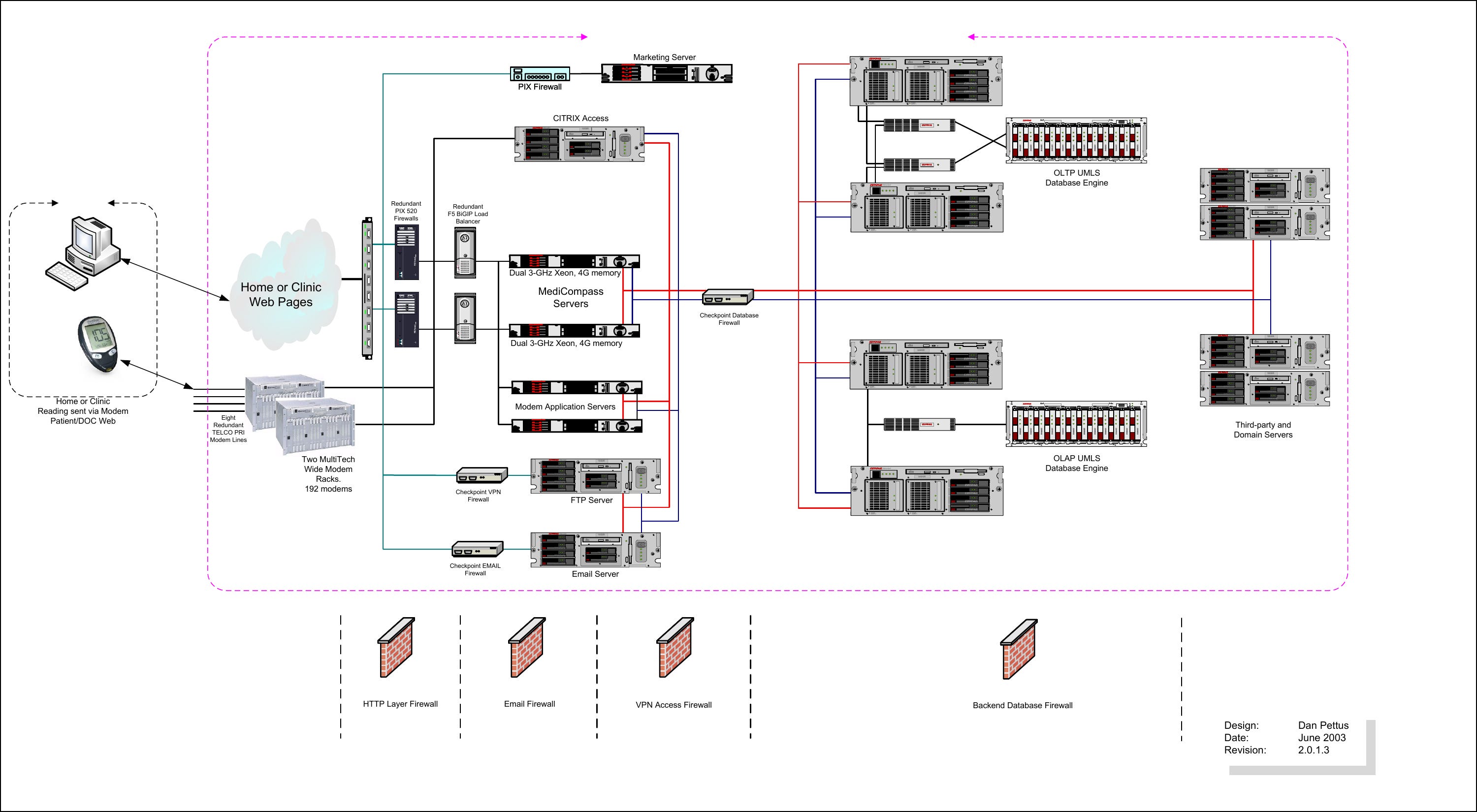
It was crude. It was a ton of code. Installing and using the UMLS was miserable work, and I will not romanticize it. But it was a real attempt to get past the number on the glucose meter and say something about the patient’s journey, using as much data as we could reach. No one else was reaching into a public data mart to reason about a remote patient inside a commercial telehealth product then. We were early, and we were alone.
So why have you never heard of any of this. Because the company ran out of money. That is the whole autopsy. The model was skewed toward acute care, the hospital, where the urgency and the dollars live. Managing a patient at home is a completely different animal, with different economics and a much longer payback. Anyone who wants the cautionary version of that story can follow what happened to Qualcomm Life. That is another article, and I will write it.
The point I want to carry forward is this. The instinct to build on public, authoritative, taxpayer funded data was right in 2003, and the instinct to stay dark until something is actionable was right too. What I did not have, what nobody had, was a way to make the reasoning itself intelligent. I had SQL. What I needed was a colleague who could read.
