

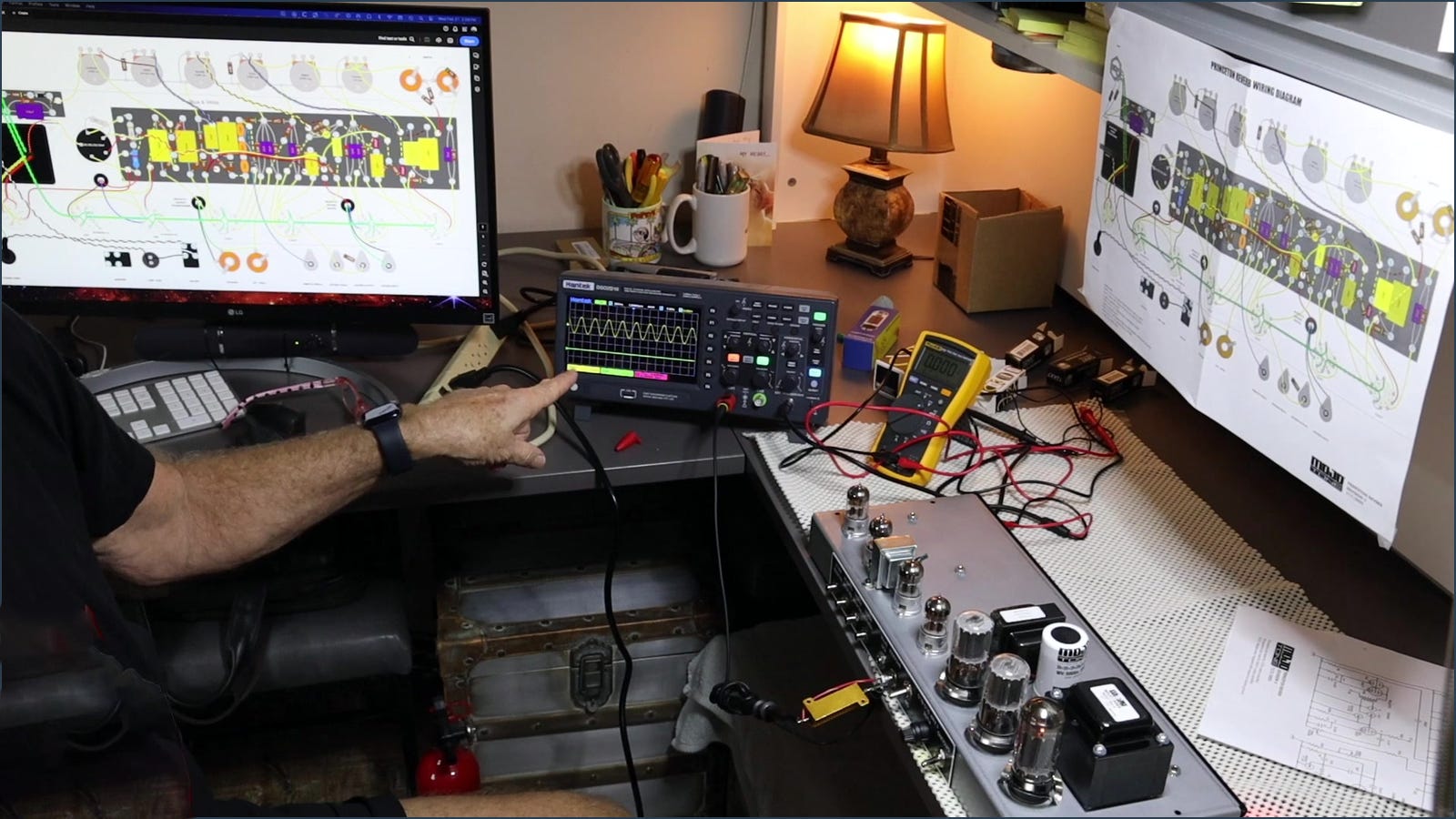
People ask me what it is like to retire after forty years in healthcare technology. One word: wonderful. It was a transition for sure. It is hard to step away from work that mattered, and some of mine did. I discovered how public data marts can be used for patient outcomes, helped connect wireless enabled infusion pumps to the medical record back when most people thought that was a solved problem, and AAMI was kind enough to give the write-up an award. I helped write interoperability standards that hospitals still run on. I am named on two patents and have three more provisional patents currently in-play.
This issue is different, before you get three paragraphs in and wonder what happened to the AI-in-healthcare newsletter you signed up for. I am taking an afternoon off. No interoperability, no infusion pumps, no argument with an electronic health record. Those will be back soon.
First, a word about the man writing this. I am a baby-boomer, which means I have had a front-row seat for a world changing its mind: the moon landing, solid-state electronics and the invention of the microprocessor, the iPhone, and now artificial intelligence. I will be the first to admit that seventy years of accumulated data includes a lot of useless slop. The rest, however, is irreplaceable, and I think my generation of retirees is underused for exactly that reason. I wrote a book in retirement to memorialize my own piece of it, what worked and what failed, and the best part turned out to be reconnecting with friends and colleagues from decades back. I still advise and consult in the industry I left, and I still research on my own, because like building a Tesla coil in 1964 it keeps the brain engaged. I ride my bike for cancer research with UCSD’s Curebound event. And when AI arrived and I understood it as a reasoning tool rather than a chatbot, it changed everything, because for the first time I could see a way at the problem that has bothered me my whole career: we are taught in healthcare to react to events. I want to change that, and I will have a great deal more to say about it next issue. Back to this one.
For now, the rest of the week. The honest list is ordinary. I play golf. I play pickleball, which is what golf turns into when you want to be home by lunch. I ride my bike, and we travel. And then there is the part that is harder to explain, so I will just tell you where it comes from.
A garage, around 1965
When I was a boy, our garage belonged to my brother Mike. He hand-built giant Tesla coils, with the stated goal of a homemade particle accelerator. He built amateur radios from surplus parts. And he built guitar and stereo amplifiers, from schematics, one wire at a time. I did not understand most of it. I understood that a person could sit down with a drawing and a box of parts and, some evenings later, make something work. That has never left me.
When I need to put the world down for a while, I go back there. I build hand-wired tube guitar amplifiers from that era, the way they were built then, and I let the smell of warm solder do what it does. Call it meditation with a voltmeter.
The kit
I do not build from scratch. I start with a kit and then make my own changes. The current one is a Fender Princeton Reverb, the AA1164 circuit Fender built in Fullerton starting in 1964. Leo Fender’s shop was the next town over from our garage, which I did not appreciate at the time. This build is around 12 watts, two 6V6GT power tubes, a tube-driven spring reverb and tremolo, a 10-inch speaker. Fender’s control panel calls the tremolo “vibrato.” It is tremolo. Every part is hand-wired to a steel chassis, one lead at a time, because that is how it was done in 1964 and that is how Mike did it.
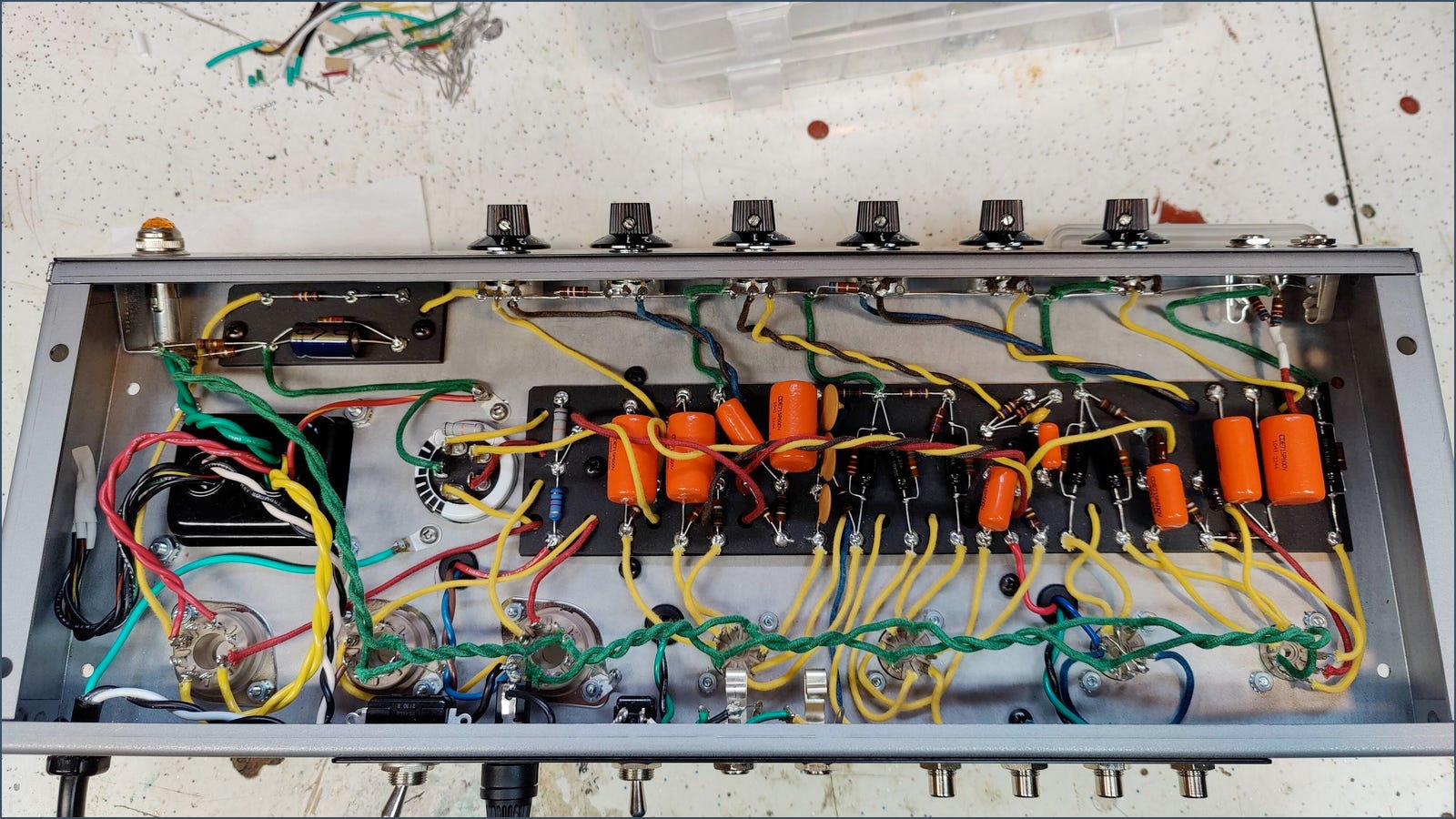
What draws me to it is a sheet of paper. Fender published the entire design: the schematic, the layout, every resistor and capacitor value, and the DC voltage you should measure at each point when the amplifier is healthy, with a note across the top saying the readings may vary plus or minus 20 percent. A 1964 guitar amplifier told you everything inside it, what it should read when it was well, and how far off was still fine. I have spent a career wishing certain other devices came with a sheet like that. I promised no healthcare this issue, so I will leave it there.
The Dan modifications
A kit is a starting point. Rob Robinette, who runs the most generous free amplifier site on the internet, publishes a layout of suggested changes to the AA1164, and I used it as my map. On top of that I made two changes of my own.
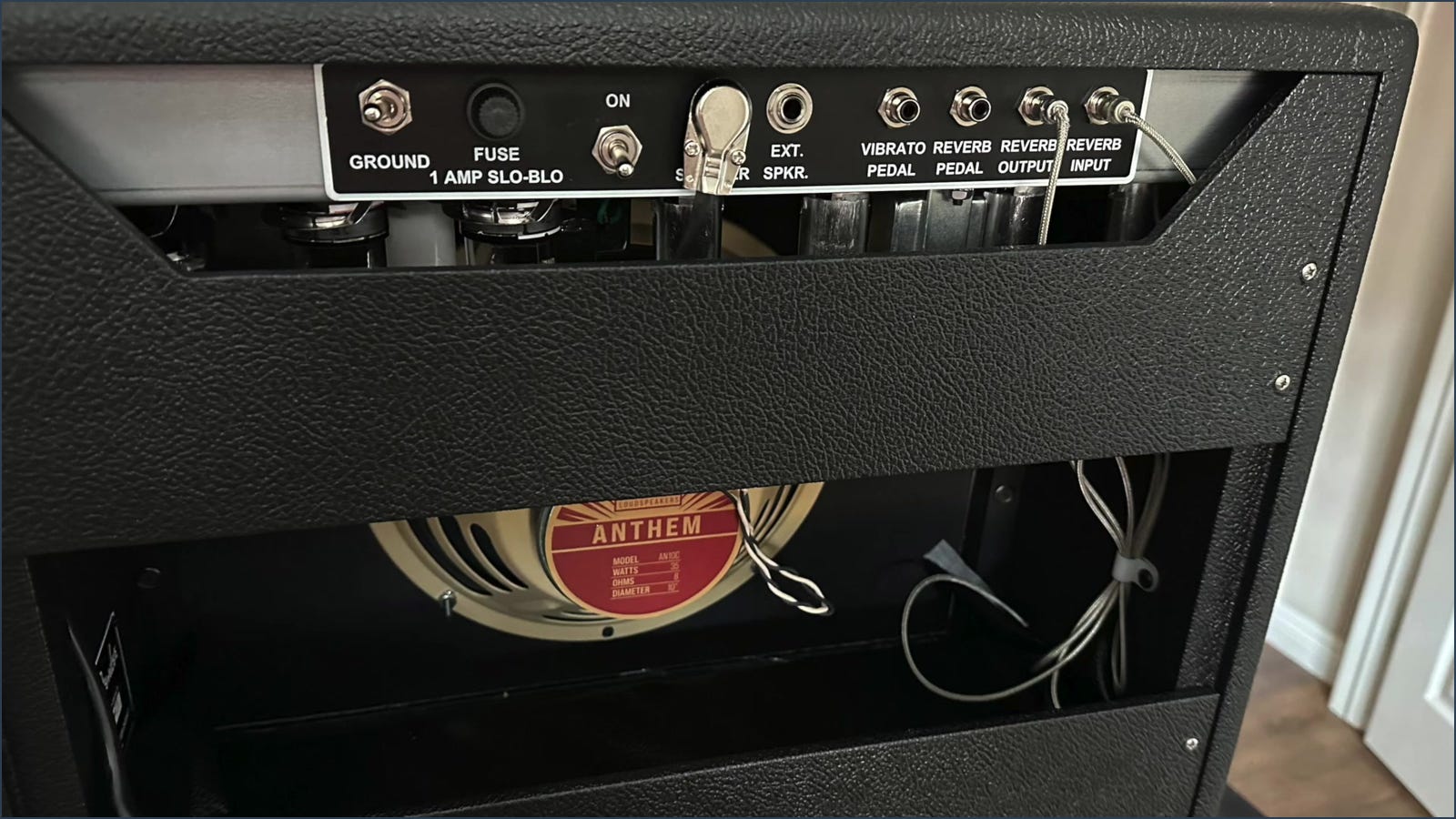
The first was grid stopper resistors on the tubes, a small part that keeps the amplifier from oscillating at frequencies only dogs and oscilloscopes can hear. The second is the one I care about, and it needs one sentence of explanation. Bias is the idle setting on a tube, the same idea as the idle on a car engine: a small steady voltage that sets how hard the tube works when no one is playing. Set it too hot and the tube runs itself into an early grave. Set it too cold and the amp sounds thin and harsh. The original circuit fixes that idle with a single resistor and calls it done. I replaced it with an adjustable one, a potentiometer, a pot to anyone who has ever turned a volume knob, and mounted it so I can reach it without pulling the chassis out of the cabinet. Every manufacturer’s 6V6 has its own personality, and every pair needs its own bias to sound right and live long. So, I swap power tubes the way other people swap guitar strings, bias each set, and write the numbers in a notebook.
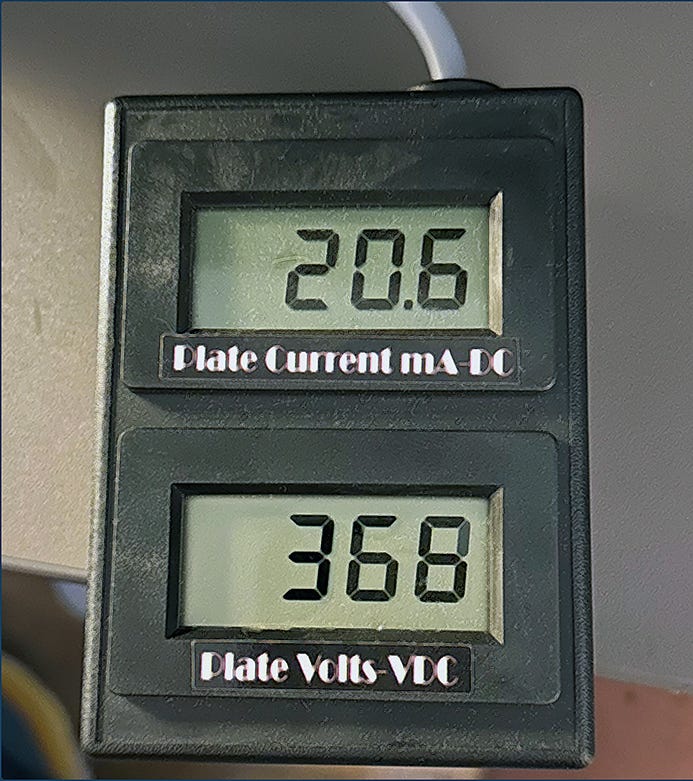
Three hundred and sixty-eight volts at 20.6 milliamps. Multiply them and you get about 7.6 watts of heat at the tube’s plate, idling. The current datasheets rate a 6V6 at 14 watts; the 1940s sheets said 12. The rule of thumb is to idle at no more than 70 percent of the rating, and I am sitting somewhere between 55 and 65 percent depending on which sheet you believe. I did not take the kit’s word for it. I measured. Mike would have measured.
The crackle
A while after one of my builds, the amplifier developed a crackle. Intermittent, which is the worst kind, because an intermittent fault is never there when you are looking at it. I put the scope on it, then the meter, and then I did what I did in 1965. I called my brother. Two Pettuses and a Fluke found it in the preamp: a cold solder joint, a connection that looked fine and was not. Reflow one joint and the crackle was gone. Sixty years on, same brother, same bench, same lesson. The drawing tells you what should be there. The instrument tells you what is.
I do not play guitar
I should admit this before someone asks to hear the amp. I own a Fender Stratocaster and a Fender Jazz Bass for the same reason a mechanic takes the car around the block: it is how I find out whether the thing I built works. I attempt to play bass, with the emphasis on attempt. What I play, nearly every day, is drums.
Two bass drums, tuned not to match
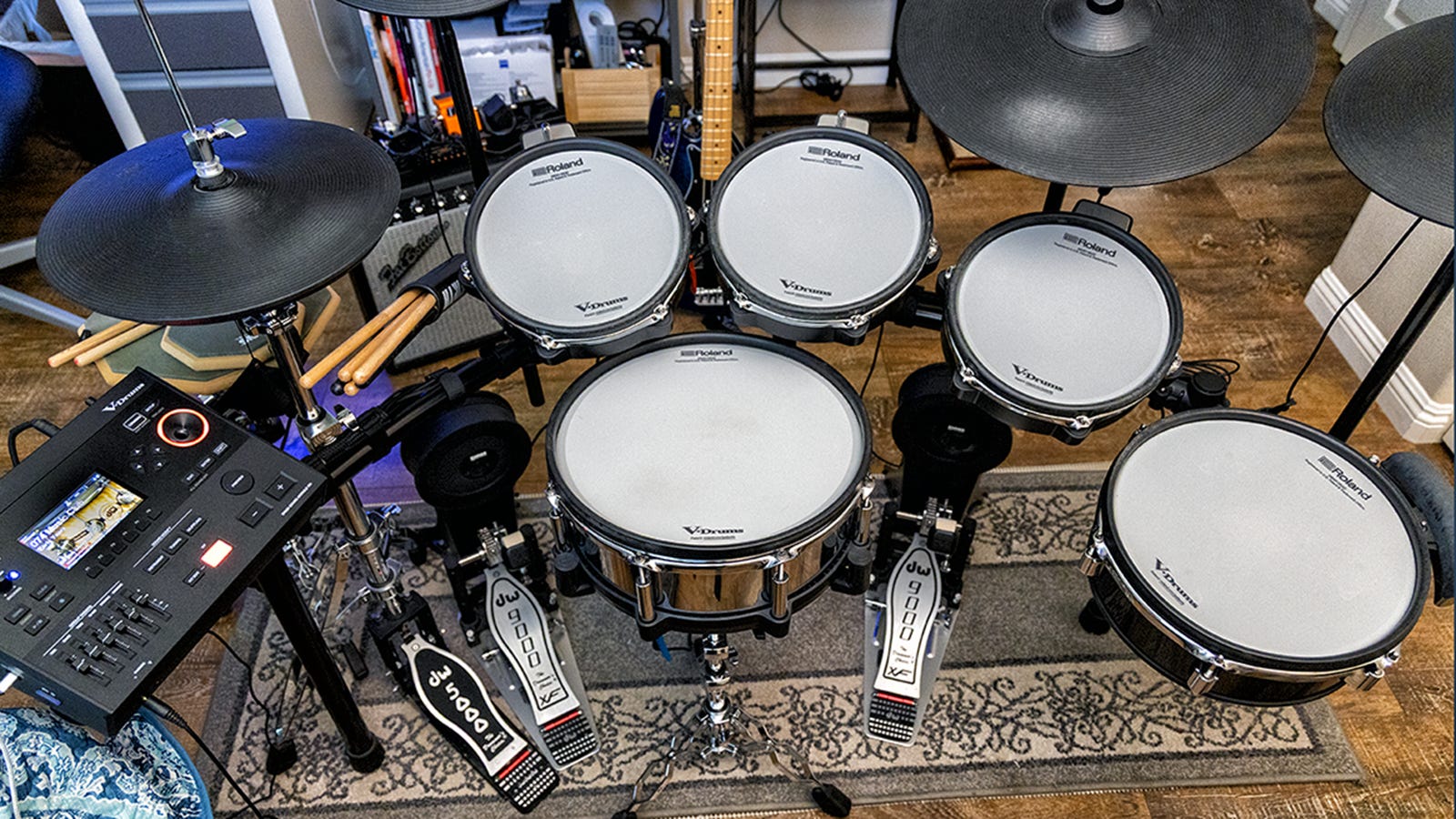
I am a trained drummer and have been since I was eight. My first professional kit was a Rogers, bought in 1967 with two bass drums, back when Rogers built them in Dayton, Ohio and sold a factory twin-bass outfit with Louie Bellson’s name on it. I have been rebuilding that kit ever since, the way some men keep buying the same car. Today it is a Roland V-Drums set with the new V51 module, and I modify every electronic kit I own to look like 1967: two separate bass drums, the snare between them, and one more floor tom than a reasonable person needs.
The two bass drums are tuned not to match, on purpose. Ginger Baker taught me that, and not from a record. I was lucky enough to grow up when the legends played within driving distance, and I saw Cream several times around Los Angeles and Hollywood. The best of them was the Shrine, with my best friend and fellow drummer Rik. The ticket was $3. Ginger’s kit carried a 22-inch drum under the left foot and a 20 under the right, wide open and pitched apart so the two feet spoke as two voices, which is what he had heard in African drumming long before he drove a Range Rover across the Sahara to go play with Fela Kuti. In heavy metal the fashion runs the other way: tune both drums the same so two feet sound like one very fast drum. Neither is wrong. The style tells you the tuning.
Jazz got into me early enough that in retirement I wrote a play about it, a one-act set in 1948 New York with a live band written into the script as a character. It is called A Song Is Born, it lives at a-song-is-born.com, and it has gone exactly nowhere, which has not stopped me liking it.
An afternoon in Bonham’s chair
Last February our community’s music club gave me an afternoon to tell the rock drummer’s story from the 1970s to today, studio and stage. I brought the e-kit, a PA, and a screen full of pictures.
We started with the Wrecking Crew, which most of the room had never heard of, and neither have most of you, and that is the point. They were a loose group of Los Angeles session musicians who, through the 1960s and into the 70s, played on more hit records than any band you can name and almost never got credit on the sleeve. Hal Blaine on drums. Carol Kaye on bass. A young Glen Campbell on guitar before anyone knew his name. Leon Russell on keys. When you hear Good Vibrations, Be My Baby, Bridge Over Troubled Water, Strangers in the Night or the Monkees’ theme, you are hearing them. I spent some hours in those same Hollywood studios myself, cutting demo tapes for local garage bands, close enough to the real thing to know exactly how far away I was.
And I did something I could not have done five years ago. Software can now take a finished stereo recording and pull it back apart into its instruments, drums here, bass there, vocals on their own, as if someone had handed you the original multitrack tape from 1971. I ran the originals through it, pulled the drum tracks out, and dropped the rest into Logic Pro, which is the recording studio that now lives inside a Mac: the tape machine, the mixing desk and the effects rack of 1975, in one window. Then I sat in the chair. Bonham’s chair on Stairway to Heaven. Ginger Baker’s on White Room. Mick Fleetwood’s on Dreams. Mitch Mitchell’s on Fire. Jonathan “Sugarfoot” Moffett on Billie Jean. And Steve Smith’s on Don’t Stop Believin’, which a right-handed drummer like me must play open-handed, left hand leading, and which I would not recommend trying in front of people the first time.
For the finale I told the room something I had been a little sheepish about. Late last year I released a seven-song album, every note of it generated with AI from prompts I wrote, under my own name. It was an experiment, and the results are remarkable, and I will be the first to say what is missing: it is artificial. No human emotion, and no human mistakes, which turn out to be the same thing. It was educational to see how far AI has gone in a completely different direction from the one I work in, reasoning over critically ill patients, where a mistake is not a style.
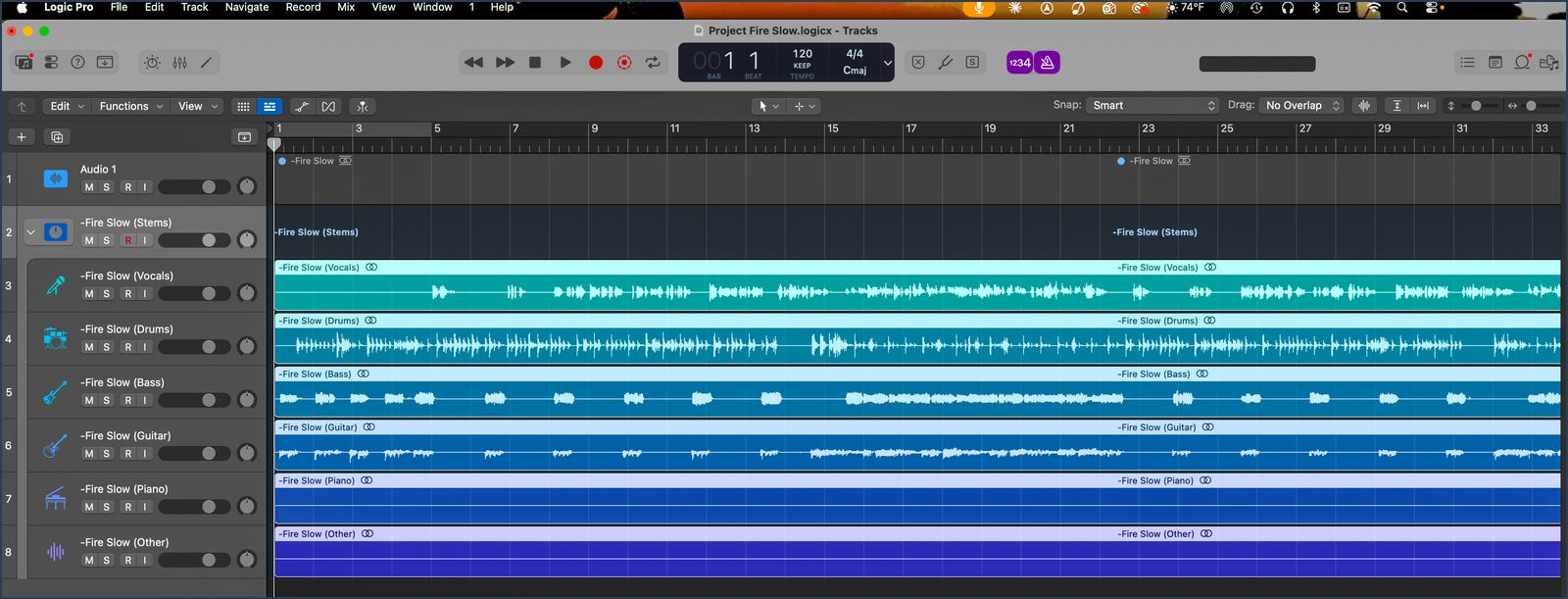
What I learned is simple, and it is the reason I said yes to the afternoon. The machine separated the stems in seconds, cleaner than any studio could have done with a razor blade and a week. It wrote an album, of sorts, in a couple of days. What it could not do was the thing the whole talk was about. Technology has changed everything about how music gets made, the tape, the machines, the room, and one thing has not moved an inch: the human being at the center of it. I watched a ballroom full of people lean forward when the groove landed, and no software did that. Time is the drummer’s whole job. You cannot fake time. You can only keep it. And when a machine keeps it perfectly, something is missing, and everyone in the room can hear what it is.
That, in one sentence, is also how I feel about the AI I use for my current experiments in healthcare, and for AI MedAgent. It does the reasoning. It does it fast and it does it well. The concept, the vision, the reach, and the judgment about what is worth building still come from a person in a chair. I promised not to overdo that here, so that is all I will say.
Back soon
The amplifier is warm. Mike is a phone call away. Nobody told me retirement would sound like this, and I would not trade it.
Next issue, back to health technology, and it picks up something I said at the top of this one. Airline pilots have a phrase for the discipline that critical care does not have: staying ahead of the airplane. The FAA also has a name for the failure, and when you read its definition you will think somebody was describing a bad night in an intensive care unit. Next time: what aviation learned about asking for a deviation long before the storm, why the fix was never the equipment, and why I built AI MedAgent to make that argument rather than sell anything. Until then, thank you for letting me take the afternoon off.
Daniel Pettus spent forty years in medical device and health IT leadership at Alaris, CareFusion and BD, contributed to IHE Patient Care Device interoperability standards, and is named on two United States patents. He writes Inside the Loop at insidetheloopdp.substack.com.
The serious version of the day job is a book. The Technology Was Never the Problem: forty years of trying to connect medical devices, what actually stopped it, and why the answer was never engineering. Paperback and ebook at pettusbook.com.
AI MedAgent is a research demonstration of a patent-pending method. Advisory only. Not a medical device. Not for clinical use. Simulated patients, synthetic data only. aimedagent.net
#Retirement #TubeAmps #Drums #MakerLife #HealthIT