

Inside the Loop, Issue 22 | Daniel C. Pettus | 23 September 2026
Brisbane, 2017, and the medication pass nine years later.
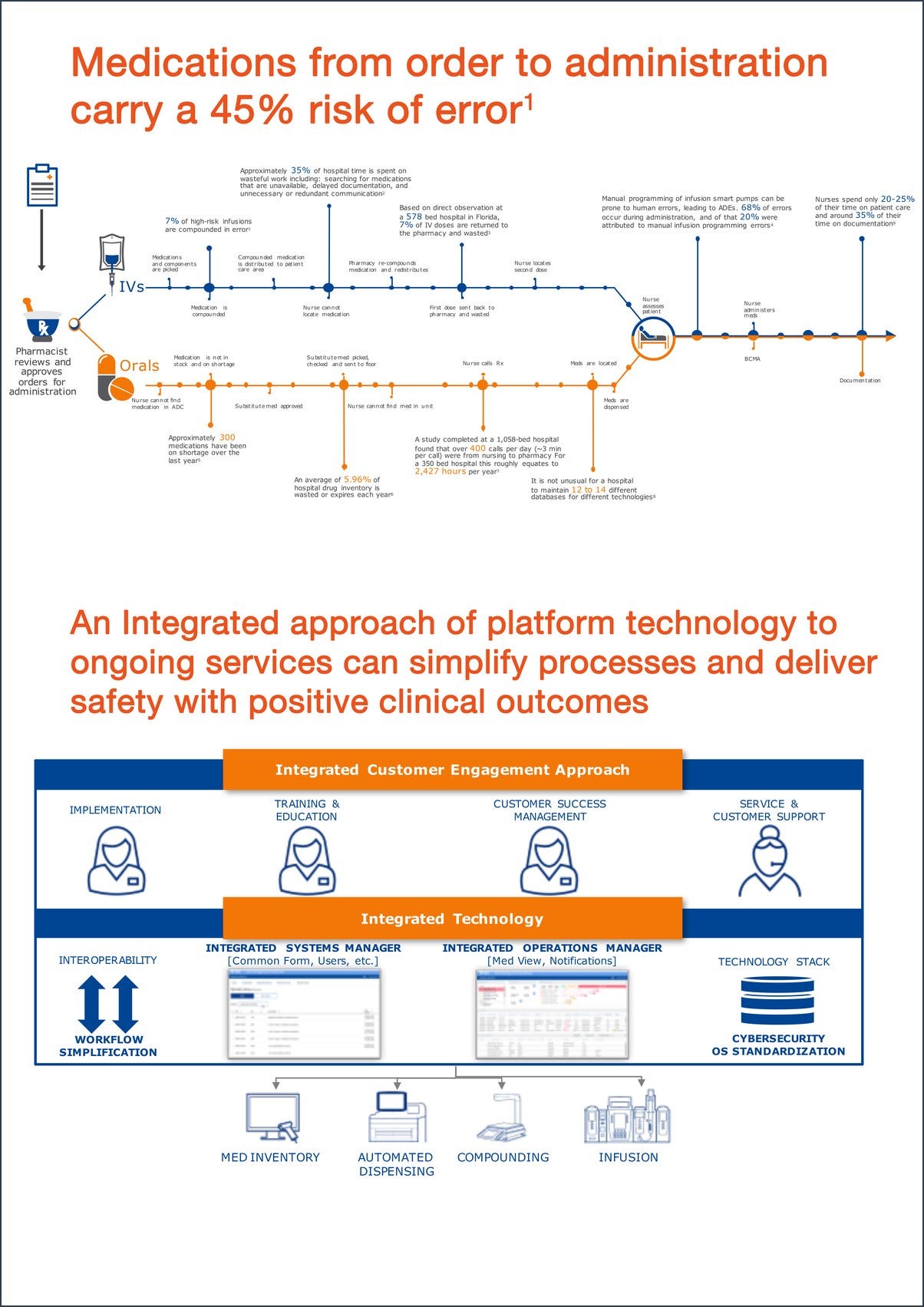
On 8 August 2017 I presented at HIC 2017, the national conference of the Health Informatics Society of Australia, in Brisbane.[1] I was a vice president at BD. The abstract, the talk and the poster made one argument: the medication pass in an acute care hospital is a relay of roughly thirty steps, and risk and delay are documented at nearly every hand-off.
IV medications got the most attention, and they deserved it. IV infusion errors have been identified as carrying the greatest potential for patient harm.[2] But the poster drew two lanes, not one. Oral medications had their own shortages, substitutions, missing doses and calls back to pharmacy. Plenty of risk and plenty of ways to fail, with no pump in sight.
We showed where BD’s products fit with the EHR to close those gaps. It was a vendor poster. It was also well received, because the problem it described was the one every nurse and pharmacist in the room worked inside every day.
The name Australia already had
The title of our abstract used a term Australia had already made standard: Electronic Medication Management Systems, or EMMS.[3] The Australian Commission on Safety and Quality in Health Care publishes a national guide to implementing them, now in its third edition.[4]
In the United States we still buy CPOE, pharmacy, dispensing, the eMAR, barcode administration and smart pumps as separate systems with separate owners, and we have no single word for the whole. Australia named it. The name is nine years older than this article and it still fits. We should use it here.
Nine years on
I am retired now. This year I launched a concept and a method for using AI reasoning to optimize a patient’s therapy proactively at the bedside, especially in critical care. Looking back at the 2017 poster, I asked two questions. Has the medication pass improved? And would a reasoning layer have a place in it?
The answer to the first, not surprisingly, is: not much.
In a review of 2,809 admissions at eleven Massachusetts hospitals in 2018, an adverse event occurred in 23.6 percent of admissions. Adverse drug events were the most common type, 39 percent of all events.[5]
Across 2,314 hospitals tested with the Leapfrog CPOE evaluation tool from 2009 to 2018, median performance at catching potentially harmful orders rose from 53.9 percent to 65.6 percent. About a third still get through.[6]
With smart pumps connected to the EHR, one multi-hospital study still counted 96.5 errors per 100 infusions, down from 114.6.[7]
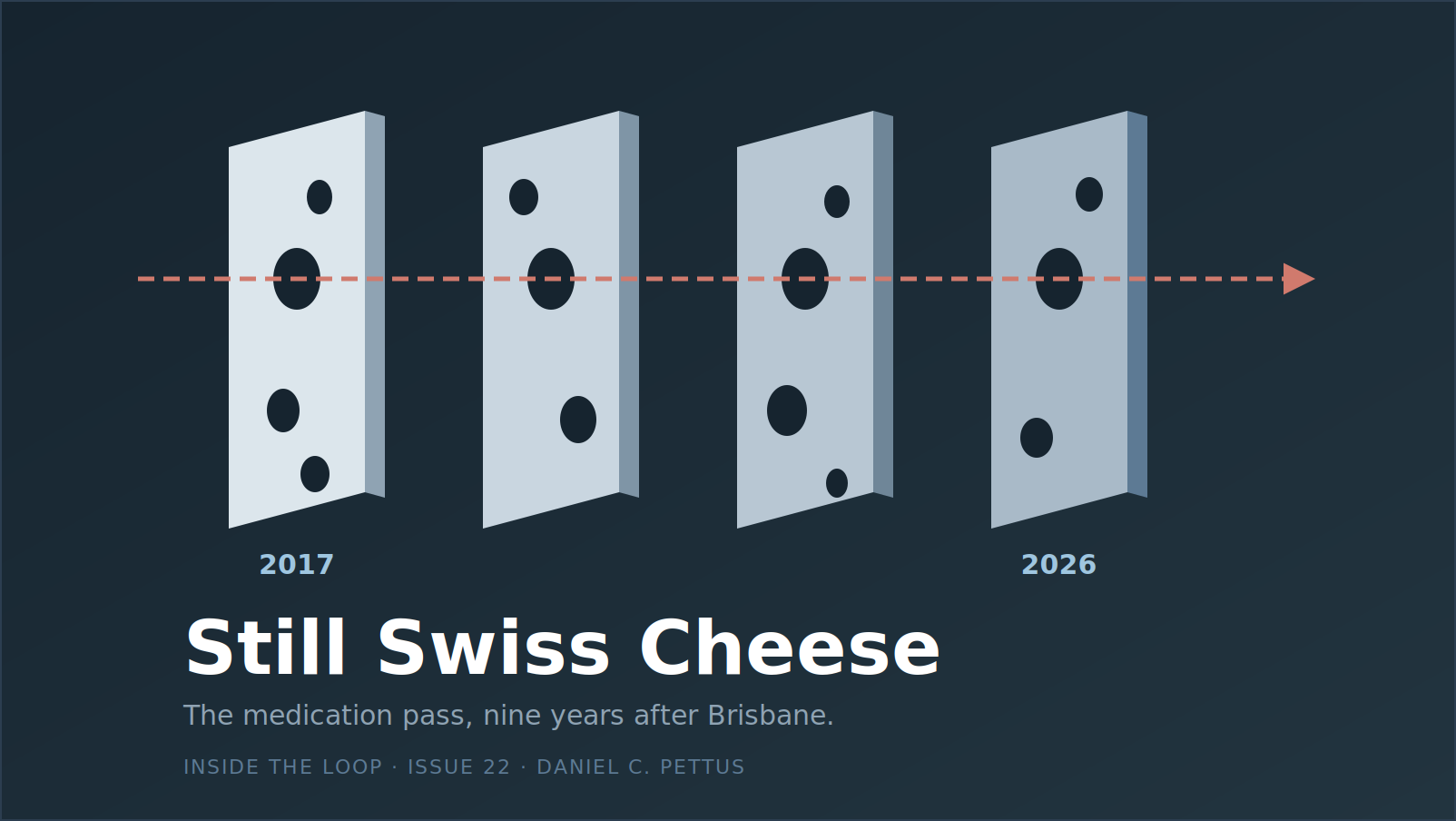
The slices of cheese are thicker than they were. The holes still lineup.[8]
IVs should not be the only focus
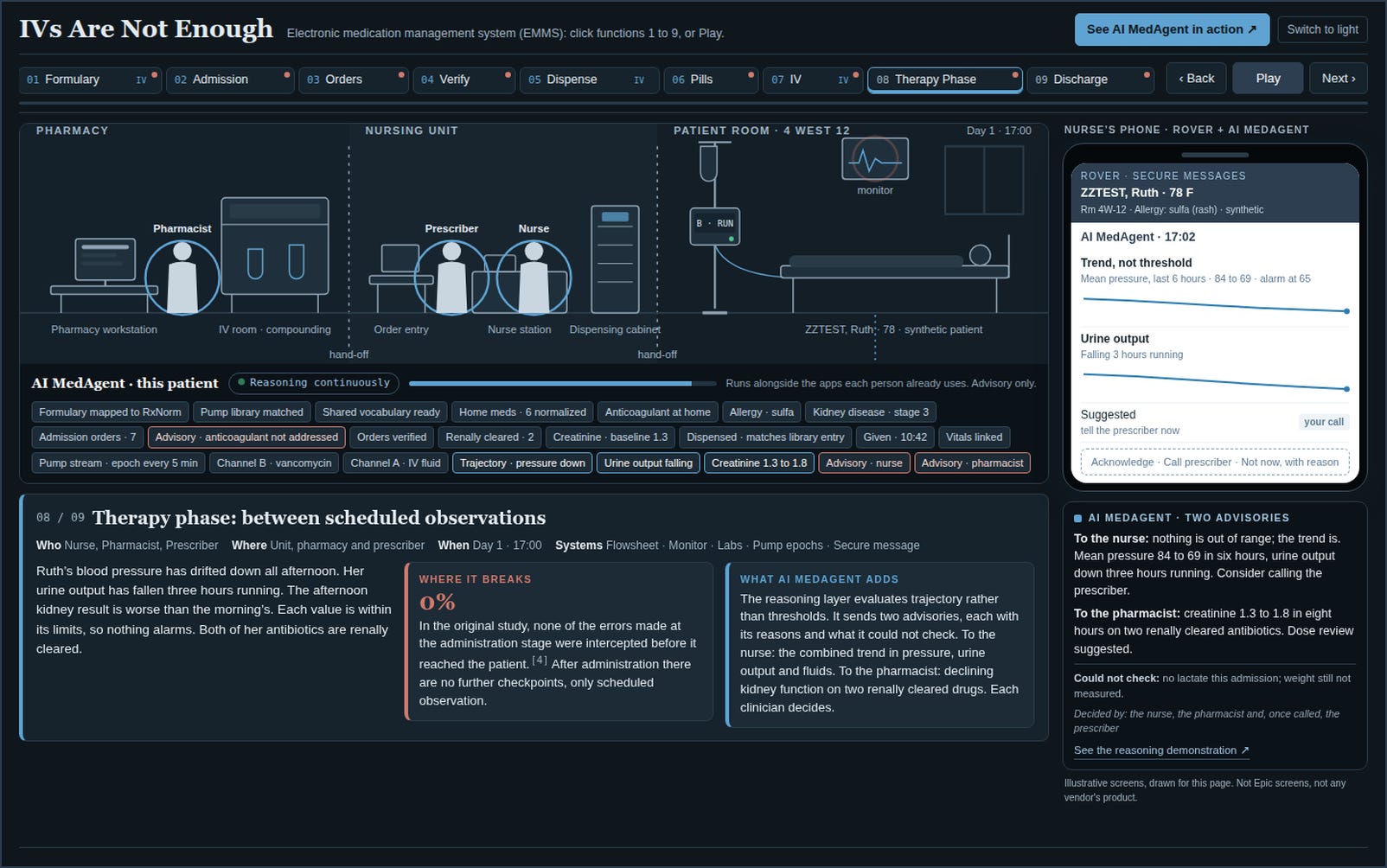
The founding study of adverse drug events traced where the errors behind preventable harm began: 56 percent at ordering, 34 percent at administration. Nearly half of the ordering errors were caught before they reached the patient. None of the administration errors were.[9] Two thirds of the errors start before anyone touches a pump. Fixing the IV is necessary. It is not sufficient.
One source of truth, fed from the start
We should accept the eMAR and barcode administration as the single source of truth for what a patient received. It is the last record before a drug reaches the patient, and it is the one the nurse signs.
But truth at the end of the chain depends on alignment at the start. The drug the nurse scans must be the same drug, in the same concentration and units, that pharmacy built into the formulary, the prescriber ordered, the pharmacist verified and the pump library expects. When those disagree upstream, the eMAR records the disagreement faithfully. Alignment starts at the formulary and does not end until the patient is discharged.
The eMAR itself has improved. It now runs on the nurse’s handheld: Epic’s Rover app, for example, supports medication administration and IV infusions at the bedside.[10] That is real progress. What has not changed is the workflow behind it. The EMMS still lacks a common, connected process from formulary development onward.
The free data we leave on the table
There is a vast amount of drug data and knowledge online, and most of it is free. The National Library of Medicine’s Unified Medical Language System maps more than a hundred vocabularies, including RxNorm, into more than a million concepts.[11] DailyMed holds 159,318 labeling documents submitted to the FDA.[12] openFDA publishes the adverse event reports submitted to the agency since 2004, refreshed every quarter.[13]
These data marts are large and complex. Querying and reconciling them by traditional methods is hard and far too slow for the pace of a medication pass. The best way I have found to access and reason over them is AI working at speed: normalizing a local drug name to its RxNorm concept, reading the label, checking what has been reported, and bringing the result to the clinician while the order is still open.
That comes with a condition: the right controls. Regulators already require them. Since January 2025, certified health IT that supplies predictive decision support must make 31 source attributes available to users and apply risk management practices.[14] In my own work the controls are simple and not negotiable: advisory only, every finding traceable to its source, a report of what could not be checked, and a clinician who decides.
Can AI help?
Possibly. A reasoning layer that follows one patient across the whole EMMS, from formulary to discharge, could see what no single system in the relay sees: a home anticoagulant left off the admission orders, kidney function falling on two renally cleared drugs, a blood pressure trend that never crosses an alarm threshold. That is a hypothesis, not a result. It needs testing, and it needs investment to test it.
I rebuilt the 2017 walk as an interactive page, with the published evidence at every step and an AI MedAgent layer running alongside. Step through it at aimedagent.net/medication-pass.html, then tell me what has changed where you work.
We still have a long way to go.
Daniel Pettus spent forty years in medical device and health IT leadership at Alaris, CareFusion and BD, contributed to IHE Patient Care Device interoperability standards, and is named on two United States patents. He writes Inside the Loop at insidetheloopdp.substack.com.
The serious version of the day job is a book. The Technology Was Never the Problem: forty years of trying to connect medical devices, what actually stopped it, and why the answer was never engineering. Paperback and ebook at pettusbook.com.
AI MedAgent is a research demonstration of a patent-pending method. Advisory only. Not a medical device. Not for clinical use. Simulated patients, synthetic data only. aimedagent.net
Notes
[1] Health Informatics Society of Australia. HIC 2017, the 25th Australian National Health Informatics Conference, Brisbane, 7 to 9 August 2017. Proceedings: Integrating and Connecting Care, IOS Press, 2017.
[2] Maddox RR, et al. Intravenous Infusion Safety Initiative: Collaboration, Evidence-Based Best Practices, and “Smart” Technology Help Avert High-Risk Adverse Drug Events and Improve Patient Outcomes. In: Advances in Patient Safety: New Directions and Alternative Approaches, Vol. 4: Technology and Medication Safety. Agency for Healthcare Research and Quality, 2008.
[3] Pettus D, et al. Interoperable Electronic Medication Management Systems brings technology, products, and administration into one solution. Abstract, HIC 2017. Author’s files.
[4] Australian Commission on Safety and Quality in Health Care. Electronic Medication Management Systems: A Guide to Safe Implementation. Third edition. Sydney: ACSQHC, 2019.
[5] Bates DW, et al. The Safety of Inpatient Health Care. New England Journal of Medicine. 2023. doi:10.1056/NEJMsa2206117. 2,809 admissions, 3 large and 8 smaller Massachusetts hospitals, 2018.
[6] Classen DC, et al. National Trends in the Safety Performance of Electronic Health Record Systems From 2009 to 2018. JAMA Network Open. May 2020. Figures as reported by The Leapfrog Group and University of Utah Health.
[7] Skog J, Rafie S, Schnock KO, et al. The impact of smart pump interoperability on errors in intravenous infusion administrations: a multihospital before and after study. Journal of Patient Safety. 2022. PMID 35344977.
[8] Reason J. Human error: models and management. BMJ. 2000;320(7237):768-770. PMID 10720363.
[9] Bates DW, Cullen DJ, Laird NM, et al. Incidence of adverse drug events and potential adverse drug events: implications for prevention. JAMA. 1995;274(1):29-34. PMID 7791255.
[10] University of Iowa Health Care, Epic Support, Rover: medication administration, IV infusions and flowsheet documentation in the Rover app. Accessed 23 September 2026.
[11] National Library of Medicine. Unified Medical Language System (UMLS), nlm.nih.gov/research/umls. More than 100 source vocabularies, including RxNorm, and more than one million concepts. No charge for the license.
[12] National Library of Medicine. DailyMed, dailymed.nlm.nih.gov. Home page count of labeling submitted to the FDA, 159,318, accessed 23 September 2026.
[13] US Food and Drug Administration. openFDA Drug Adverse Event API, open.fda.gov/apis/drug/event. FDA Adverse Event Reporting System data from 2004, updated quarterly.
[14] Office of the National Coordinator for Health Information Technology. HTI-1 Final Rule, Decision Support Interventions Fact Sheet, December 2023, and 45 CFR 170.315(b)(11). 31 source attributes for predictive decision support interventions; risk management practices; effective 1 January 2025.