

Inside the Loop // Issue 06
A neighbor told me a story last month that I have not been able to shake. He drove the family Tesla on Full Self Driving from Murrieta to a relative’s home in the San Fernando Valley, and the car handled all of it. Point to point and back. Merging, lane changes, the grind of Los Angeles traffic that rattles seasoned human drivers, and finally the surface streets on the far side. His hands stayed in his lap. He was supervising a machine that was driving better than he would have, and by his account it was, frankly, brilliant.
The most advanced piece of autonomous technology in his day was not in any hospital. It was under his seat.
I heard that story and thought about my own field. Then, a few days later, I lived the same lesson myself. I was in Hollywood with a friend visiting the Petersen Automotive Museum, of all places, a shrine to the machine we are now teaching to drive itself. When we finished, we took a self-driving Waymo back to our hotel through the busy streets of Hollywood. No safety driver. No hands on anything. No issues. Two ordinary Southern California errands, both chauffeured by software, and neither one remarkable to anyone but me.
I have spent nearly fifty years building the machines that deliver medicine. In 1988 I helped connect every monitor, ventilator, and infusion pump in an operating room into a single automated record, at a time when there were no standards to connect anything to anything. I know this field down to the wire. So what follows is not a technologist’s daydream. It is a builder’s frustration. We will let a car drive itself across four lanes of freeway, with strangers in the next lane, but we will not let the pump beside a patient’s bed adjust its own rate, even where the science to do that safely has existed for most of my career.
The Uncomfortable Part, Said Out Loud
Closed-loop medicine already works. It is in safe, routine use, today, almost everywhere except the United States.
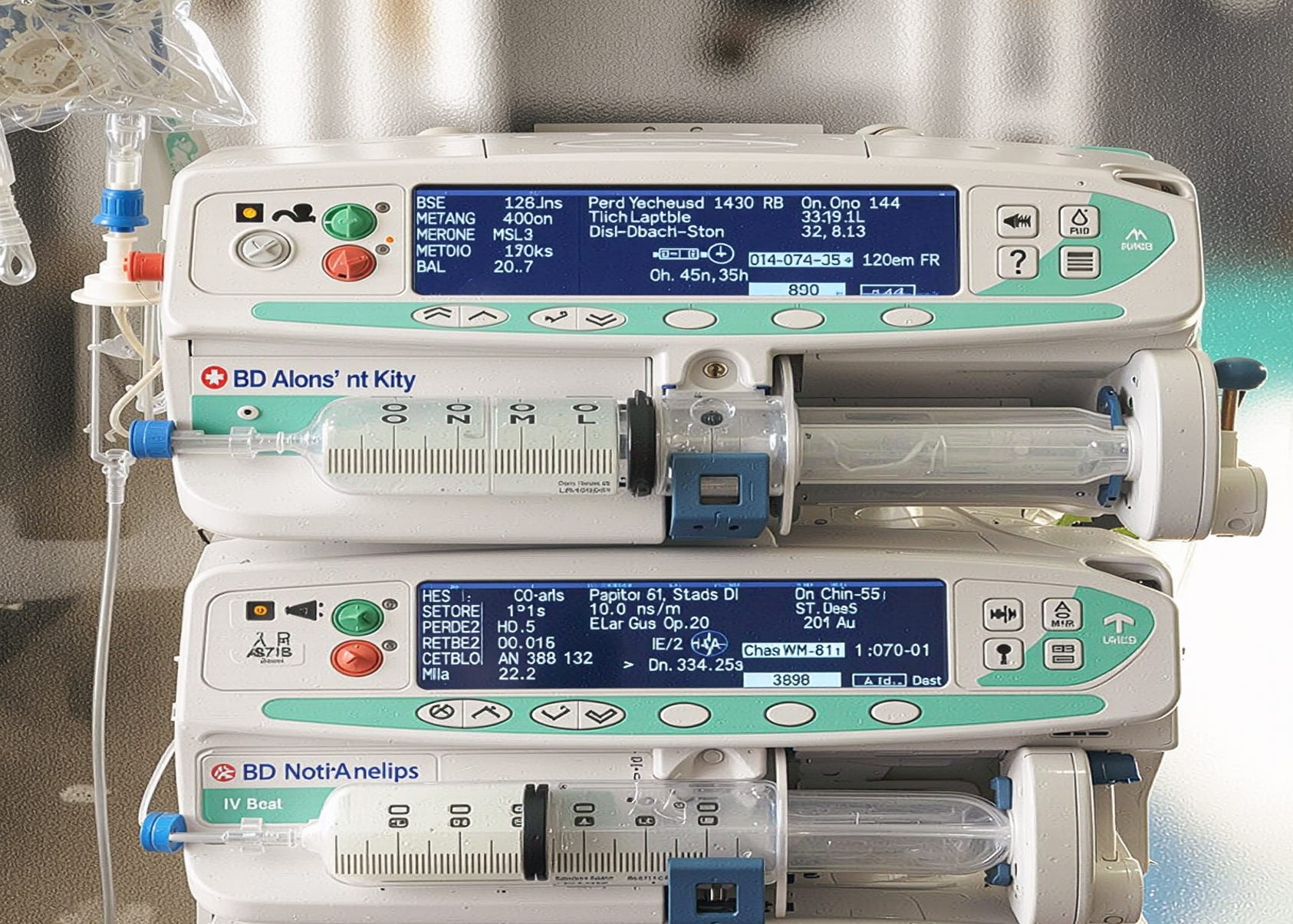
The evidence is not thin. Target-controlled infusion, in which the system manages an anesthetic drug to a chosen blood or effect-site concentration rather than to a fixed rate, was first approved in Europe in 1996. It is now available in more than ninety countries and has been used to deliver anesthesia and sedation to well over twenty million patients.[1] The one notable holdout is here. The FDA has never cleared a target-controlled infusion device for routine use, so in the United States the technology survives only inside research studies.[2] The reasons are regulatory, not clinical. The safety record abroad is long and well documented.[3]
And lest closed-loop control sound exotic, remember that we already trust it here with one of the most dangerous drugs we give. The artificial pancreas, an insulin pump that reads a continuous glucose sensor and adjusts its own delivery, is FDA-cleared and sold in American pharmacies.[4] Hundreds of thousands of people wear one right now. A machine is titrating insulin, unsupervised, on the body of a child asleep in the next room, and we consider that unremarkable. We have already crossed the line we claim we are afraid to cross. We just crossed it quietly, one disease at a time.
The Real Objection Is Not Safety. It Is Habit.
When I raise this, the reflex answer is safety. It is always safety. And I understand the instinct, because I have spent a career respecting it. But look honestly at what the objection actually protects. We accept a closed loop for anesthesia everywhere but here. We accept a closed loop for insulin even here. What we will not accept is the idea, in general, that a machine should decide the next dose. The line we defend is not a line of evidence. It is a line of comfort. It moves, disease by disease, country by country, and it moves in exactly one direction.
Elon Musk drew the same fire with Tesla. Autopilot was a nice-to-have, a lane-keeper for the freeway, and no one lost sleep over it. Full Self Driving was different. It was a claim that the machine should hold the wheel, and it provoked genuine controversy, some of it deserved and some of it pure reflex. But the rest of the automobile industry did not respond by writing op-eds about why it could never be done. They responded by scrambling to catch up, because they understood that the nice-to-have was becoming the must-have, and that the company willing to say so out loud would define the category.
I think medicine is standing exactly where the car industry stood a decade ago, and telling itself exactly the same comforting story.
