

Inside the Loop, Issue 28 | Daniel C. Pettus | 26 October 2026
Last week I drew the ladder. Nobody stepped forward to pay for it, so I wrote the bill. How a citizen’s draft becomes law, why HIMSS should hold the ladder, and why known rules make adoption faster, not slower.
In Issue 27 I proposed an AI Adoption Model: eight stages, 0 to 7, drawn the way HIMSS Analytics drew EMRAM, so that every hospital and practice could see exactly what safe adoption of AI looks like at each step [1]. I wrote that the ladder needs no vote. I still believe that. A week of conversations made the other half plain. The money needs a vote. So does the oversight. And nobody in Washington is volunteering.
So I wrote the bill. The Meaningful AI Act is a discussion draft, published at danielpettus.com/bill, in HTML and as a PDF [2]. It is written so that a Senate office can pick it up and finish it. It has not been introduced, and no Member of Congress has endorsed it. That is the point of this issue.
Why a retired person is writing legislation
Because that is how a lot of legislation starts. Members of Congress release discussion drafts to collect comment before anything gets a bill number. In June, two House members released the Great American AI Act exactly that way [3]. Advocacy groups and professional societies hand model language to congressional offices all the time. A draft from someone who spent forty years on the inside of the last health technology transition is not unusual. Not acting on what I know would be.
The road ahead is long and well marked. The Congressional Research Service describes it plainly: a Member introduces the bill, it is referred to the committees with jurisdiction, the committee holds hearings and a markup and votes to report it, each chamber passes it, the two chambers agree on one text, and the President signs it [4]. Most bills die at the committee step.
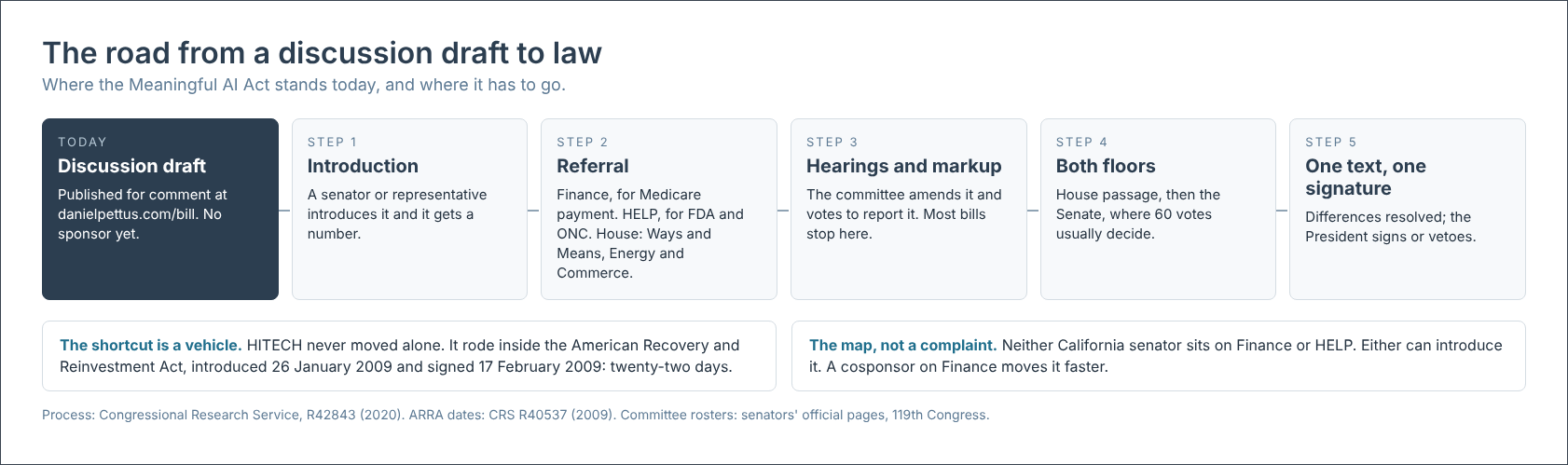
This bill touches Medicare payment, which belongs to the Senate Finance Committee, and the agencies that certify health IT and regulate devices, which belong to the HELP Committee. The uncomfortable part: neither of my senators sits on either one. Senator Schiff serves on Judiciary, Environment and Public Works, Agriculture, and Small Business [5]. Senator Padilla serves on Rules, Judiciary, Budget, Environment and Public Works, and Energy and Natural Resources [6]. Either can introduce the bill. It moves faster with a cosponsor on Finance. That is not a complaint. It is the map.
Twenty-two days
The best argument that this can move quickly is the law it copies. The HITECH Act, which created Meaningful Use, never moved as a standalone bill. It rode inside the American Recovery and Reinvestment Act, which was introduced on 26 January 2009 and signed on 17 February 2009 [7]. Twenty-two days. The most consequential health IT law in American history was ready when the vehicle came along, and it got on.
That is the real job of a discussion draft. Big bills come along: a health package, a Medicare extender, a spending deal. The staff who assemble them reach for language that is already written, already defended, already scored. A framework sitting on a shelf is what gets picked up. A good idea in a newsletter is not.
Oversight is not a brake
The objection I hear most is that rules slow things down. The electronic record says otherwise. In 2008, 9 percent of hospitals had a basic electronic health record. By 2015 it was 84 percent, a ninefold increase in seven years [8]. By 2024, 99 percent had a certified record [9]. The software did not suddenly get better in 2009. What changed was that every hospital knew the standard, knew the payment, and knew the date the penalty started [10]. Hospitals plan around known rules. They stall around unknown ones.
Compare that with AI today. At the HIMSS forum in San Diego I watched dozens of organizations each invent their own governance, their own checklists, their own definition of “validated” [1]. That is the slow part. Every board meeting that ends with “let us wait until the rules settle” is a delay caused by the absence of oversight, not its presence. Lane markings are the reason people drive seventy.
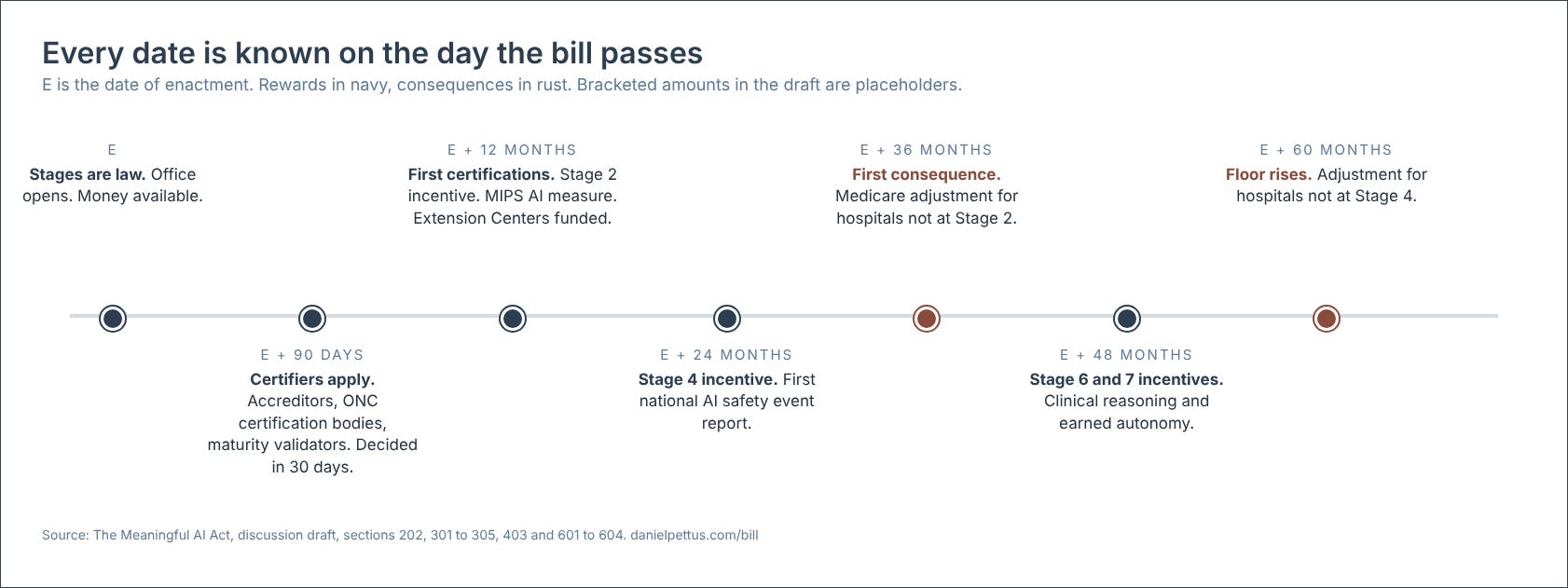
So the bill is built to make every date known on the day it passes. The eight stages become law on enactment. Independent certifiers can apply in ninety days. Incentives start at twelve months. The first consequence arrives at three years, not one.
What is in it
The ladder, in law. The eight stages, from an inventory of every AI system in use up to bounded clinical autonomy with published outcomes. Autonomy is earned: administrative work at Stage 5, clinical work only at Stage 7.
Independent certification. Certifiers recognized by HHS on the model of Medicare deemed status and the ONC certification program. No certifier may be paid by the vendors it grades, or certify a hospital it advised in the last two years.
The money. Medicare incentives to hospitals for each certified stage, on the same formula Meaningful Use used, at about a fifth of the HITECH maximum. AI adoption credit in MIPS. Full federal funding for Medicaid incentives. Extension centers for rural and small practices.
The consequence. A Medicare payment adjustment for hospitals not certified at Stage 2 after three years, and Stage 4 after five. HITECH used the same lever [10].
The oversight. A public registry of every organization’s stage, AI safety events reported through the Patient Safety Organizations that already exist, protection for clinicians who report, and a ban on vendor contracts that gag hospitals from describing what an AI system got wrong.
No waiting on the agency. If HHS misses a deadline, a default applies and the program runs anyway.
HIMSS, this is your ladder
HIMSS Analytics created EMRAM in 2005, eight stages from 0 to 7, with a site visit before anyone could claim Stage 7 [11]. I was on the inside of that ladder. At HIMSS17 I co-presented the EMRAM medication management criteria update with John Daniels of HIMSS Analytics, and the 2018 criteria added smart pump interfaces to Stage 7, first as a non-scored criterion [12]. In 2019 HIMSS sold the HIMSS Analytics data products to Definitive Healthcare and kept the maturity models [13]. Today HIMSS runs six of them, and none is for AI [14].
The bill is written so that HIMSS can apply to certify organizations in month four: section 202 opens interim recognition to established programs that already validate health IT maturity by site visit [2]. The ladder is HIMSS’s natural work. The incentive is Congress’s job. Neither has to wait for the other, and both are faster together.
Before the fence comes down
The timing matters. The only federal transparency rule for AI inside certified health records, the model card HTI-1 required from January 2025, has been proposed for removal [15]. A December 2025 Executive order directed federal litigation against State AI laws [16]. A House bill introduced in July would preempt certain State rules for frontier AI developers [17]. Meanwhile at least seven States have written thirteen health care AI laws of their own [18], and the FDA authorized 331 AI-enabled devices last year alone [19].
Follow those lines forward and the risk is plain. If the State rules are preempted and no federal standard replaces them, nobody is watching the hen house, and the fox is already at the door. The Meaningful AI Act takes the position Congress took for health information in HITECH: a contrary State law gives way to the federal rule, and a State law that adds protection stands [20]. States can build on it. They cannot undo it. And no State can punish a hospital for doing what the federal law requires.
What I am asking
Read it. danielpettus.com/bill. Tell me what is wrong with it. Every finding is sourced.
Tell your senators. One paragraph and the link. The Senate publishes every senator’s contact page.
HIMSS, pick up the ladder. You built the last one.
Staff, take the draft. Change the dollar figures. Keep the stages, the certifier firewall and the ban on gag clauses.
Acquire the data. Normalize the data. Reason over the data. Connect it to a human being. The first three are engineering. The fourth needs rules everyone can see, money everyone can count on, and somebody watching. Oversight is how we get there faster. It was about the data. It still is.
About me
Daniel Pettus spent forty years in medical device and health IT leadership at Alaris, CareFusion and BD, was a founding member of the iMetrikus team, and contributed to IHE Patient Care Device interoperability standards. He is co-inventor on US patent 7,375,647 and has filed five provisional applications on the reasoning method behind Ai MedAgent™. He writes Inside the Loop from Murrieta, California.
The serious version of the day job is a book. The Technology Was Never the Problem: forty years of trying to connect medical devices to the record, and what finally changed. pettusbook.com.
Ai MedAgent™ is a research demonstration of a patent-pending method. Advisory only. Not a medical device. Not FDA cleared. Synthetic patients and simulated feeds. See it at aimedagent.net. Ami is an unreleased experiment and is not available to download.
Notes
[1] Daniel C. Pettus. Meaningful Reasoning. Inside the Loop, Issue 27, 23 October 2026. newsletter.danielpettus.com
[2] The Meaningful AI Act, discussion draft, October 2026, HTML and PDF. https://danielpettus.com/bill/
[3] Noah Knapp. The hidden costs of AI preemption. The Regulatory Review, 7 October 2026; and CASRAI, Federal AI preemption fight: where it stands, 20 September 2026: the Great American AI Act was released as a discussion draft on 4 June 2026. https://casrai.org/news/federal-ai-moratorium-state-preemption-fight-2026
[4] Congressional Research Service. Introduction to the Legislative Process in the U.S. Congress. R42843, updated 24 November 2020. https://www.everycrsreport.com/files/2020-11-24_R42843_d52abc229a57fab125c897165317ad2d773dba41.html
[5] Senator Adam Schiff. Committee assignments, 119th Congress. https://www.schiff.senate.gov/about/committee-assignments
[6] Senator Alex Padilla. Committee assignments, 119th Congress. https://www.padilla.senate.gov/about/committee-assignments
[7] Congressional Research Service. American Recovery and Reinvestment Act of 2009 (P.L. 111-5): Summary and Legislative History. R40537, 20 April 2009: introduced 26 January 2009, signed 17 February 2009. https://www.everycrsreport.com/files/20090420_R40537_0845d60f1482e8043ff0c3b793db576775302cb8.html
[8] ONC Data Brief No. 35, May 2016: 84 percent of hospitals had at least a basic EHR in 2015, a ninefold increase since 2008. https://www.healthit.gov/sites/default/files/briefs/2015_hospital_adoption_db_v17.pdf
[9] ASTP/ONC. National trends in hospital and physician adoption of electronic health records: 99 percent of hospitals with a certified EHR in 2024. https://www.healthit.gov/data/quickstats/national-trends-hospital-and-physician-adoption-electronic-health-records
[10] CMS. Medicare and Medicaid Health Information Technology: Title IV of the American Recovery and Reinvestment Act. Fact sheet, 16 June 2009. Incentive formulas and market basket reductions of one-quarter, one-half and three-quarters for hospitals that were not meaningful users. https://cms.gov/newsroom/fact-sheets/medicare-and-medicaid-health-information-technology-title-iv-american-recovery-and-reinvestment-act
[11] Rajiv Leventhal. EMRAM 2.0: HIMSS Analytics raises the bar in its push for hospitals to reach Stage 7. Healthcare Innovation, 5 October 2016. https://www.hcinnovationgroup.com/cybersecurity/article/13026905/emram-20-himss-analytics-raises-the-bar-in-its-push-for-hospitals-to-reach-stage-7
[12] John H. Daniels and Dan Pettus. EMRAM Criteria Update: Medication Management. HIMSS17, Orlando, February 2017. Healthcare IT News, HIMSS Analytics announces new EMRAM criteria for 2018: non-scored Stage 7 criteria for smart pumps that interface bidirectionally with the EMR. https://www.healthcareitnews.com/news/himss-analytics-announces-new-emram-criteria-2018-focus-security-digital-imaging
[13] Healthcare IT News. Definitive Healthcare acquires HIMSS Analytics data products and services (January 2019); HIMSS Analytics continued its maturity and adoption models. https://www.healthcareitnews.com/news/definitive-healthcare-acquires-himss-analytics-data-products-and-services
[14] HIMSS. Digital maturity models: EMRAM, AMAM, INFRAM, C-COMM, DIAM and CCMM. https://www.himss.org/maturity-models/
[15] ASTP/ONC. HTI-5 proposed rule, Federal Register, 29 December 2025, which would remove the predictive decision support source attributes required under 45 C.F.R. 170.315(b)(11) since 1 January 2025. https://www.federalregister.gov/documents/2025/12/29/2025-23896/health-data-technology-and-interoperability-astponc-deregulatory-actions-to-unleash-prosperity
[16] Executive Order 14365, Ensuring a National Policy Framework for Artificial Intelligence, 11 December 2025, 90 Fed. Reg. 58499. https://www.federalregister.gov/documents/2025/12/16/2025-23092/ensuring-a-national-policy-framework-for-artificial-intelligence
[17] Noah Knapp. The hidden costs of AI preemption. The Regulatory Review, 7 October 2026: the FRONTIER Act, introduced in late July 2026 by Reps. Obernolte and Trahan, would preempt new State obligations on frontier AI developers in three areas. https://www.theregreview.org/2026/10/07/knapp-the-hidden-costs-of-ai-preemption/
[18] Naomi Diaz. 13 state healthcare AI laws to know. Becker’s Hospital Review, 9 October 2026. https://www.beckershospitalreview.com/healthcare-information-technology/ai/13-state-healthcare-ai-laws-to-know/
[19] MedTech Dive. Tracking the FDA’s AI-enabled device authorizations. Updated 27 May 2026: 331 authorizations in 2025. https://www.medtechdive.com/news/ai-medtech-track-new-devices-fda/748397/
[20] 42 U.S.C. 17951 (HITECH Act section 13421), applying HIPAA’s State preemption rule, section 1178 of the Social Security Act. https://www.law.cornell.edu/uscode/text/42/17951