

INSIDE THE LOOP · A SUPPLEMENT, A QUICK ONE BETWEEN ISSUES
A short one, between the regular issues. The next full issue is on its way. I wanted to get this into your hands now, because it is live and it is free.
Every hospital that turns on pump auto-programming spends weeks in a room with a pharmacist, a nurse, and a spreadsheet. They reconcile the formulary line by line, so the drug a physician orders is the same drug, at the same concentration, in the same units, that the pump will accept. Miss one line and the order will not program, and the dose limits quietly stay off.
I have argued for years that this is a data problem, not a technology problem. Four systems have to say the same thing about the same drug: the order, the pharmacy label, the formulary, and the pump library. When they disagree, nobody is wrong on purpose. The mismatch just sits there until a go-live finds it, or until a patient does.
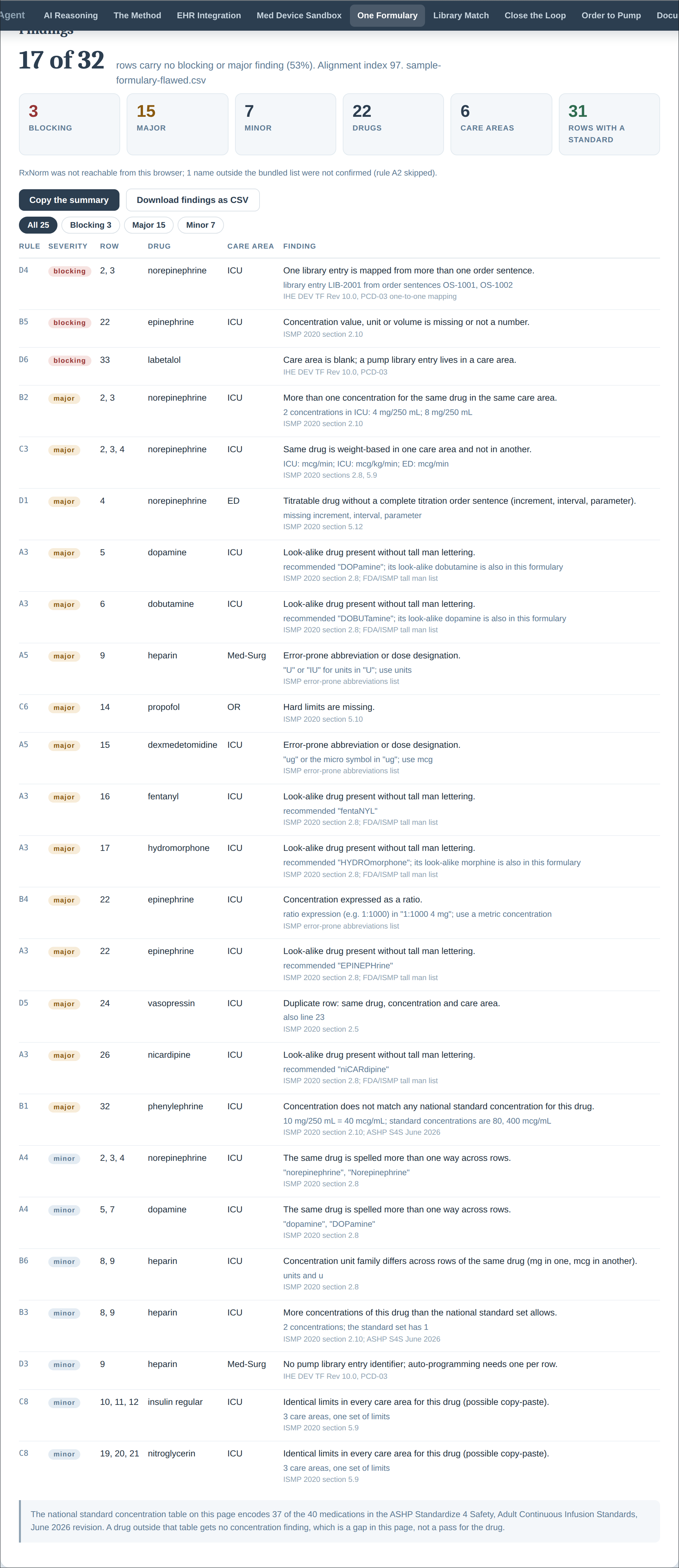
So I built something that finds the mismatches in a few seconds. It is called One Formulary. You drop in a continuous-infusion formulary, a CSV or a spreadsheet, and it checks every row against the national standard concentrations, the ISMP smart pump guidance, and the order-to-pump rules. Twenty-six checks across names, concentrations, units, limits, and order sentences. It shows you exactly where two systems that must agree do not, and it cites the published rule behind each finding. It never recommends a dose. It is an alignment check, not clinical advice, and it says so on the page.
It runs entirely in your browser. Nothing is uploaded, there is no account, and there is no cost. It is open source under the Apache license, so you can read every rule and feedback is encouraged.
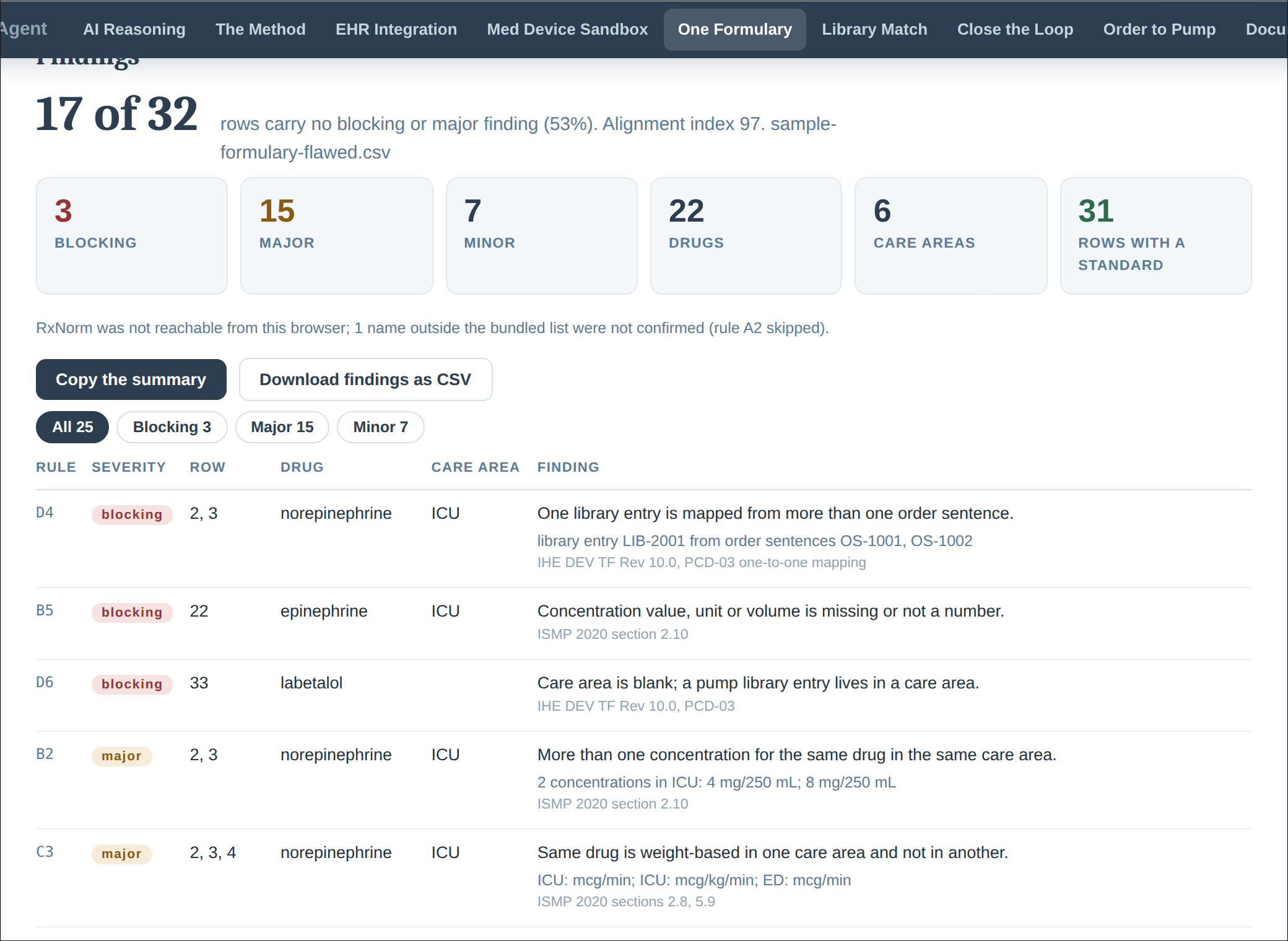
The part that bothers me is simple. The standards it checks against have been public for years. The reconciliation it does in seconds is the single most time-consuming step of every pump integration I have watched. A retired engineer built this in a few weeks. The companies that sell the pumps could have handed the same thing to every customer a decade ago, at no cost. They did not, so I did.
Run it on a real formulary and tell me what you find. If it flags something it should not, or misses something it should catch, I want to hear it. The rules are open, and they are meant to be argued with. That is the point.
There is more, and this next part is aimed squarely at the people who build the pumps.
Library Match takes an aligned formulary and checks it against your drug library, the set of dose limits the pump actually enforces. Every maker builds that library differently and exports it differently, so the tool assumes no one format. You map your own export onto a short, neutral set of columns, and it tells you, care area by care area, which entries will auto-program with the dose limits on and which will drop to a manual infusion with none, and why. That reconciliation is the step that eats months at every install.
Then there is the handshake. A third view walks the whole path an order takes: the CPOE order sentence, the formulary, the drug library, and the actual messages that carry the order to the pump and bring the pump’s answer back, built on the published IHE and HL7 standards. It is a plain, working demonstration of what full auto-programming interoperability looks like, end to end.
None of it is proprietary to anyone. It is built on standards that have been public for years. Take a look, and do it better. I will retire the whole thing the day one of you ships something that makes it unnecessary.
Start here · https://aimedagent.net/one-formulary.html
Library Match · https://aimedagent.net/library-match.html
The full handshake · https://aimedagent.net/close-the-loop.html
#InfusionPumps #MedicationSafety #Pharmacy #HealthIT #Interoperability #ISMP #Baxter #BD #Alaris #ICUMedical #BBraun
Daniel Pettus spent forty years in medical device and health IT leadership at Alaris, CareFusion and BD, contributed to IHE Patient Care Device interoperability standards, and is named on two US patents. He is the author of The Technology Was Never the Problem, available in paperback and Kindle, and the builder of the AI MedAgent research demonstration at aimedagent.net, where One Formulary is free and open source. Advisory only. Not a medical device. Not clinical decision support.