

Inside the Loop // Issue 07
A monitor watched a patient get worse for four hours and did exactly what we built it to do. That is not a malfunction. That is the design.
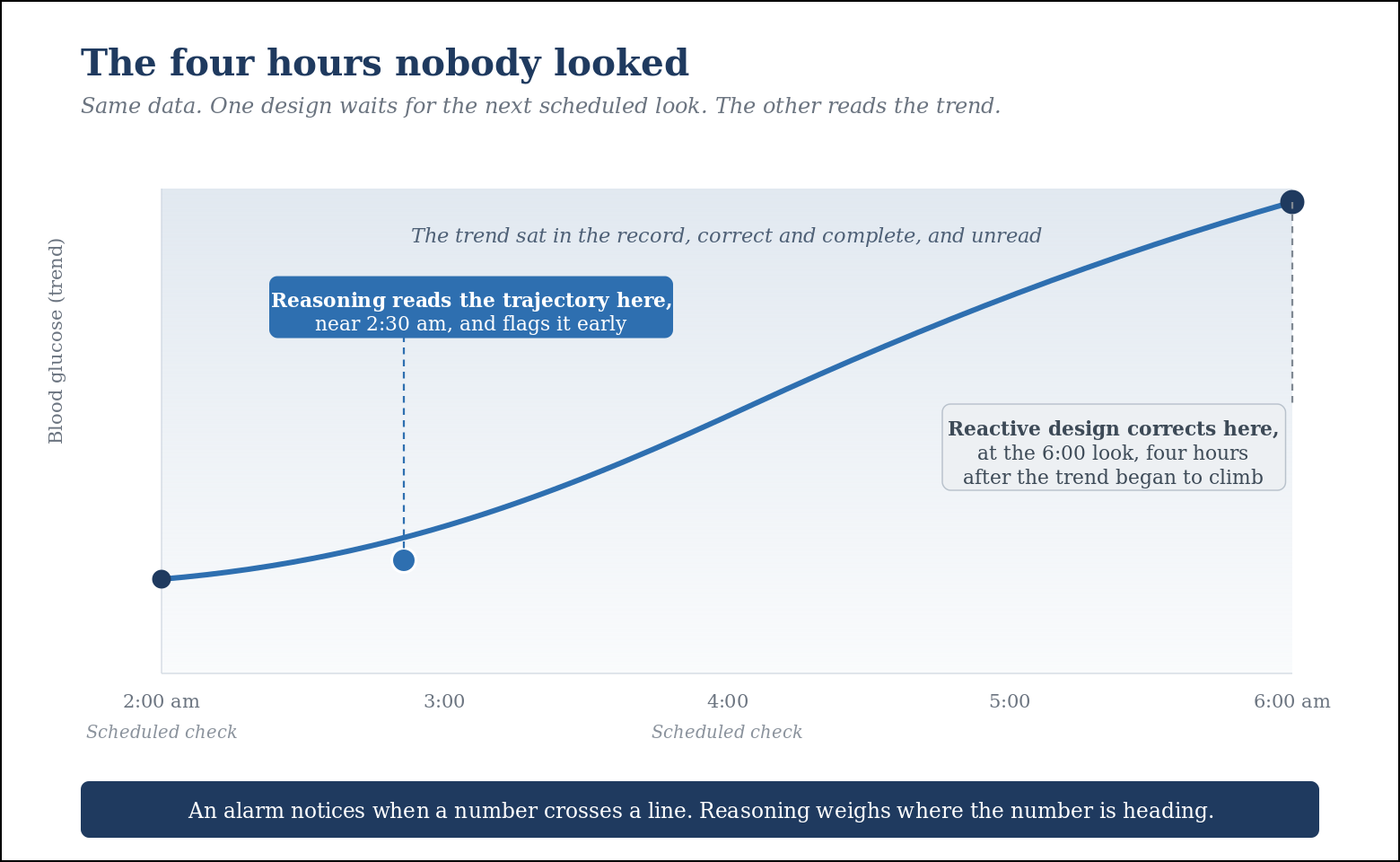
The glucose started climbing a little after two in the morning. The next scheduled check was at six. For four hours the trend sat in the record, correct and complete, and unread. When the nurse drew the six o’clock stick, the number was almost exactly where the earlier trajectory said it would be. The team did what good teams do. They corrected it, they charted it, they moved on to the next room.
Nobody failed. No one was careless, no policy was broken, no device malfunctioned. The monitor worked. The record worked. The people worked, and they worked hard. The system did precisely what it was designed to do, which was to wait for the next scheduled look and then react to whatever it found. That is the problem. Not the people, the design. And it is a problem I have spent the better part of a year trying to say out loud in a way that lands.
For thirty years I helped build machines that sound alarms. Faster alarms, smarter alarms, medication orders sent straight into the pump and into the chart. We got very good at telling a clinician that something is already wrong. We never taught the machine to reason about what to do next. An alarm is a threshold. It waits for a number to cross a line and then it shouts. It does not know where the number was ten minutes ago, or where it is heading, or what the other twelve numbers around it are doing. That is the line I want to cross: from a machine that notices to a machine that reasons.
Why me, honestly
I have no product to sell and no job to protect. That is the only reason I can afford to tell you the truth instead of a pitch.
People ask why me, and I owe you an honest answer rather than a flattering one. I do not have a tidy story. I am a retired medical device executive who cannot let go of a single idea, and that is most of it.
The rest is a pattern I only see clearly looking backward. In 1986 I worked on a processed EEG that gave anesthesia clinicians an early read on brain function, a continuous signal where before there was a guess. In 2003 we built MediCompass on the national medical terminology system, reasoning over public data to give clinicians and patients a clearer picture of therapy. Every decade or so I have made the same bet in a new form: take a signal that already exists, add a better way of reasoning over it, and try to catch harm before it lands. Some of those bets became ordinary. So when I say I do not have a clean answer for why me, the closest true one is that I have done this four or five times before it was obvious, and I am doing it again. I am retired, which means there is no product to sell and no job to protect. That is not a small thing. It is the only reason I can afford to be this blunt.
What we are actually buying
We spend twice what the rest of the wealthy world spends, and our patients live shorter lives for it. Read that sentence again.
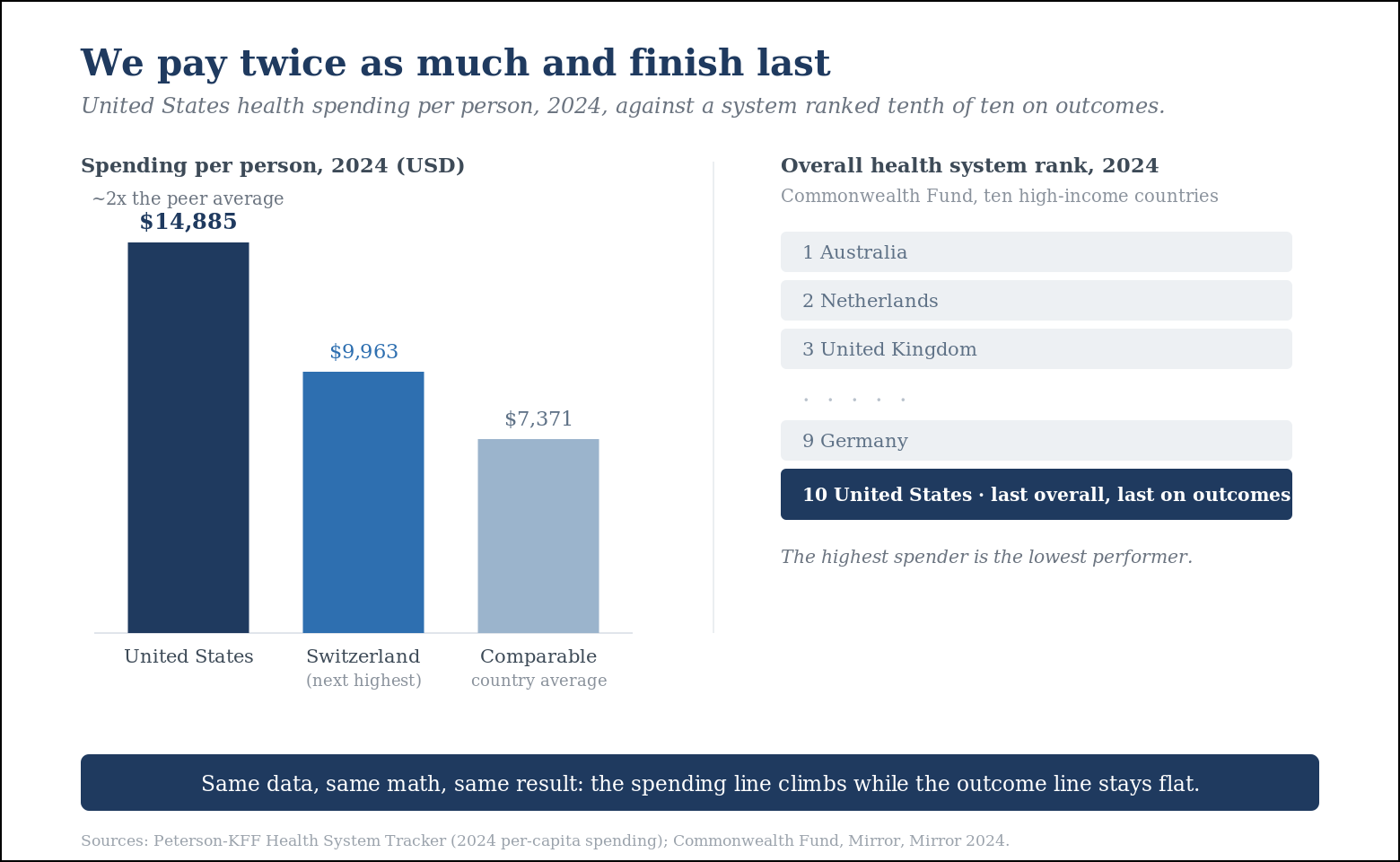
I have made the money argument in these pages before, so I will not re-litigate it in full. The short version, updated with this year’s figures: in 2024 the United States spent an estimated 14,885 dollars per person on health care, against an average of 7,371 dollars across comparable wealthy nations. We spend roughly twice what our peers spend [1]. For that premium the Commonwealth Fund’s 2024 comparison placed the United States dead last among ten high-income countries on overall performance, and last specifically on health outcomes, with Americans projected to live more than four years less than the ten-country average [2].
Let me put a sharper edge on the word outcome, because it gets used loosely. I mean three things a patient or a family would actually recognize. How long you live. Whether you have to come back. Whether the treatment itself hurts you. Take the second one: nearly fifteen of every hundred Medicare patients discharged from a hospital are back inside thirty days, a rate that has barely moved despite a decade of federal penalties aimed straight at it [3]. Take the third: adverse drug events send more than 1.5 million Americans to the emergency department every year, and nearly 500,000 of those visits end in a hospital admission [4].
Here I have to be a careful journalist rather than a passionate one, because this is exactly where our field oversells. You may have read that medical error is the third leading cause of death in the United States, a figure of around 250,000 deaths a year. That number comes from a 2016 analysis, and it is genuinely contested [5]. More conservative work puts avoidable inpatient deaths closer to 26,000 a year [6]. I am not going to hand a skeptic an easy reason to dismiss the rest of what I say by pretending the high number is settled. The honest range runs from tens of thousands to a couple hundred thousand, the measurement is hard, and even the low end is a jetliner falling out of the sky every week or two. The point does not need the biggest number. It needs the trend line, which has been nearly flat for twenty-five years while the spending line has not.
Same data, same math, same result
Feed the same numbers through the same logic for twenty-five years, then act surprised at the flat line. That is roughly what we have done.
Here is my actual thesis, and it is a testable one, not a proven one. We have spent a generation and a great deal of money pointing better and better technology at this problem, and we have looked at the same data with the same kind of logic the whole time. A threshold. A rule. An algorithm that maps one measured variable to one response. When you feed the same data through the same kind of math, you should not be shocked to keep getting the same kind of result.
Something changed recently, and it changed fast. A large language model does not reason the way a control algorithm reasons. A rule asks a single question: has this one value crossed its line. A model can hold the whole picture at once, the trajectory of the glucose and the vasopressor already running and the potassium drawn an hour ago and the drug’s known adverse-event signal, and weigh them together in plain clinical logic, the way a good clinician does on rounds. It is not magic and it is not a diagnosis. It is a different kind of reading of the same stream we already collect.
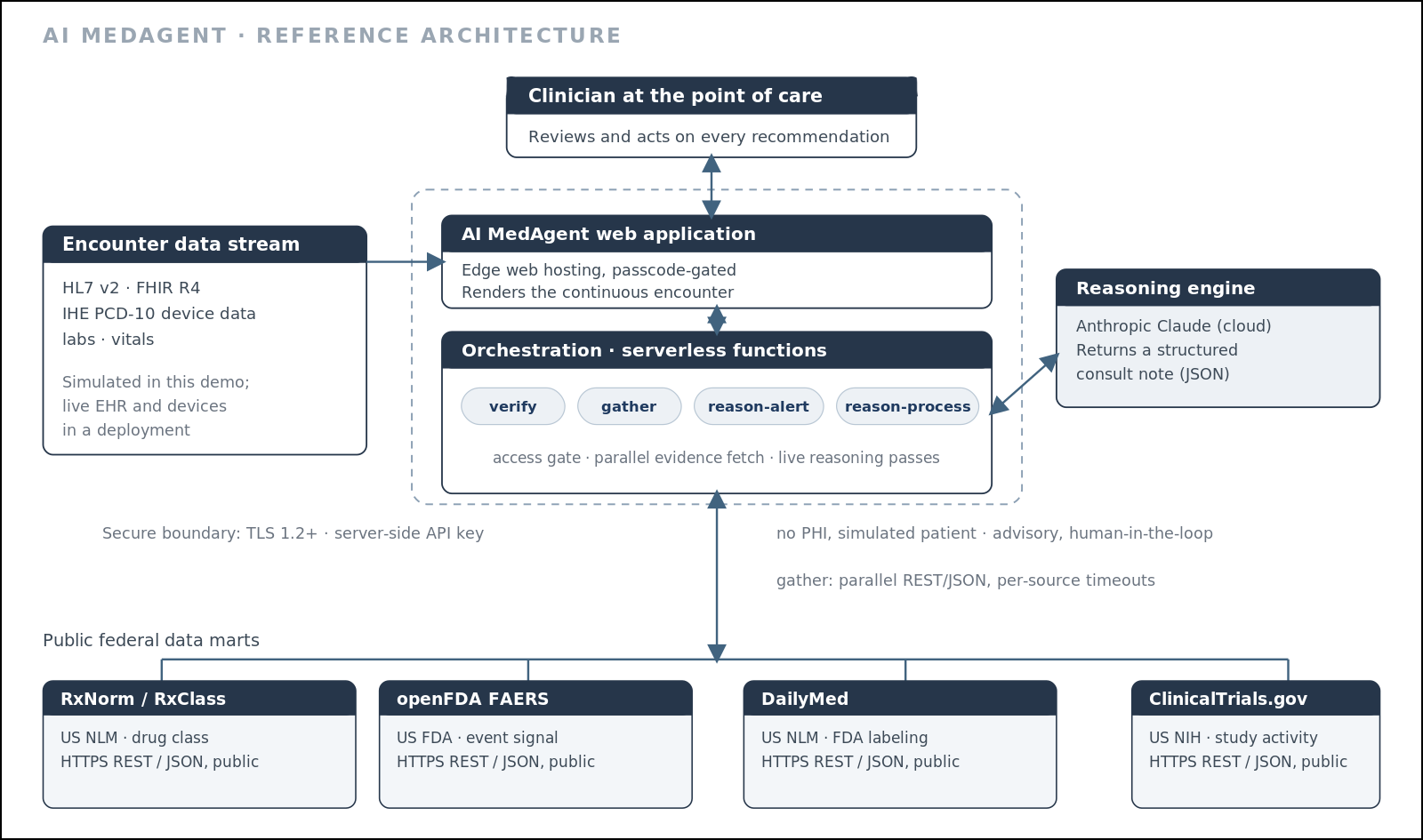
And there is more of that stream sitting in the open than most people building in this space seem to use. My demonstration draws on four public federal data marts. When I went looking for what else is freely accessible, the answer was a lot. The openFDA service alone exposes far more than the adverse-event feed everyone cites: structured drug labeling, the recall and enforcement database, the National Drug Code directory, and the device adverse-event record known as MAUDE, all as free JSON with no login [7]. The Centers for Medicare and Medicaid Services publishes hospital-level readmission, mortality, and complication data through its Provider Data Catalog, the machinery behind Care Compare, as open downloads and interfaces [8]. This is the raw material of patient safety, already public, already machine readable, and mostly unread by the systems that could act on it. Reasoning is the part we were missing, not data.
How it actually works
The data to catch this kind of harm is already public, already free, already machine readable. The part we never built was the reasoning.
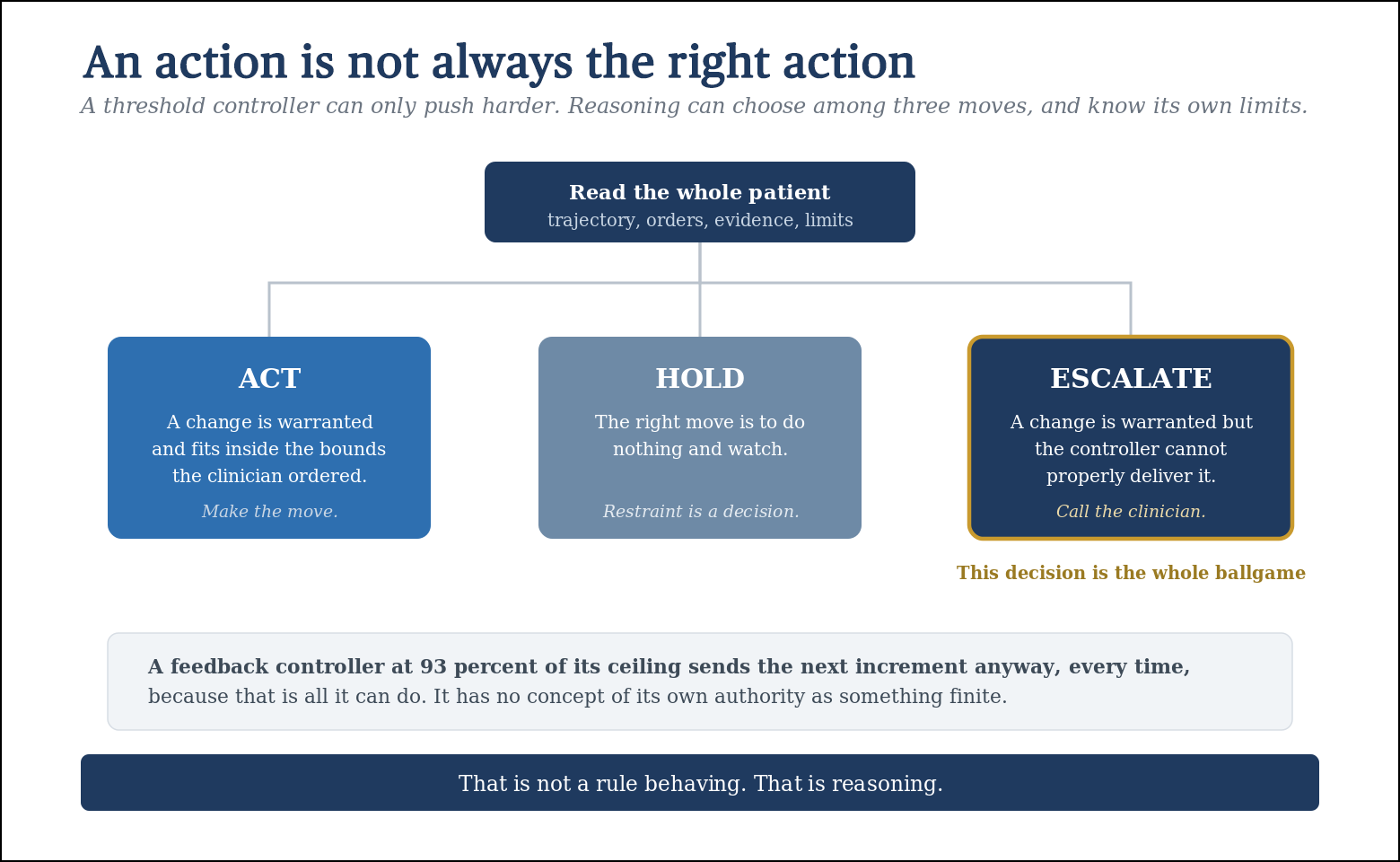
The part that makes it an invention rather than a faster alarm is what happens when you let the reasoning close the loop instead of only advising. Every pass returns one of three decisions. Act, when a change is warranted and fits inside the bounds the clinician ordered. Hold, when the right move is to do nothing and watch. Escalate, when a change is warranted but the controller cannot properly deliver it, because the ordered envelope is spent or the correct response is one it is not authorized to make. That third decision is the whole ballgame. A feedback controller sitting at 93 percent of its ceiling computes the next increment and sends it, every time, because that is all it can do. Asked in one run to nudge a vasopressor two units below its ordered maximum against a still-falling pressure, the reasoning engine declined. Its logic: the step is permitted but not enough, and spending the last authorized increment would exhaust its authority while delaying the clinician who actually needs to be called. An action is not automatically the right action. No fixed algorithm can hold that distinction, because no fixed algorithm has a concept of its own authority as something finite. That is not a rule behaving. That is reasoning.
In FSD mode the system does not stop at a recommendation. It reasons over the live stream and decides: it issues a medication order and drives it through ordering, pharmacy, dispensing, and the administration record, and it changes an infusion rate by commanding the pump directly. It also decides when not to act, and when the right action is one it is not authorized to take, in which case it hands the decision back. The clinical team is aware and supervising throughout, exactly as a driver supervises an autonomous vehicle. This is a demonstration of a future capability. It is not cleared for clinical use
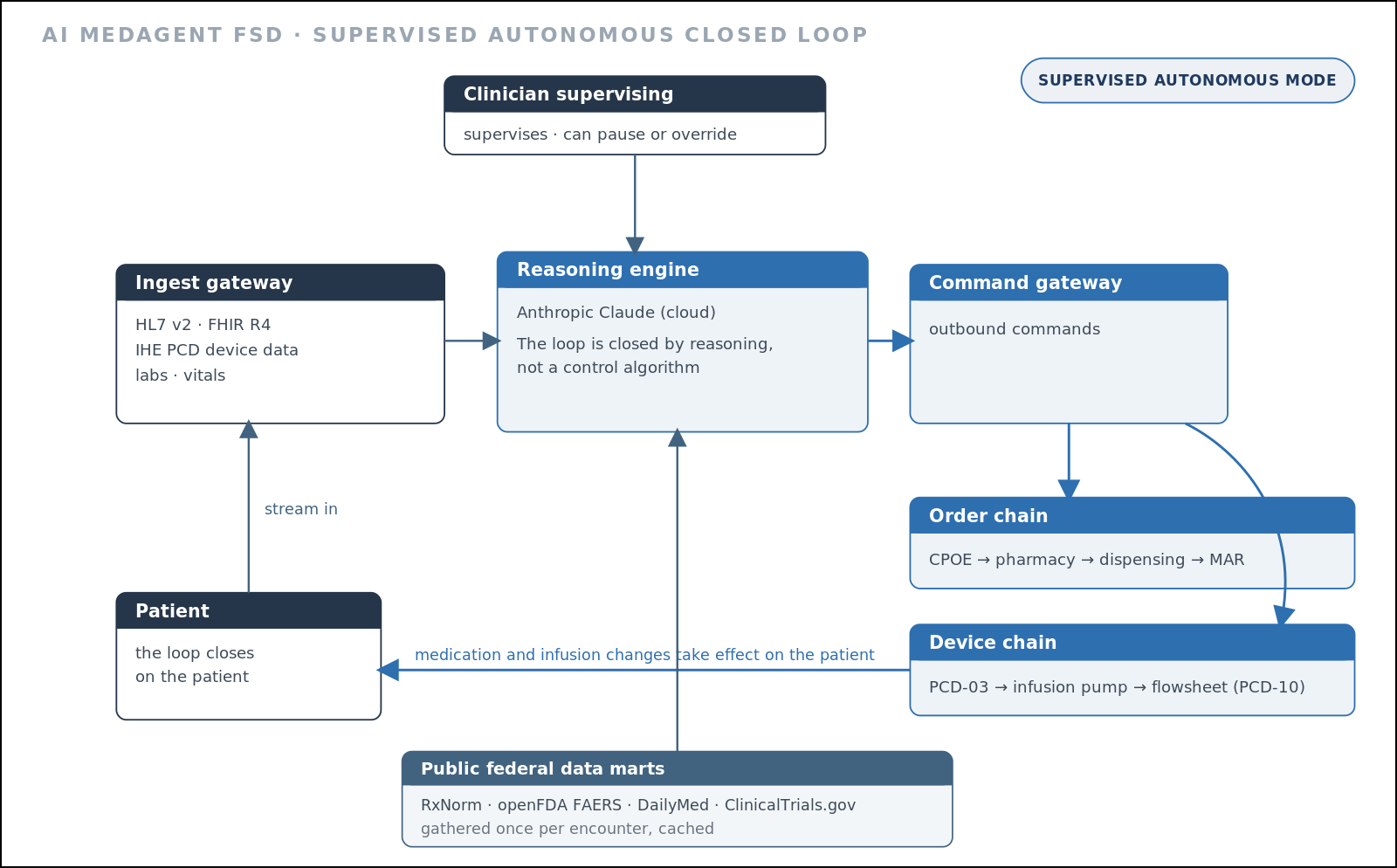
A reason
Tens of thousands of avoidable deaths a year is not a number to manage down by a percentage point. It is a design we chose. Designs can be un-chosen.
I am not going to dare anyone to try this. Daring is cheap and this subject is not. I will make a quieter case. We have spent twenty-five years and a fortune defending a design that waits for the next scheduled look, and the outcomes that matter to patients have barely moved. A genuinely new kind of reasoning arrived in the last few years, it runs over data we already collect and already publish, and for the first time it can weigh a whole patient the way a clinician does rather than watching a single line for a threshold. That might move the needle. It might not. I believe it is worth finding out, and I believe protecting the method while we find out is the sensible thing any diligent person would do, which is why the approach sits under three provisional patents rather than in a slide deck.
For me there is no product at the end of this, and there never was. If there is a personal payoff, it is narrow and honest: helping people who want to build clinical solutions on AI reasoning and public data do it well and do it safely. That is the whole ambition.
If you have read this far, I have three asks. Argue with me in the comments, because I read every one and the sharp disagreements are where this gets better. Send it to the one person you know who should see it. And if you want to see the method reason over live federal data for yourself, go to aimedagent.net and request an access code.
Nobody failed. Let us build something that does not need them to.
References
[1] Peterson-KFF Health System Tracker. How does health spending in the U.S. compare to other countries? 2024 per-capita spending: United States 14,885 dollars; comparable-country average 7,371 dollars. https://www.healthsystemtracker.org/chart-collection/health-spending-u-s-compare-countries/
[2] The Commonwealth Fund. Mirror, Mirror 2024: A Portrait of the Failing U.S. Health System. United States ranks last overall and last on health outcomes among ten high-income countries. September 19, 2024. https://www.commonwealthfund.org/publications/fund-reports/2024/sep/mirror-mirror-2024
[3] Centers for Medicare & Medicaid Services. Hospital Readmissions Reduction Program (HRRP). 30-day risk-standardized unplanned readmission measures; U.S. average readmission rate approximately 14.7 percent. https://www.cms.gov/medicare/payment/prospective-payment-systems/acute-inpatient-pps/hospital-readmissions-reduction-program-hrrp
[4] Centers for Disease Control and Prevention, Medication Safety (FastStats); Shehab N, et al. US Emergency Department Visits for Outpatient Adverse Drug Events, 2013-2014. JAMA. 2016;316(20):2115-2125. More than 1.5 million ED visits annually; approximately 27 percent result in hospitalization. https://www.cdc.gov/medication-safety/data-research/facts-stats/index.html
[5] Makary MA, Daniel M. Medical error, the third leading cause of death in the US. BMJ. 2016;353:i2139. Estimate of approximately 251,000 deaths; methodology subsequently contested. https://pubmed.ncbi.nlm.nih.gov/27143499/
[6] Agency for Healthcare Research and Quality, PSNet. Measuring and Responding to Deaths From Medical Errors. More conservative estimates place avoidable inpatient deaths near 26,000 per year. https://psnet.ahrq.gov/perspective/measuring-and-responding-deaths-medical-errors
[7] openFDA, U.S. Food and Drug Administration. Drug and device API endpoints: adverse events, structured product labeling, recall enforcement, NDC directory, and device MAUDE. Free public JSON, no authentication. https://open.fda.gov/apis/
[8] Centers for Medicare & Medicaid Services. Provider Data Catalog and Care Compare. Hospital-level readmission, mortality, and complication measures published as open data. https://data.cms.gov/provider-data/
[9] AI MedAgent Technical Datasheet. Reference architecture, data flow, and governance for the advisory method. aimedagent.net. https://aimedagent.net
Daniel Pettus is the founder of Inside the Loop and the inventor of AI MedAgent, a proof-of-concept closed-loop medication management architecture. He spent nearly forty years in medical device and health IT leadership at Alaris, CareFusion, and BD. He co-founded iMetrikus in 1998 and contributed to IHE Patient Care Device interoperability standards. AIMedAgent methods are patent pending.
Thanks, Dan. This one hit close to home. I spent years in Med Tech myself, including time with you at Diatek, and now I'm living the patient side of exactly what you're describing.
Since retiring I've made a project out of finally dealing with health issues I let slide during my career. The biggest obstacle hasn't been any one doctor, it's the lack of a whole patient view. I've got a GP and a dozen specialists, all excellent in their own domain, but they run on different EHRs, use different labs, and consolidation of notes, results, and observations across practices is weak. I've had specialists order tests another practice had already run weeks earlier because the result never crossed the EHR boundary. More than once I've been the one carrying lab values and imaging notes from one office to the next myself, because the systems wouldn't do it for me.
Your monitor example is one piece of a much bigger problem. Data, analytics, and reasoning applied to the whole patient in near real time isn't just about catching a glucose trend at 2 a.m., it's what's missing from most of my care right now. I've spent many hours building my on personal health data management system in AI to help me manage my care across providers. While its been a fun challenge, I wish it wasn't necessary. Cheers!