

A short one. Something went live on aimedagent.net this week, and I would rather you try it than read about it.
Smart Formulary
Before a smart pump can program itself from an order, four systems have to agree on the drug: the order screen the doctor uses (CPOE, computerized provider order entry), the pharmacy, the label on the bag, and the pump’s own drug library. When they disagree, the pump drops to basic mode, with no dose limits. I spent a good part of my career watching that happen. Smart Formulary finds the disagreements before the pump does. Its two tools, One Formulary and Library Match, run in your browser, upload nothing, and are free and open source.
Smart Orders
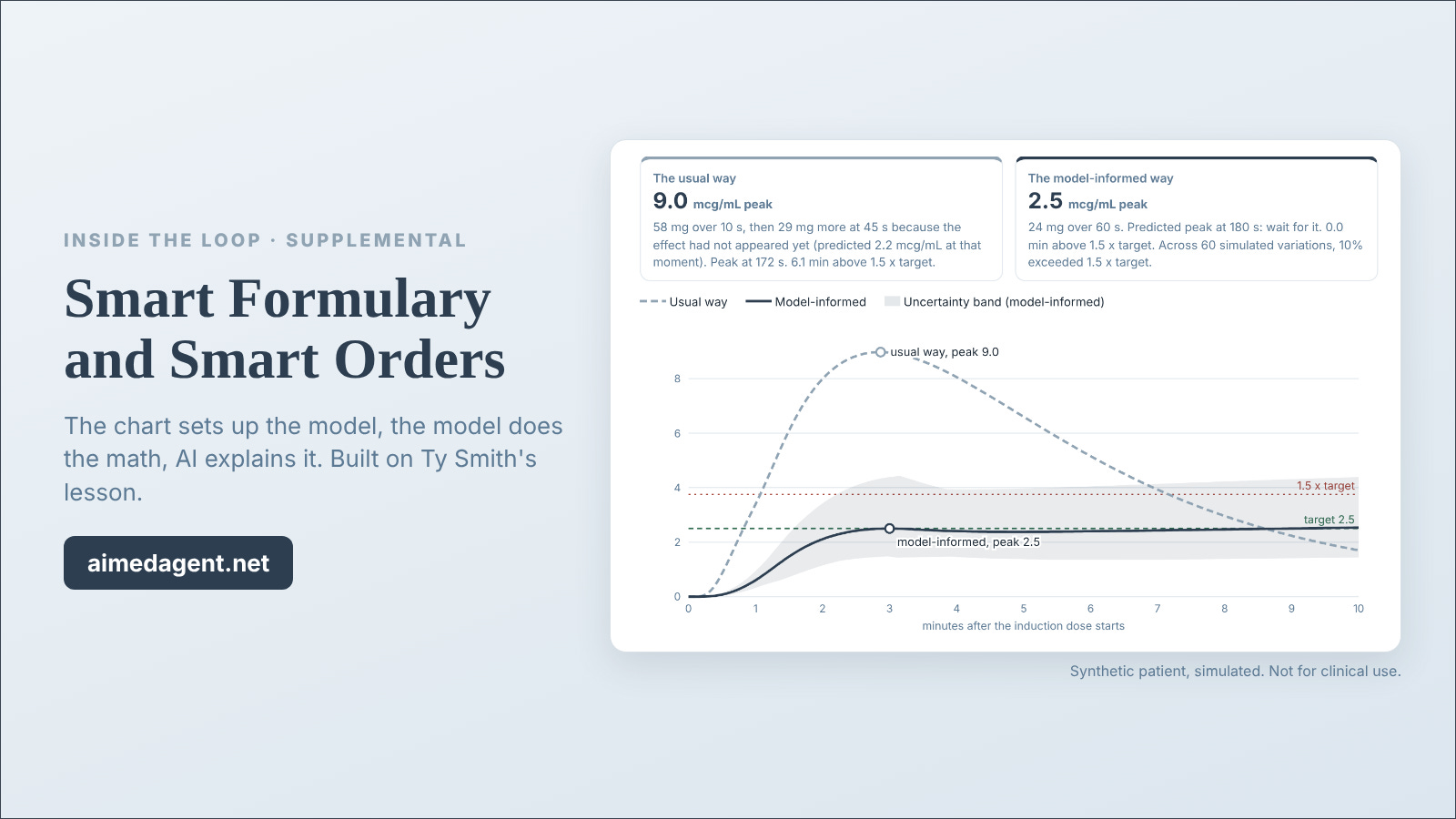
This is the new one. Pick a synthetic patient. The chart sets up a published pharmacokinetic model, which is the math of how a body moves a drug: how fast it arrives, where it spreads and how fast it clears. The model does the arithmetic. AI MedAgent reads the chart and the FDA label, explains the result, and says what it could not check. Out comes a draft IV order with a goal, a flow pattern and a time not to give more.
Try Mrs. R, 79, heart failure, a slow circulation. The usual way is a weight-based dose given fast, then a second dose at 45 seconds because nothing seems to be happening. In the simulation both doses arrive together, and the predicted level peaks at more than three and a half times the target. The drug was never failing. It was stuck in traffic [3, 4]. The model-informed order gives a smaller dose more slowly, reaches the target, and says in writing: do not repeat for 210 seconds.
Fair warning on that example. The slow-circulation adjustment is an illustrative extension of published findings, not a validated model.
Credit where it is due
Dr. N. Ty Smith, a mentor of mine, spent decades showing that the circulation changes the drug and the drug changes the circulation. In 1972, with Anton Zwart and Jan Beneken, he coupled the two on an analog computer [1]. That work grew into BODY, a PC simulation with more than 200 variables in which a teacher could build a patient and watch the same drug land differently in a different body [2].
BODY could teach the lesson. It could not reach a real patient, because there was no electronic chart to read and nothing that could reason over it. Now there is both. AI is what finally carries Ty’s lesson from the classroom to the bedside, and I am not going to be shy about saying so.
What it is not
A demonstration on synthetic patients. One drug, propofol, on the Schnider model, built from 24 adult volunteers aged 25 to 81 [5]. Every order is drafted, never placed; a clinician accepts or rejects it. Software that calculates a patient-specific dose is a medical device function under FDA’s clinical decision support guidance [6], and none of it is for clinical use.
Come and check it out
aimedagent.net, box 03, Smart Formulary and Smart Orders.
Next up: taking AI MedAgent from the ICU into the home. More later this month.
References
[1] Smith NT, Zwart A, Beneken JEW. Anesthesiology 1972;37(1):47-58. Also Zwart A, Smith NT, Beneken JEW. Multiple model approach to uptake and distribution of halothane: the use of an analog computer. Comput Biomed Res 1972;5(3):228-238.
[2] Smith NT. PC-based “BODY” simulation presents anesthesia learning chance, challenge. APSF Newsletter 1999;14(2). https://www.apsf.org/article/pc-based-body-simulation-presents-anesthesia-learning-chance-challenge/
[3] Krejcie TC, Avram MJ. What determines anesthetic induction dose? It’s the front-end kinetics, doctor! Anesth Analg 1999;89:541-544.
[4] Upton RN, et al. Cardiac output is a determinant of the initial concentrations of propofol after short-infusion administration. Anesth Analg 1999;89:545-552.
[5] Schnider TW, Minto CF, Gambus PL, et al. The influence of method of administration and covariates on the pharmacokinetics of propofol in adult volunteers. Anesthesiology 1998;88:1170-1182.
[6] US Food and Drug Administration. Clinical Decision Support Software: Guidance for Industry and Food and Drug Administration Staff. Revised January 2026.
Daniel Pettus spent his career in medical device and health IT leadership at Alaris, CareFusion and BD and contributed to IHE Patient Care Device interoperability standards. AI MedAgent is a research demonstration of a patent-pending method. Synthetic data only. Not for clinical use.