

Inside the Loop, Issue 21 | Daniel C. Pettus | 22 September 2026
I spent forty years getting technology into hospitals. Alaris, CareFusion, BD. I am retired now, which means I can say what I think, and what I think is that the investment community is about to make the same mistake in both directions at once. Fund things that say AI and are not. Walk past things that are, because nobody in the room could tell the difference.
This is not a piece telling you to be careful. You have lawyers for that, and the medical device sector is better at regulation than at almost anything else. This is a piece telling you the next wave is real, that it will take risk capital to happen, and that the thing most likely to stall it is not caution. It is not knowing.
The worst outcome is to do nothing because you do not know.
Where the money is, in three numbers
Silicon Valley Bank’s seventeenth Healthcare Investments and Exits report, published in January 2026, put total healthcare venture investment at $46.8 billion in 2025, down 12 percent. Of that, AI took 46 percent, more than $18 billion. The device sector grew 1.5 percent. [1]
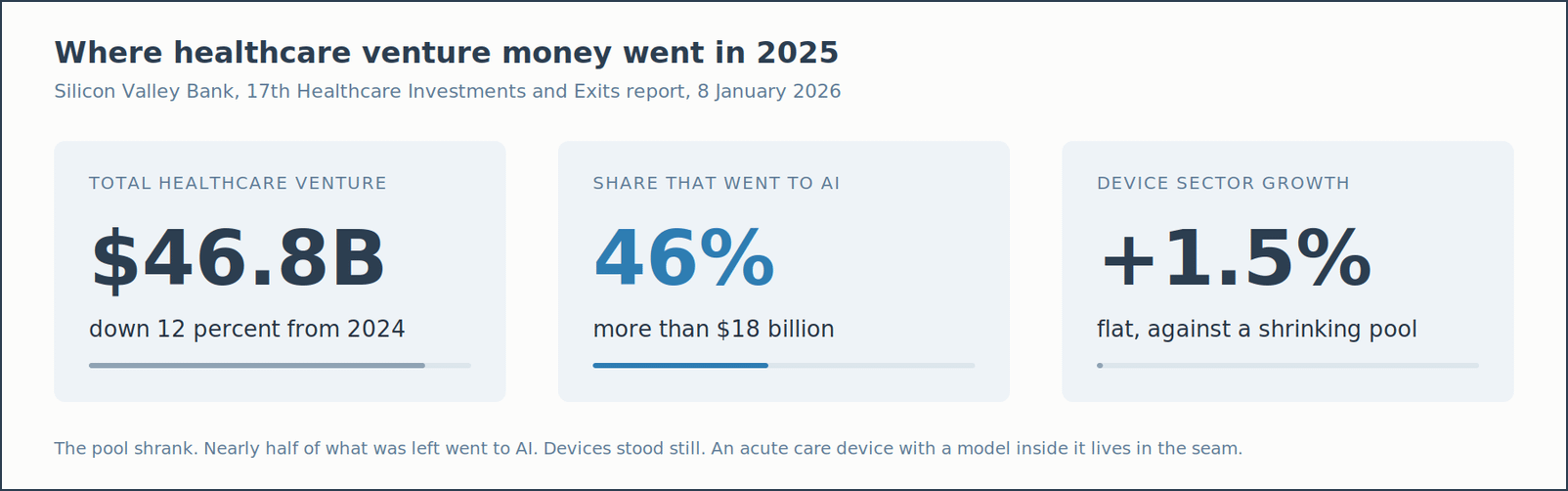
The pool shrank, half of it went to AI, and devices stood still. An acute care device with a real model inside it lives in the seam between those two numbers, too much hardware for the software money and too much model for the device money, and neither bench has the people to judge it.
Rock Health, in its first half 2026 report, put the shift in one sentence. [2]
“Investors and buyers are not asking, ‘Who has AI?’ but instead, ‘Who has something AI alone can’t provide?’”
Good. That is the right question. What follows is how to answer it.
Where clinical AI is today
At scale, it is at the keyboard.
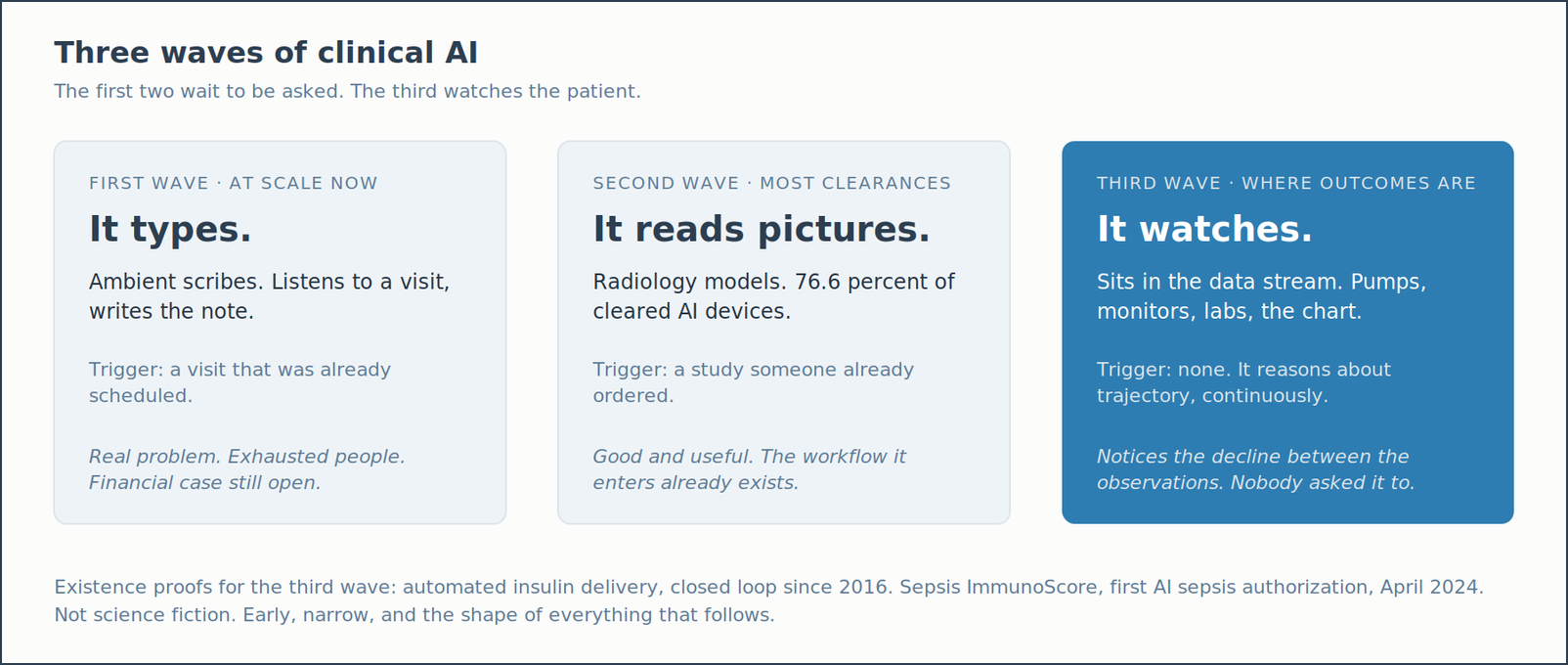
Ambient scribes, the tools that listen to a visit and write the note, are the first wave and they are real. The Peterson Health Technology Institute reported in March 2025 that adoption “is on track to be one of the fastest in recent healthcare history,” that the tools are “potentially effective at reducing clinician documentation time and cognitive load,” and that the financial impact is still unproven. [3] All three of those things are true at once. It is a good product category solving a real problem for exhausted people.
The other place AI has landed is imaging. Of the 903 AI-enabled devices authorized through August 2024, 76.6 percent were radiology, according to Windecker and colleagues in JAMA Network Open. [4] Software that reads a picture and hands a finding to a physician who was already going to look at that picture.
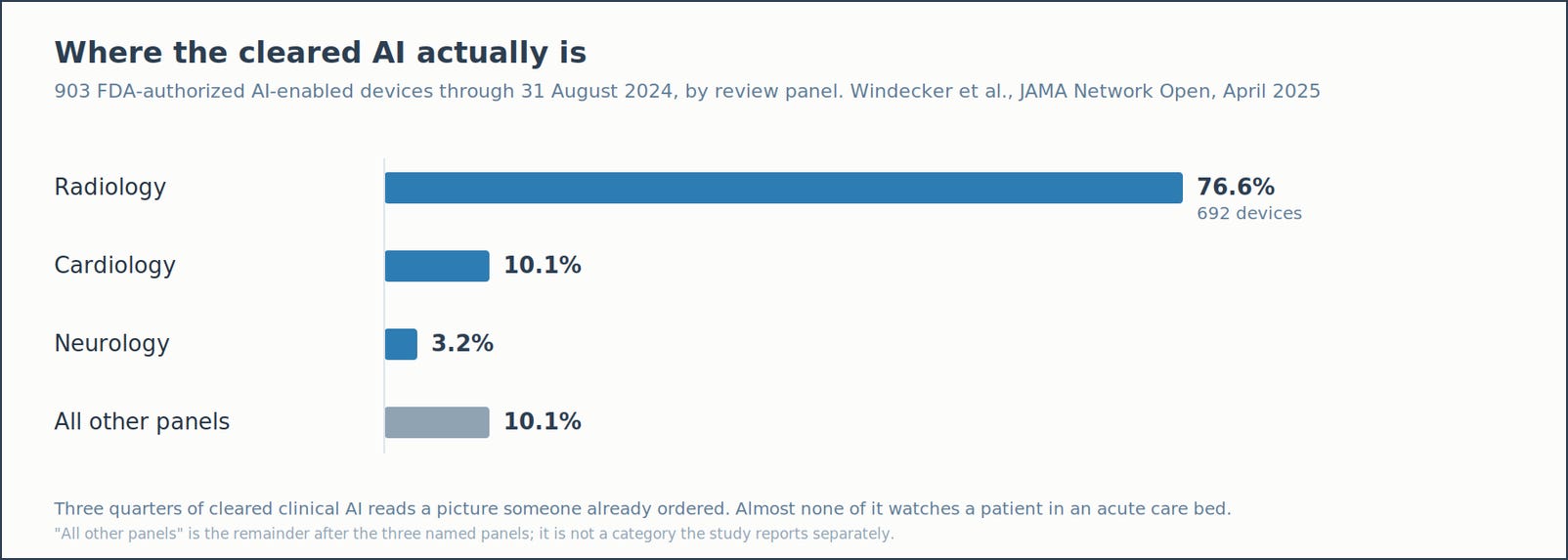
Notice what those two waves have in common. They wait to be asked. A scribe listens to a visit that was already scheduled. A radiology model reads a study someone already ordered. Neither one is watching the patient at three in the morning, and three in the morning is where patients are lost.
The next wave: from chat to continuous
The wave that changes outcomes is the one where the model does not wait to be asked.
It sits in the data stream. Monitors, infusion pumps, ventilators, labs, the chart. It watches continuously, it reasons about trajectory rather than thresholds, and it either proposes an action to a clinician or, eventually and carefully, takes one. That is the difference between a tool that helps a doctor write faster and a tool that notices a patient declining between the scheduled observations, in the hours when nobody is looking because nobody was due to look.
This is not science fiction.
It has already been done, once, at scale
Automated insulin delivery. In September 2016 the Medtronic MiniMed 670G was approved as the first hybrid closed loop system, a continuous glucose sensor feeding an algorithm feeding an insulin pump. [5] In December 2019 Tandem’s Control-IQ was authorized as the first interoperable automated glycemic controller, software that, in the regulator’s own words, can “automatically increase, decrease and suspend delivery of basal insulin to the patient based on insulin delivery history, iCGM readings and predicted glucose values.” [6]
Continuous sensing, a predictive model, a therapy device, and a closed loop between them, deployed at scale, worn by children. It worked under specific conditions: one variable, one drug, one patient who owns the device and lives with it. Acute care is harder on every one of those axes. But the sentence “it cannot be done” is no longer available to anyone.
It has started in the hospital
On 2 April 2024 the Prenosis Sepsis ImmunoScore became the first AI tool authorized for sepsis. It draws up to 22 inputs from the electronic health record and produces a risk category for sepsis within 24 hours. [7] Narrow, early, explicitly an aid and not a decision. And a model reasoning over live hospital data about what is going to happen next, which is the shape of everything that follows.
The first wave helped clinicians type. The second wave reads pictures. The third wave watches the patient. The third wave is where the outcomes are, and it is the one your diligence process was never built to evaluate.
What “AI integration” actually means
Here is the part of the brochure nobody unpacks, and it is the part I have spent my career inside. Getting clinical technology to change an outcome is four steps, in order. Acquire the data. Normalize the data. Reason over the data. Connect it to a human being. A real product has something at every step. A brochure has something at step three and a picture of the rest.
1. Acquire. Is the data actually flowing?
The brochure says: “Integrates with the EHR.”
The real thing has: a named feed, a named standard, a named direction. And there are two feeds, not one. The stream is what is happening to the patient right now: pumps, monitors, ventilators. It comes off the device network through IHE and HL7 to a gateway. The chart is who it is happening to: orders, labs, allergies, history. It comes through the FHIR interfaces that every certified EHR in the United States has been required to expose since the end of 2022. [8] No single source carries both. Ask which one they have connected. Most have neither, and the ones with one will tell you they have both.
2. Normalize. Do the systems speak the same language?
The brochure says: “Works with any data source.”
The real thing has: a data dictionary, and I want to spend longer here than on the other three, because this is the step that quietly kills projects and it is the step almost nobody funds.
Without normalizing the data, and without an agreed dictionary of terms underneath it, none of the reasoning works. Not some of it. None of it. A model reasoning over a stream where the pump says one thing, the lab says another and the chart says a third is not reasoning. It is guessing with confidence, and confident guessing at a bedside is the thing every one of us in this industry has spent a career trying to remove.
The good news is that the hard part of this was solved a long time ago and it is sitting in plain sight. The National Library of Medicine started the Unified Medical Language System in 1986. It brings together more than a hundred clinical vocabularies, including RxNorm, SNOMED CT, LOINC and ICD-10-CM, into a single Metathesaurus of more than a million concepts, and it assigns each concept one identifier, a CUI, that is the same no matter which vocabulary a system happens to speak. The license is free. [9] It is public infrastructure, paid for already.
My personal experience with UMLS goes back to the early 2000s, and it is where I learned that the same-language problem is solvable if someone is willing to do the unglamorous work. Take the simplest case that matters, formulary alignment. A hospital’s master formulary, its order sentences, its pump drug library and its dispensing cabinet all name the same drug and concentration slightly differently. Map each of them to the same concept identifier and they can finally agree. Fail to, and every downstream system is reconciling by string match and hoping.
That is where AI earns its first honest keep, and it is not glamorous either. A model plus the public data sources, RxNorm, openFDA, DailyMed, is very good at the first pass of that mapping, at proposing the concept a local term most likely means and flagging the ones it is not sure of for a pharmacist to settle. It is the step that has to be done before any of the other steps in AI reasoning can be trusted. And I will be honest about its limit: public data gets you the first pass, not the last word. A licensed drug knowledge base and a person with a license still stand behind the final mapping, and any vendor who tells you otherwise has not shipped into a pharmacy.
Ask the founder to show you the dictionary. Not describe it. Show it. The mapping table from their sources to a common concept set, with the un-mapped terms listed. The companies that have one will bring it to the meeting. The companies that do not will talk about the model.
3. Reason. What does the model actually do?
The brochure says: “AI-powered.”
The real thing has: what goes in, what comes out, how fast, what it does when an input is missing, and the one thing that never makes the slide: what it reports that it could not check. A model that watches trajectory over an hour and flags a patient nobody has looked at is a different object from a model that waits for a number to cross a line. And an engine that reports its own blind spots is checkable. One that does not is a brochure.
4. Connect. Who acts, and who let them?
The brochure says: “Clinical decision support.”
The real thing has: a named role, a named moment in that person’s existing workflow, a named governance body that approved the change to that workflow, and an answer for what happens when the human disagrees. This is the step where the hospital’s buying committee lives, where pharmacy owns the configuration and nursing owns the response and security owns the door. It is also the step my industry spent forty years underestimating, which is how I know it is the step you will underestimate too.
The pattern across all four: a brochure asserts a capability as a noun. A real product can describe it as a verb. What changes, for whom, at what hour, and under whose authority.
What it is worth, and what it costs
I will not do the pom-poms. Here is the honest ledger.
What it accomplishes. It catches the trajectory that no threshold catches. It sees the interaction between two systems that neither system sees alone, a drug on a pump and a lab value in the chart. It gives the night shift, which is understaffed everywhere, a second set of eyes that does not get tired. And it does the one thing five decades of connectivity never did: it puts a reasoning step between the data and the human, instead of just moving the data faster.
What it risks. A model wrong at scale is wrong in every bed at once. Automation bias is real, it has been measured, and clinicians do defer to confident software. [10] Nobody has yet settled who is liable for a model’s recommendation, and the first lawsuit will settle it for everyone. And the industry it is breaking into is a status quo industry with policies, committees and buyers who have been burned by five previous nouns and are not wrong to be skeptical of the sixth.
Why it is still worth the risk. Because the alternative is the current state, and the current state is patients declining between observations while the data that would have told you sits in three systems that do not talk. That is not a hypothetical cost. It is the one we are paying now, and we have simply stopped counting it.
Five questions that separate the real thing from the brochure
None of these is about the regulator. Founders in this sector can handle the regulator. These are about whether the thing exists.
Which feed do you have running, the stream or the chart? Show me. Not a diagram. The data, moving, today. A company that has the chart connected through FHIR is real. A company that has device data flowing through a gateway is rare. A company that says it has both and cannot show either has a slide.
Show me the dictionary. The mapping from your sources to a common concept set, with the un-mapped terms listed. If there is no dictionary, there is no normalization, and if there is no normalization the model is reasoning over noise.
What does the model report when it cannot check something? If the answer is silence, you are funding confidence, not reasoning. The second output, what it could not see, is the one that tells you whether the engineers understood the problem.
Who acts on the output, at what point in their existing workflow, and who approved putting it there? A physician champion is not an answer. A committee minute is.
What is the smallest version of this running today, and can I see it? Not the vision. The thing. A small working example beats a large described one every time, and it is the single most reliable tell I know.
A small thing, by design
I should show you what I mean by that last question, since I am asking you to apply it to others.
I have a demonstration running at aimedagent.net. It is not a product and it is not a company. It is a reasoning layer sitting between a patient’s data and a clinician, built to show one thing: that the third wave can be built today, with the standards and the public data that already exist. I am not selling it. I am pointing at it, because it is easier to argue about something you can see.
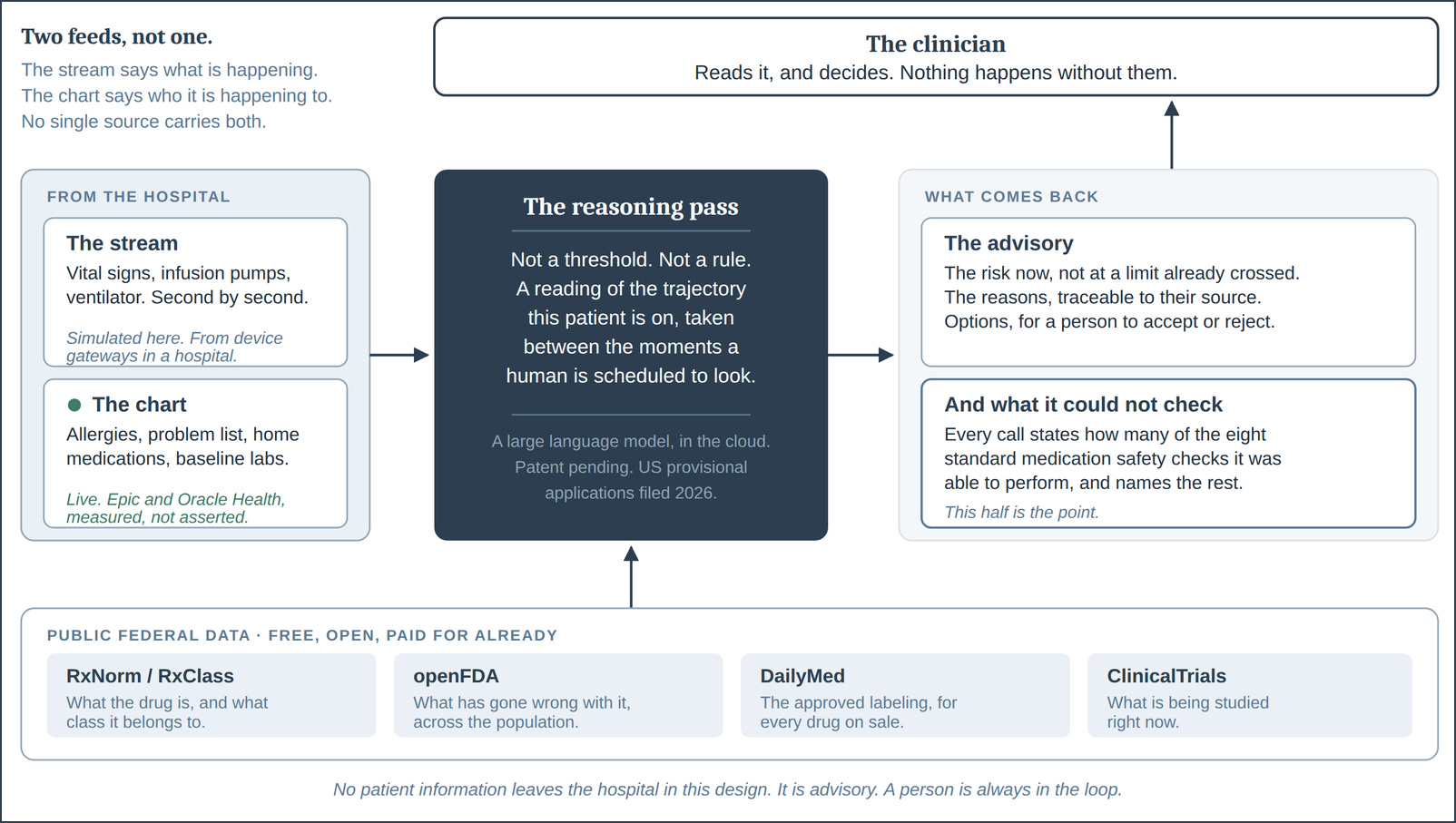
Read the diagram against the four steps. Acquire: two feeds, the stream and the chart, which one is simulated and which one is live. Normalize: the row along the bottom, RxNorm, openFDA, DailyMed, ClinicalTrials, the free public vocabularies doing the same-language work. Reason: the dark box in the middle, trajectory rather than threshold, and it reports what it could not check as a first-class output, not a footnote. Connect: the clinician at the top. Reads it, and decides. Nothing happens without them.
It is small on purpose. It is advisory only. It is patent pending. And it exists so that when I say the third wave is real, I am not asking you to take my word for it.
I invite the investment community to pay attention. Not to this. To the class of thing it is. That is where the value of AI reasoning is heading, and it is going to need people with capital who can tell it apart from the noun on the slide.
Where this leads
I have no idea. Neither do you. Anyone who tells you they know how clinical AI plays out over the next decade is selling something, and it is probably in a brochure.
But the inevitable is the inevitable. The models are good enough. The interfaces exist. The vocabularies were built forty years ago and are sitting there free. The first authorizations are on the books. What is missing is the capital to carry the real ones across the gap between a demonstration and a deployment, and the judgment to know which ones those are.
We are going to see a massive change in how care is delivered over the next several years. It will take risk investment to make it happen. Many will fail. Some will break out. The ones that break out will change healthcare, and I would like it to be for the better, which is why I am writing to the people who decide what gets funded rather than to the people who build it.
You now have four steps and five questions. That is more than most of the market has.
The AI in the brochure is not the risk. The risk is that you cannot tell it from the real thing, and so you fund neither.
Daniel Pettus spent forty years in medical device and health IT leadership at Alaris, CareFusion and BD, contributed to IHE Patient Care Device interoperability standards, and is named on two United States patents. He writes Inside the Loop at insidetheloopdp.substack.com.
The serious version of the day job is a book. The Technology Was Never the Problem: forty years of trying to connect medical devices, what actually stopped it, and why the answer was never engineering. Paperback and ebook at pettusbook.com.
AI MedAgent is a research demonstration of a patent-pending method. Advisory only. Not a medical device. Not for clinical use. Simulated patients, synthetic data only. aimedagent.net
Notes
[1] Silicon Valley Bank, a division of First Citizens Bank. AI Investment Accounted for Nearly Half of Healthcare Investment in 2025; Silicon Valley Bank Releases 17th Healthcare Investments and Exits Report. Press release, 8 January 2026. Total healthcare venture investment $46.8 billion in 2025, down 12 percent; AI 46 percent and more than $18 billion; device sector growth 1.5 percent.
[2] Rock Health. H1 2026 digital health funding report, July 2026, as reported by Fierce Healthcare, July 2026. Rock Health counts digital health, which is predominantly software and services, not acute care devices.
[3] Peterson Health Technology Institute. Leading Health Systems: AI-Powered Scribes Alleviate Clinician Burnout; Financial Impact Unclear. 25 March 2025.
[4] Windecker D, Baj G, Shiri I, et al. Generalizability of FDA-Approved AI-Enabled Medical Devices for Clinical Use. JAMA Network Open. 2025;8(4):e258052. Published 30 April 2025. 903 devices authorized through 31 August 2024; radiology 692 (76.6 percent); cardiology 10.1 percent; neurology 3.2 percent.
[5] US Food and Drug Administration. Approval of the Medtronic MiniMed 670G hybrid closed loop system, September 2016, described by the agency as the first device approved in the United States to automatically monitor glucose and provide appropriate basal insulin doses in people 14 and older with type 1 diabetes.
[6] US Food and Drug Administration. FDA authorizes first interoperable, automated insulin dosing controller designed to allow more choices for patients looking to customize their individual diabetes management device system. Press announcement, 13 December 2019. Tandem Diabetes Care Control-IQ Technology, De Novo pathway.
[7] US Food and Drug Administration. De Novo DEN230036, Sepsis ImmunoScore, Prenosis, Inc. Decision date 2 April 2024. Up to 22 predetermined inputs from the electronic health record; risk of presence of or progression to sepsis within 24 hours; intended for use in conjunction with other laboratory findings and clinical assessments.
[8] Office of the National Coordinator for Health Information Technology. 21st Century Cures Act: Interoperability, Information Blocking, and the ONC Health IT Certification Program, Final Rule, 85 FR 25642, 1 May 2020, and 45 CFR 170.315(g)(10), the standardized FHIR API criterion. Compliance deadline 31 December 2022. ONC reported on 10 February 2023 that more than 95 percent of certified health IT developers met the deadline.
[9] National Library of Medicine. Unified Medical Language System (UMLS), nlm.nih.gov/research/umls. Begun in 1986 under NLM Director Donald A. B. Lindberg. The Metathesaurus integrates more than 100 source vocabularies, including RxNorm, SNOMED CT, LOINC and ICD-10-CM, into more than one million concepts, each carrying a Concept Unique Identifier. There is no charge for the UMLS license.
[10] Goddard K, Roudsari A, Wyatt JC. Automation bias: a systematic review of frequency, effect mediators, and mitigators. Journal of the American Medical Informatics Association. 2012;19(1):121-127.