

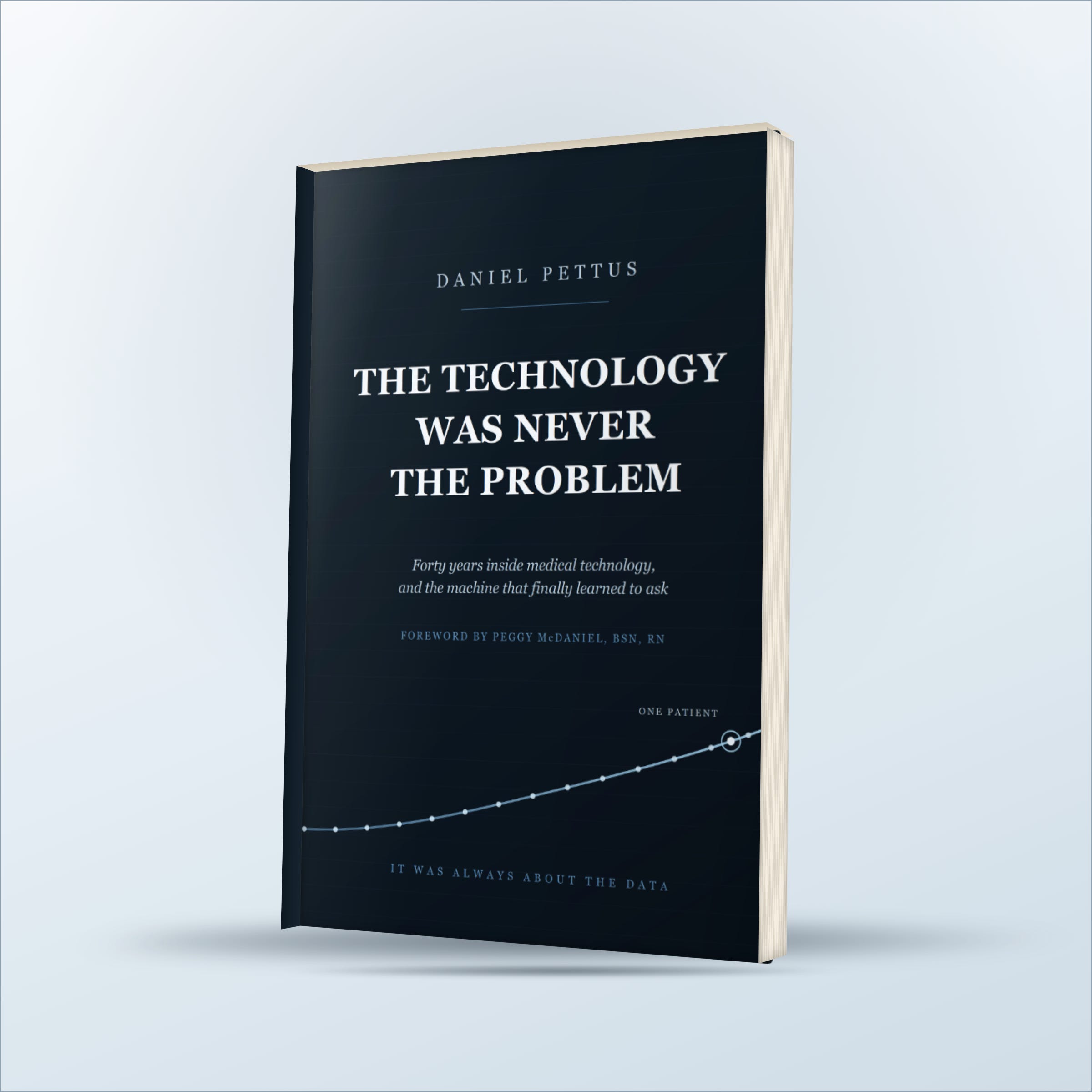
My brother Michael got one of the first paperbacks. He wrote to say that he and a friend were both having trouble reading it. Light grey, low contrast, hard on older eyes.
He was right, and it was not his eyes.
The body text in the first printing was not black. It was set to 90% black.
On a screen, 90% black and 100% black are indistinguishable. That is not a figure of speech. I looked at that file for weeks, ran it through a proof review, and approved a printed proof, and at no point did anything on my display tell me the text was not black. The difference is invisible until it reaches a press.
On a print-on-demand press it is not invisible at all. Anything that is not solid black gets broken into a halftone dot pattern rather than laid down as solid toner. At ten and a half point on cream paper, that reads exactly as Michael described it.
It was not the ink. The file told the press to print 90% black, and the press did precisely what it was told. The figure captions were worse than the body text, at 73 to 75% black in eight and a half point type.
Measured off the actual file at 400 dots per inch, the darkest pixel in the body text never got below 90% black. Corrected, it reaches true black, and ink density improves by 39%.
It is fixed as of 30 August, on both Amazon and Ingram. Every copy printed from here carries the corrected interior.
If you bought a copy in the first two weeks and you are finding it hard to read, write to me and I will replace it. No proof of purchase, no argument, no form. Just tell me where to send it.
I will not pretend this is not funny. I have written a book about an industry that keeps shipping things which technically work, checked against instruments that cannot see the failure, by people who had no reason to doubt what they were looking at. Then I shipped one.
The part worth keeping is not the defect. It is that exactly one person told me. Everybody else who noticed would have read it slightly annoyed, or assumed their eyes were going, and said nothing.
That is the whole argument of the book, and it took nine days for my own object to demonstrate it.
Thank you, Mike.
Dan
Daniel Pettus spent forty years in medical device and health IT leadership at Alaris, CareFusion and BD, contributed to IHE Patient Care Device interoperability standards, and is named on two United States patents. He is the author of The Technology Was Never the Problem, at pettusbook.com, which is about this subject and how forty years of it actually went. AI MedAgent is a research demonstration. Advisory only. Not a medical device. Not for clinical use.